service genset jogja
Matthew 5:22

Not one Tittle!

30 of us will leave tomorrow for Israel. We have a strange route from Omaha to Phoenix to Philadelphia to Tel Aviv. When we land at Ben Gurion Airport in Tel Aviv, we’ll make our way up the Highway by the Sea to the Dan Caesarea Hotel for the night. We’ll pass by Bene Berak, one of the more interesting suburbs of Tel Aviv. It’s the only large city (150,000) whose inhabitants are mainly ultra-Orthodox Jews. It’s small area & large population make it one of the most densely populated city in Israel. It’s birthrate is one of the highest in the Country as well. Since the establishment of Israel as a state, many of the “Grand Rabbis” moved their courts to Bene Barak. The city’s religious character gives it a special charm. It has no modish fashion shops, yuppie coffee houses, or posh restaurants, but it has an extraordinary simplicity, modesty and uniqueness. It sounds like an exceptionally large Amish community.

There are many Yeshivas, Institutes for learning Sacred Jewish Texts. There are a number of “schools of interpretation” in the community, one of which is the school associated with Rabbi Akiba who lived between 50 and 150 CE. He’s been a towering figure in the history of Jewish interpretation. Christian Scholars attribute an entire hermeneutical system to him. We owe a great debt to him with respect to the preservation of the Hebrew Scriptures. After the destruction of the temple in AD 70, Jews focused more than ever on the study of Scripture. A school arose that focused on the smallest details of the Hebrew manuscripts, and enforced a strict adherence by the scribes to the approved texts. It was Akiba who became the principal spokesman of this concern for textual minutiae. For him the sanctity of Scripture meant that each letter, syllable, and word of the Torah was important. Even the tittle was the inspiration for a multiplicity of interpretative rules.

Many more modern scholars suggest that Akiba is responsible for establishing one standard text from which all other Hebrew texts were copied. I’m not certain the evidence supports all that, but it’s undeniable that the focus on the details of Old Testament Texts that he maintained greatly contributed to the standardization and stabilization of the Old Testament that we hold in our hands today.

Chuck
“For assuredly, I say to you, till heaven and earth pass away, one jot or one tittle will by no means pass from the law till all is fulfilled.” Matthew 5:18
Malachi 2:2

The Tithe Of The Tithe

The Lord of Heaven’s Armies confronts His people with their lack of trust in Him and respect for Him as they offer blind, diseased, and crippled sacrifices to Him. This is no way to honor, respect, and revere the Lord of Heaven’s Armies. But in Chapter 2, verse 2, he points out that much of the blame for these irreverent offerings belong to the priests who accept them. This is what Malachi says to the priests, “If you will not listen, if you will not take it to heart to give honor to my name, says the LORD of hosts, then I will send the curse upon you … because you do not lay it to heart.”

The Priests and Levites were charged with teaching the truth of God’s Word and to live it as an example for the people. Malachi says, “For the lips of a priest should guard knowledge, and people should seek instruction from his mouth, for he is the messenger of the LORD of hosts. But you have turned aside from the way. You have caused many to stumble by your instruction. You have corrupted the covenant of Levi, says the LORD of hosts…” Malachi charges the Priests and Levites of using their positions for personal gain. They accept inadequate offerings and take graft for doing so. And they keep it all for themselves. The Covenant with the Levites specifically says, “When you take from the people of Israel the tithe that I have given you from them for your inheritance, then you shall present a contribution from it to the LORD, a tithe of the tithe.” (Numbers 18:26)

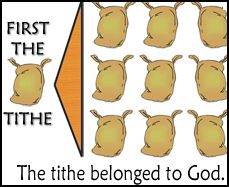
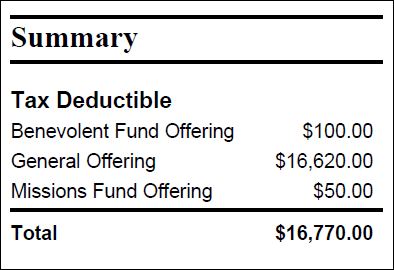
Those of us who make our living from the sacrificial giving of God’s people are not only required to give as well, but to give “the first part & the best also.” The offering from the Lord’s servants was considered exceptionally holy. Woods, in his commentary on the above verse says, “The Levites tenth given to the LORD as an offering is properly designated the best and holiest part. After the Levites had offered a tenth, the remainder was theirs, reckoned for them as ordinary agricultural product without restrictions upon its consumption or disposal. If a Levite properly offered the holy tenth, he would not be guilty as he consumed the remainder. If a Levite failed to give the holy offering, his eating would defile the holy offerings…” If I don’t give the first tenth of my income to the Lord, I would be like the Priests & Levites that Malachi was addressing & my offerings would be defiled. I take this seriously (“lay it to heart”) and openly share with anyone our family giving statement for 2010 – well over 10%! (see today’s devotion at www.chucklarsen.com.) Thus, we enjoy our home, our food, our toys etc. with a clear conscience and have prospered wonderfully because of it. Plus, it frees me to teach the truth of biblical tithing, as I believe God’s Word teaches it.

Chuck
“…see that you excel in this act of giving also.” 2 Corinthians 8:7

Malachi 3:10-12

The Tithe Challenge

20 times in the book of Malachi God refers to Himself as the “Lord of Heaven’s Armies.” I couldn’t help but notice that he does that three times alone in Malachi 3:10-12. This passage of course is the famous tithe challenge passage. There’s a huge difference between believing in God and trusting Him. God points to our giving in these verses as that which is a vivid illustration of the level of “trust” we have in Him and His promises. Look at these verses: “Bring all the tithes into the storehouse so there will be enough food in my Temple. If you do, says the LORD of Heaven’s Armies, I will open the windows of heaven for you. I will pour out a blessing so great you won’t have enough room to take it in! Try it! Put me to the test! Your crops will be abundant, for I will guard them from insects and disease. Your grapes will not fall from the vine before they are ripe, says the LORD of Heaven’s Armies. Then all nations will call you blessed, for your land will be such a delight, says the LORD of Heaven’s Armies.

The Lord of Heaven’s Armies says he will open “the windows of heaven” for you. Since He’s the great commander of all heaven’s resources, only He can make such a promise. The multitude of blessings promised in this passage are ours to be enjoyed. Malachi has explained in the first Chapter how we can “return” to Him. It begins with admitting we’re not “worth-shipping” the Lord of Heaven’s Armies as we should. If we confess that, and turn to Him, his ears are wide open. He tells us in 2 Chronicles 7:14, “if my people who are called by my name humble themselves, and pray and seek my face and turn from their wicked ways, then I will hear from heaven and will forgive their sin and heal their land.”

He is the God who holds all Heaven’s resources in the palm of His hand. We should be able to trust Him. If says it, you know it will come to pass. Paul writes this “Lord of Heaven’s Armies” as “the one who is able to do far above and beyond all we ask and hope…”

Chuck
“Because of his grace he declared us righteous and gave us confidence that we will inherit eternal life. This is a trustworthy saying, and I want you to insist on these teachings so that all who trust in God will devote themselves to doing good.” Titus 3:7-8

Malachi 3:7-10

The Promise Of The Tithe

Believing in God and trusting God are not necessarily the same thing. Many believe in God, but trusting God is much harder, especially when it comes to money. In Malachi 3:7–10 God instructs us to “Be” obedient to Him in three areas. First of all He call us to be honest. Verses 7 & 8 say, “From the days of your fathers you have turned aside from my statutes and have not kept them. Return to me, and I will return to you, says the LORD of hosts.” The call to return is a call of repentance. It all begins with the acknowledgment that there is sin in the camp and in our selfish lives. He just wants us to be honest about it and acknowledge our failure. The greatest thing about sin, is that there is a remedy. There’s no remedy for a bad upbringing, or a genetic disposition, or a societal influence. But there is hope for us if we can be honest and call it what God calls it: Sin! But like the Israelites we argue that we don’t know what God is talking about. They said, “how shall we return?” God explains that they are robbing him! They again don’t understand how and say, “how have we robbed you?” God answers “in your tithes and contributions.”

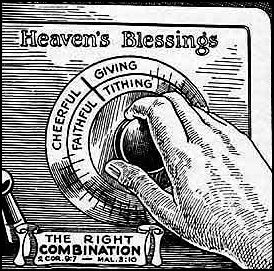
God then calls for them (and us) to be faithful. He says in verse 10 to “Bring the full tithe into the storehouse…” The word means one-tenth. Many Christians argue that this standard is no longer relevant for us today, but I strongly disagree. It was obvious before the law was given when Abraham gave a tenth to Melchizedek in Genesis 14. it was alive when Jacob promised to return a tenth of all God blessed him with when he woke from his dream at Bethel. The New Testament calls for us to give “proportionately.” The only thing Jesus commended the religious leaders for was tithing. He even said, “yes, you should tithe” but don’t neglect the more important matters of love, truth and compassion.

Finally the call to obey God with honesty about our giving, and then faithfulness in meeting the standard is followed by the call to give expectantly. God promises to bless this faithfulness. Verse 10 concludes, “If you do,” says the LORD of Heaven’s Armies, “I will open the windows of heaven for you. I will pour out a blessing so great you won’t have enough room to take it in! Try it! Put me to the test!”

Trusting God always has an impact on our check stubs.

Chuck
“Bring this tithe to the designated place of worship…Doing this will teach you always to fear the LORD your God.” Deuteronomy14:23

Zechariah 4:10

Small Beginnings

Haggai and Zechariah were contemporaries. It wasn’t long after Haggai began his ministry that Zechariah joined him. Stuart Briscoe suggests, “One probably was a Baptist, and the other was a Presbyterian, and they prophesied on opposite sides of the street, but they had more or less the same ministry.” Their call was to encourage the people to continue building the temple. But there was external opposition from the Samaritans that occupied the land, and even worse, there were those who criticized the “smallness” of the new project as they remembered the size of Solomon’s temple.

Zechariah picks up Haggai’s challenge to “get back to the task at hand” be foretelling the success of this project and prophesying the immensity of its significance in the lives of so many people in the future. He speaks of the rightful king, Zerubbabel and says, “The hands of Zerubbabel have laid the foundation of this house; his hands shall also complete it. Then you will know that the LORD of hosts has sent me to you. For whoever has despised the day of small things shall rejoice…” I would translate the phrase “small things” as “small beginnings.”

God usually starts with small things. The mustard seed, the tiniest of all, yet it becomes the largest plant of them all. God’s people themselves all started with one man named Abraham. God took it from there! It started with a baby born in a stable in Bethlehem and God took it from there. Remember how the church got started in Acts chapter 2! Peter preached one sermon and God took it from there. Country Bible Church started with a vision given to six people back in the late 1960’s. God took it from there!

Don’t ever let “small beginnings” get you down. Discouragement overcame some of the greatest heroes of the Bible. Elijah, Moses, and Jonah all grew so discouraged they prayed for death. Jeremiah spent his whole life in the throes of depression. John the Baptist asked, “Are you really the Messiah or should we look of someone else?” David said, “Why art thou cast down, O my soul, and why art thou disquieted within me?” Even the apostle Paul said that he was once so weary and worried that he couldn’t preach the gospel though a great door had opened to him.

Chuck
“And whosoever shall give even a small drink to one of these little ones… I say unto you, he will never lose his reward.” Matthew 10:42

Zechariah 1:14

On Love & Jealousy

Zechariah is all about God’s love for his people. It begins with a call for them to come home, or return to Him, and He will return to them. The same call of course is extended to all prodigals everywhere. Many translations use “jealousy” instead of “love” as the description of God’s attitude toward His people. There are connotations associated with that word that make it inappropriate. Understood correctly we might agree. We think of jealousy as an inappropriate craving for something or someone and bad feelings towards those who have what we want. The bible makes it clear that we are not to “covet our neighbors goods or wives.” But that’s not what’s meant here. Jealousy is the pain we feel when the affections of someone who are rightfully obligated to us are placed on someone else. We fear that our children or spouses will be lured away by some other entity to their harm, because they may seem more attractive or more interesting. We all know those painful feelings of betrayal but none know them more that the Lord of Heaven’s Armies.

“The Lord of Heaven’s Armies” is the most frequently repeated term in the post exilic prophets for God. It’s sometimes translated as the “Lord of Hosts.” It means all power & all control is in His command. The roll of the dice is His to determine. The success & failure of all our deeds is in His hands. He determines the rain fall, crops, the weather, wealth, health, happiness, peace, joy, the nations and everything else in the world. He is our creator and the one to whom we truly owe our allegiance. He made this the first commandment in the big 10. “I am the Lord your God, and you shall have no other god’s before me.” When we break that commandment, God is rightfully jealous, and it is called sin.

No one likes the term “sin” anymore. It sounds too religious and too pompous to the world. But the truth is, sin is the best news there is, because with sin, there’s a way out. You can’t repent of confusion or psychological flaws inflicted by your parents—you’re stuck with them. But you can repent of sin. Sin and repentance are the only grounds for hope and joy, the grounds for reconciled, joyful relationships.

Chuck
“Then the Angel said to me, shout this message for all to hear: This is what the LORD of Heaven’s Armies says: ‘return to me, and I will return to you.’” Zechariah 1:3

Zechariah 1:3

Return To Me! And I Will Return To You!

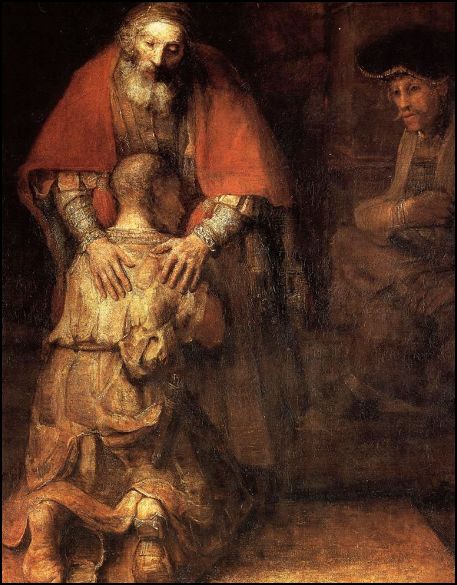
One of my favorite stories is in Luke regarding the prodigal son. We have a copy of Rembrandt’s painting entitled, “The Prodigal” hanging in our dining room. (See it at www.chucklarsen.com in today’s blog) There’s an old Sunday school joke that you may have heard. They were talking about the Prodigal Son in the class when the teacher asked, “Was anyone sorry when the Prodigal Son returned?” After a bit of soul-searching, one little boy said, “The fatted calf.”

Zechariah is the largest of the Minor Prophets. It contains 14 chapters with very significant prophecies. All these prophecies are given from the perspective of God’s love for His people. Chapter 1, verse 14, sets this tone, “This is what the LORD of Heaven’s Armies says: My love for Jerusalem and Mount Zion is passionate and strong.” Out of His deep love for his people (us too), he call for them (and us) to return to Him. Chapter 1, verse 3 says, “Return to me, and I will return to you, says the Lord of Heaven’s Armies.” This same exhortation is repeated in the last book of the Old Testament, Malachi. Chapter 3 verses 6-7 say, For I am the LORD, I do not change; therefore you are not consumed, O sons of Jacob. Yet from the days of your fathers you have gone away from My ordinances and have not kept them. Return to Me, and I will return to you, says the LORD of hosts.”

One of the most beautiful stories of the Scriptures is that of the prodigal son, the youth who left home, got into deep difficulty, wasted his life in riotous living, and ended up in the pigpen. Dr. J. Vernon McGee once asked, “Do you know the difference between the son in that pigpen and the pig?” He goes on to explain that the difference is that no pig has ever said to himself, “I will arise and go to my father.” He is right; only sons and daughters can say that. That is why there will be no condemnation, no rejection by God of his children. All believers, even prodigal sons, are his children, not his enemies.

Everyone is happy when a sinner returns to God! God is glad, the sinner is glad and the angels rejoice!

Chuck
“For this my son was dead, and is alive again; he was lost, and is found. And they began to celebrate.” Luke 15:24

Haggai 1:8

The House of Worship

Six times the Lord calls mankind to “consider your ways” in the book of Haggai. Socrates said, “The unexamined life is not worth living.” We all reflect on the essential issues of life and whether we like it or not we all are philosophers in that we all have a philosophy of life. The three man issues everyone must consider is “Where do I come from? What am I here for? And Where am I going.” In the last three blogs (devotions) I’ve argued against the evolutionary hypothesis that claims man is as man is by chance. I’ve argued that God created each of us for a purpose of worshipping and loving Him. And I’ve argued that God’s plans for man are eternal.

The real purpose of Haggai’s exhortation to “consider your ways” is to see if your actions truly live up to your items of faith. Are you basing your life’s choices on the fact that you came forth from God, that God has purpose for your life, and that you will return once again to God to give an account for your life? Are you? Are you? Six times, God asks His people through Haggai, “Are you?”

The expected answer was “No, we’re not.” They were living as if they believed life was an accident and there was no God who had a purpose and plan for them. They were basing the expenditure of their resources on selfish interests and not God’s purpose. They were living as if they were autonomous and had no accountability to God. Thus, Haggai’s call to “consider” is to see and recognize the truth that one’s life choices say. But then he concludes with the call to get it right. Put God back in His proper place in your life! Give God the priority He deserves.

Chuck
“Thus says the LORD of hosts: Consider your ways. Go up to the hills and bring wood and build the house (of worship), that I may take pleasure in it and that I may be glorified, says the LORD.”

sewa motor jogja
© Chuck Larsen 2019. Powered by WordPress.