service genset jogja
Philippians 4:13

Come What May

The Daily Bread reports: The Hope College Women’s basketball team had made it to the national playoffs. The final game saw Hope 20 points behind with 10 minutes left to play. The team remained 22 all thingscalm and began to narrow the gap. Then with just 5 seconds remaining, a 3 point basket tied the game. The final score was decided by Dina Disney. With no time left on the clock, she sank two free throws to win the game. When television and press interviewers asked her how she stayed calm under so much pressure, Dina said she recited to herself, “I can do all things through Christ who strengthens me.”

As John Butler observes in his commentary on the book of Philippians, “Seldom, if ever, is this text quoted in its context. Paul is not speaking of ability to do just anything. He is specifically speaking here of having the ability to adjust to any income or material situation. This is where the text needs more application than in any other area.” I wouldn’t limit this text to just material situations, but rather to being in want or having abundance. It could be in other areas than just finances. The general words used could mean something like “I can be content when I’m healthy and I can be content when I’m sick.” It might mean “I can be content when I’m at work at hard labor and I can be content when I’m at leisure.” The point is that Paul has learned the secret of being content in every and all circumstances in life.

Anthony Ash also comments on the context of Philippians 4:13 in his commentary. He says, “This verse is often misapplied, though with good intentions. Paul’s statement must be understood in context.” He explains that the phrase “all things” “is not a universal statement, suggesting that anything in all of life can be done by God’s power. Of course that power is without limit, but there are things God did not and does not intend to do, such as removing Paul’s thorn in the flesh. We must see that Paul spoke here of the secret of contentment.” I’m glad the Hope College Women’s basketball team came back for the win and that Dina made the winning basket but would she have the same thought if she had lost? Paul says, “I can be content when win, and I can be content when I lose.” Paul learned that God’s grace was sufficient for him even with a thorn in the flesh or while in prison. It’s not my circumstances that determine my contentment. Gary Weedman concludes, “The source of joy and contentment is Jesus Christ, and not in what mankind can or cannot do for him.”

Philippians 4:12, Proverbs 11:24

Coffee Spoon or Soup Ladle?

One of my favorite poems is the “Love Song of J. Alfred Proofrock.” T. S. Eliot wrote this poem to capture the stoic image of a man who was afraid to take chances in life. He wanted to approach a maiden but couldn’t take 21 coffee spoonsthe chance of rejection. He lived of himself and to himself. The song is about his failed attempt to come out of himself and live life in a real significant way, but alas, he failed again. He resigns himself to his destiny with resolve and disappointment. He looks forward to his future with remorse, sadness, and melancholy boredom. He says, “I’ve known them all before. I’ve known them all! I’ve known the mornings, the evenings and the afternoons. I’ve measured out my life in coffee spoons.”

That’s certainly not the case with the Apostle Paul. He was a man of great extreme experiences in life and yet loved them all. In Philippians 4:12 he writes, “I know how to be brought low, and I know how to abound. In any and every circumstance, I have learned the secret of facing plenty and hunger, abundance and need.” Paul lived a life of great adventure. He ventured beyond his comfort zone with a world view and a passion for sharing the Love of God with the entire world. Upon his conversion he seemed to have understood that God had a calling on his life and purpose to be fulfilled. It was a purpose that would take him to the most distant places in the known world. He even dreamed beyond his travels to the uttermost ends of the earth to a place called Spain. Maps from hundreds of years later would say in the westward seas, “here there be dragons.” Yes, Paul was a man of great courage and adventure and there was no measuring out his life in coffee spoons. He seemed to have scooped his life out upon the world in soup ladles.

The Apostle Paul was the living proof of the truth of Proverbs 11:24. It says, “One gives freely, yet grows all the richer; another withholds what he should give, and only suffers want.” Paul poured himself out upon the world in a way few ever have or ever will and he claims to be all the richer for it. A tight-fisted J. Alfred Proofrock ends up the poorer, while the open handed man becomes the richer and wealthier although he has little. Speaking about Christian giving, Paul puts it this way: “he who sows sparingly will also reap sparingly, and he who sows bountifully will also reap bountifully” (2 Cor. 9:6). It is true with our wealth and it is true with our lives. Are you a “coffee spoon” or a “soup ladle” kind of person?

Philippians 4:11

An Old Fashioned Education

After thanking the Philippians for their generosity, Paul explains that money isn’t his primary concern. He’s grateful for their gift but Paul finds peace and contentment with or without financial support. His gratitude is 20 hardknocksnot based on their provision of something for him that he couldn’t have done without. He is confident that God will meet his needs all along the way. He doesn’t stress out or fret about his physical needs. He says in Philippians 4:11, “Not that I am speaking of being in need, for I have learned in whatever situation I am to be content.” He had learned that his life was more than what he ate or wore or where he lived.

I think of all the specifics in my life today; I need windows replaced because of the hail storm back in June. But, I’ll be content with or without them? I’m still wrestling with a broken arm that just doesn’t want to heal. But, I’ll be content even if it doesn’t heal? There are numerous other little concerns in my life and I’m sure you can make a list of your own. I have to admit that I’m not quit as spiritual as Paul. I still find myself wrestling with what I want and what I feel I “need.” Paul is primarily concerned about spiritual things. I’m still wrestling with my fleshly desires. I take some encouragement that Paul’s maturity with regards to his circumstances is something that wasn’t natural to him any more than it is natural to me and you. It’s something that comes with experience.

Notice in the verse that says “I have learned…” It didn’t come natural. He’s been a believer for over 30 years after being radically converted on the road to Damascus. He’s been through much pain and suffering as he embarked on three previous missionary journeys. He’s been beaten. He’s been stoned and left for dead. He’s been shipwrecked and imprisoned already for several years in Caesarea as well as Rome. It took a lot of trials to teach Paul contentment. Richison observes, “Contentment is not something that comes naturally. In his early years he grew up in the lap of luxury. At that time he had not learned contentment. At this point in his life he is needy; yet he is content. ‘Contentment’ is not automatic. Paul ‘learned’ contentment in the School of Hard Knocks. Courses in that school are difficult. We think university is tough. It is not nearly as difficult as God’s Graduate School. Can we say with the Psalmist, ‘It is good for me that I have been afflicted (119:71)?”

Philippians 4:10, 1 Corinthians 9:7

Tangible Love

The Philippians had given Paul financial support on several occasions and along with the report of what was happening in Philippi Epaphroditus also brought another financial gift to Paul to help with his expenses in 19 tangible loveRome. Unlike most prisons today, the Roman prisons did not feed or clothe the inmates. Paul had to see to his own necessities. The Philippians helped him. Philippians 4:10 is an expression of Paul’s gratitude for the gift they sent. He says, “I rejoiced in the Lord greatly that now at length you have revived your concern for me. You were indeed concerned for me, but you had no opportunity.”

Paul says that he “rejoiced in the Lord greatly.” This phrase describes Paul’s attitude in all life situations as he will elaborate in the verses to follow. Here “great” joy is a result of a blessing received from fellow believers in Philippi. There is always some “great joy” when we receive things from others. Paul isn’t any less human. I expect the gift helped him significantly but what really brought him joy was that the saints concern for Paul had blossomed into more fruit again. Paul knows they had always been concerned about him, but had no way of showing it until now. I suppose delivery systems weren’t as simple in his day. The gift was a tangible demonstration of their love and concern for Paul. It thrilled him.

You’ve heard it said that it’s not the gift but the thought that counts. I get that idea from the way Paul expressed his gratitude. In Exodus 25 God instructed the Israelites to give offerings “willingly from the heart.” In 1 Chronicles 29 we also see that “the people rejoiced because they had given an offering willingly.” There is great joy associated with Christian giving. Just as the Israelites were excited about being part of God’s work in the world, so too where the Philippians, and they were both commended. Philippians is all about “joy” as I’ve suggested for the past few months and here Paul’s joy is reflected as a result of others caring enough to make a sacrifice for his welfare. Paul took great joy from the gift from the Philippians. The Lord takes great joy in our rightly motivated giving. In 1 Corinthians Paul explains that giving is to be from the heart and in 9:7 he says that “God loves a cheerful giver.” David Jeremiah says, “So when we come to the offering, we ought to be excited, for we are given the opportunity to take part in God’s great plan. As an expression of our love for Him, we give our gifts. After all He has done on our behalf, we can do no less.”

Philippians 4:8-9, Proverbs 15:13-14

Stinking Thinking

In Philippians 4:4-7, Paul instructs us to place our cares at God’s feet. To trust Him in all life’s circumstances and when we do we’ll find that His peace that passes all understanding will guard our hearts and minds in Christ 18 stinkingJesus. In this position we can truly find joy regardless of the circumstances that we might be going through. Only then can we do as Paul instructed the Thessalonians: “rejoice always, pray continually, and give thanks in all circumstances.” We will find a joy that transcends our problems as we entrust our lives into the hands of the one who gave them to us in the first place.

Paul then goes on the Philippians 4:8-9 and addresses us again and this time dealing with what we let ourselves think. Sadness, sorrow, depression and pain drive us to think such negative thoughts about life. It’s so easy to let the circumstances of our lives dictate how we think. When we allow our circumstances to drive our thought life, all joy will go out the window. This is why Paul talks to us in these verses about our thought life. He writes, “Finally…whatever is true, whatever is honorable, whatever is just, whatever is pure, whatever is lovely, whatever is commendable, if there is any excellence, if there is anything worthy of praise, think about these things.”

I like the way the Good News Bible translates Proverbs 4:23. It instructs us, “Be careful how you think; your life is shaped by your thoughts.” Discussing the various possible ways to translate this Hebrew phrase, the United Bible Societies Handbook for Translators says that in some languages this is expressed as “Watch your mind,” “Keep a hand on your head,” or “Take care of your thoughts.” We may also say, for example, “The most important thing you can do is be careful what you think” or “The most important … is to think good thoughts.” A website that describes AA uses of the phrase “stinking thinking” says, “Thoughts are a bit like nutrition and stinking thinking is similar to junk food. Those who live on a diet of junk food will end up paying for it. The same is true or stinking thinking.” Eugene Peterson translates Proverbs 15:13-14 in a similar way in that he contrasts joy that comes from focusing on truth and sadness & depression that feeds on trash. It says, “A cheerful heart brings a smile to your face; a sad heart makes it hard to get through the day. An intelligent person is always eager to take in more truth; fools feed on fast-food fads and fancies.” Or consider the New Living translation that says, “A wise person is hungry for knowledge, while the fool feeds on trash.”

Guardian of the Soul

In 1 Thessalonians Paul exhorts his readers to rejoice always and pray without ceasing and to give thanks in all circumstances! Those are pretty big agendas for the common person. In Philippians 4:4 Paul exhorts us all to “Rejoice always.” But then he goes on and says, “I will say it again; rejoice always!” As in the letter to the Thessalonians Paul moves from rejoicing to prayer. Why? 15 my peaceWell, in the world we live in it’s impossible to be joyful in our circumstances all the time. There are many pains and losses and hurts and hardships that come our way and as we focus on them they will literally eat away our joy. But if we learn to entrust these things to God, and be thankful for His love and grace in our lives, we can find that it’s not all that hard to rejoice in the Lord. We not only find joy but God blesses us with the second fruit of the Spirit; Peace! Not just any ‘peace’ but a peace beyond our imagination.

Philippians 4:6-7 says, “Do not be anxious about anything, but in everything by prayer and supplication with thanksgiving let your requests be made known to God. And the peace of God, which surpasses all understanding, will guard your hearts and your minds in Christ Jesus.” Before I became a Christian I looked at Christians as poor, discontented and unhappy people. Some Christians gave me cause to think that! But I didn’t know what a carefree and secure life I was called to in becoming a Christian. While others around us struggle with all their individual projects, burdens, pains, hurts, sorrows, and the reality of death, we should be free from all such pressures. We shouldn’t be worried about what the future holds or what might happen. All the bases have been covered. We are certain about one thing; all will be well! Robert Leighton says of believers, “They have no care except for the care of love and how to please and honor their Lord. And for the skill and the strength they need, they also depend on God. From this springs unimaginable peace.”

The word guard was a military term that described a Roman soldier holding his weapon, walking back and forth in front of an open gate so that no one could enter. Paul is saying that this is how God will guard your hearts and give you His peace. Our Father is a Father who delights to give good gifts to His children. He will actively guard your heart against whatever is troubling it. He will not allow any menacing worry to enter. Paul says that peace will guard our hearts! MacArthur points out that, “John Bunyan’s allegory The Holy War illustrates how this peace guards the believer’s heart from anxiety, doubt, fear, and distress. In it Mr. God’s-Peace was appointed to guard the city of Mansoul. As long as Mr. God’s-Peace ruled, Mansoul enjoyed harmony, happiness, joy, and health.”

Philippians 4:4, 1 Thessalonians 5:16-18

Always, Always, Always!

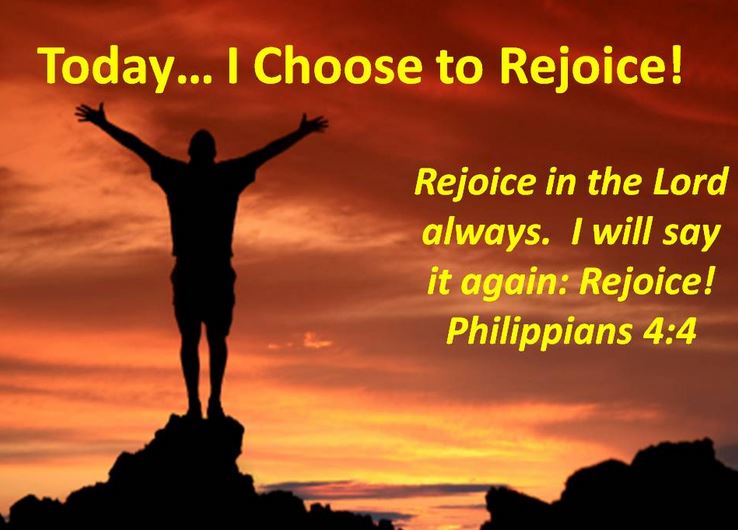
Philippians 4:4 is the happiest verse in the Bible. It says, “Rejoice in the Lord always; again I will say, rejoice!” Most things in our life bring with them ups and downs. It’s sometimes impossible to rejoice in our 14 rejoicecircumstances and Paul does not call us to do so. But we can always rejoice in the Lord. Paul says no matter what our circumstances we should still find joy in the Lord. He has our circumstances in the palm of His hand and will bring about a positive result for us. It’s a matter of trusting in God’s goodness to do so. If we do it’s easy to imagine rejoicing in all circumstances in life. Paul does so in prison in Philippi. He and Silas sing songs during the night! He rejoices in his prison cell in Rome as we see clearly from the letters he writes. He is a man who has learned how to rejoice in all circumstances of life and he’s going to assert that very truth in the verses that will follow.

If we compare this passage to a parallel passage in 1 Thessalonians we’ll see that Paul gives three things that we should be able to do always! 1 Thessalonians 5:16 is the shortest verse in the Bible. Most people think it’s “Jesus wept.” But in the Greek text that verse has three words! In the Greek text of 1 Thessalonians 5:16 there are only two words; “Rejoice Always!” I love what David Williams said in his commentary on this passage. He writes, “We might have little in the world to be glad about, but in the Lord we have much, and the world cannot take that joy from us (cf. John 16:22). The phrase ‘in the Lord’ points to the objective grounds for our rejoicing in what God has done for us in Christ: ‘God so loved … that he gave …’ But this is linked with a subjective capacity to rejoice, which is no less God-given: once again a part of the fruit of the Spirit. In short, joy lies at the heart of the gospel—a truth echoed in the common root, in Greek, of two words, grace and joy (charis, chara). It is God’s joy to be gracious to us, while our joy has its grounds in his grace.”

In 1 Thessalonians Paul says there are two other things that we should do always and I see them intimately connected to God’s grace as well. Verse 17 says “pray without ceasing.” We must learn to face all our circumstances in life with prayer. Paul is going to focus on that in great depth after exhorting us to rejoice always in Philippians. Prayer takes the burden off of ourselves and gives it to God. Williams says, “Prayer acknowledges our utter dependence upon God and the utter dependability of God in all circumstances. Prayer, as much as joy, is the product of God’s grace.” We are also are directed to “give thanks in all circumstances; for this is the of God in Christ Jesus for you.” We will be hurt, disappointed, confused, offended, defeated at times but even in those times there is one great reason to be thankful. God loves us and has promised to work everything out in our lives for good in the end.

Philippians 4:3

Side by Side

Paul wanted the two women that he addressed by name to come to an agreement by entreating each to embrace the mind of Christ. Understanding human nature, he calls for “a true companion” to assist with settling the 13 side by sidedispute between them and restoring the peace in the church at Philippi. Philippians 4:3 says, “Yes, I ask you also, true companion, help these women, who have labored side by side with me in the gospel together with Clement and the rest of my fellow workers, whose names are in the book of life.”

Paul has already focused some attention on the need for unity in the church at Philippi. He knows how crucial it is to the health and growth of the body and the individual members of the body. When unity goes the calling and purpose of the individual parts as well as the whole is unhealthy and cannot function as God intends. Thus Paul calls on help from others to work out the difficulties between the two parties. We don’t know who the “true companion” that Paul addresses is. There are numerous suggestions, but regardless of your view we cannot miss the main point that Paul wants the two who are at odds with each other to resolve their differences and get back on the same page.

As members of a family we live in homes with others. As members of a society or neighborhood we share community services and utilities with others. As members of the Body of Christ we live with others and share wonderful spiritual truths with each other. Although we see much dissent and confusion around us we are to live differently in the church. As believers we must love side by side. We must learn side by side and we must live side by side. We are all saved by grace through faith. The ground before the cross is perfectly level on which we all stand. No one is better than anyone else. No group or individual can claim to better than anyone else. But pride in our personal opinions and preferences always undermine the purpose and work of the church and destroy the joy God intended. In the next verse Paul exhorts us to “rejoice in the Lord always.” We won’t have much true joy peace, harmony and unity in our homes or churches.

sewa motor jogja
© Chuck Larsen 2019. Powered by WordPress.