service genset jogja
Genesis 1:3

Genesis 1:3

BHS (Biblia Hebraica Stuttgartensia):     וַיֹּ֥אמֶר אֱלֹהִ֖ים יְהִ֣י אֹ֑ור וַֽיְהִי־אֹֽור

ESV (English Standard Version): And God said, “Let there be light,” and there was light.

NLT (New Living Translation): Then God said, “Let there be light,” and there was light.


LXX (Septuagint): Καὶ εἶπεν ὁ Θεὸς, γενηθήτω φῶς· καὶ ἐγένετο φῶς.

BETS (Brenton English translation Septuagint): And God said, Let there be light, and there was light.

NETS (New English Translation Septuagint): And God said, “let light come into being,” and light came into being.

OSB (Orthodox Study Bible): Then God said, “Let there be light”; and there was light


VUL (Latin Vulgate): dixitque Deus fiat lux et facta est lux

DRB (Douay Rheims Bible): And God said: Be light made. And light was made

NAB: (New American Bible): Then God said, “Let there be light,” and there was light


English Translations with variant readings:

CEV: God said, “I command light to shine!” And light started shining.

EMPH (The Empasized Bible): And God said— Light、 be. And light was.

GNB: Then God commanded, “Let there be light”—and light appeared.

TM: God spoke: “Light!” And light appeared.


Observations & Discussions

  1. The NETS offers a small variety with the “Fiat” of God being “let light come into being. That’s interesting because in the VUL the verb which God is said to do is “fiat.” One interesting entry in a web based article says, “You might think a fiat is just an Italian car, but it actually means a legal, authoritative decision that has absolute sanction. From the Latin for “let it be done,” the word fiat is a binding edict issued by a person in command.” There’s little question that God is the one in command here at the beginning of the Bible. All translations except the DRB includes the idea of a “fiat” in “let there be light.”
  2. Notice also that the VUL uses the word “Facta” to report the results of the fiat. You might say, “light became a fact.” From God’s Word to reality. According to the dictionaries it simply means “was” and that means existed so we get our idea of “fact” from that idea, I’m guessing. God issued a “fiat” and it came to pass.
  3. Let there be light is normally addressed to a third person. But who is God addressing in this passage. Was God addressing the light? Jesus called himself the light. Since Christ is accredited with the creation of all things in Colossians, could this command be addressed to Jesus? Should it be something God said to himself, such as, “God said that the light should appear.”


CLV (Chuck Larsen Version): God issued a decree that there should be light, and there was light.


CLV In the beginning God created heaven and earth but the earth was invisible and incomplete. And darkness covered the abyss. The spirit of God was brooding over the abyss’ darkness so God issued a decree that there should be light, and there was light.

Genesis 1:4

Genesis 1:4a

BHS (Biblia Hebraica Stuttgartensia): וַיַּ֧רְא אֱלֹהִ֛ים אֶת־הָאֹ֖ור כִּי־טֹ֑וב

ESV (English Standard Version): And God saw that the light was good

NLT (New Living Translation): And God saw that the light was good


LXX (Septuagint): Καὶ εἶδεν ὁ Θεὸς τὸ φῶς, ὅτι καλόν

BETS (Brenton English translation Septuagint):  And God saw the light that it was good

NETS (New English Translation Septuagint): And God saw the light that it was good

OSB (Orthodox Study Bible): God saw the light; it was good


VUL (Latin Vulgate): et vidit Deus lucem quod esset bona

DRB (Douay Rheims Bible): And God saw the light that it was good

NAB: (New American Bible): God saw how good the light was


English Translations with variant readings:

AMP: And God saw that the light was good (suitable, pleasant) and He approved it

GNB: God was pleased with what he saw

ISV: God saw that the light was beautiful


Observations & Discussions

1.I wonder if you could find some reason to say that “God declared the light good” not just noticed that it was “good.” It seems to say that God “saw that it was good” is for God to learn something about what He had already called into creation. The OSB makes it less confusing on this count by saying “God saw the light; it was good.” Is the light good and God noticed it? Is the light good because God said it was? This might play into righteousness of man. Does God recognize righteousness or does he declare it to be so?

  1. Regarding the light again the NAB offers a slight variation when it adds “God saw how good the light was.” I guess that’s to emphasize the goodness of it. I’m not sure it does that.
  2. The clearest observation from this verse is that all the languages pretty much agree on the translation with slight shifts of emphasis. All noted the goodness of the light that God called into existence.
  3. God declared or observed that the “light” was good and he is going to make some similar observations in the next six more days of creation. God declares that it is all “good.” God knows what’s good for us and made what we needed. He wants to provide for all our needs with “good” things. When God set Adam and Eve in the Garden of Eden everything in there was “good” except for one thing; the tree of the knowledge of good and evil. Where man began to go astray was when he contradicted God’s appraisal. In Genesis 3:6 Eve saw that the forbidden tree was “good for food” even though God said it wasn’t. God never forbids or withholds things from us that are good. He always gives us good gifts and attempts to restrain us from things that will bring great harm to our lives.
  4. Is it just the light that was good? One commentator suggests otherwise, “Day one (1:3–4) featured an act of separation resulting in the creation of light. The darkness which shrouded the earth in verse 2 was removed. God pronounced the alternation of light and darkness good.”[1] We’re going to see the “alternation” of light and darkness in all of the six days of creation: it was day and then it was night.


CLV (Chuck Larsen Version): God saw the light and declared that the light was very good.

CLV In the beginning God created heaven and earth but the earth was invisible and incomplete. And darkness covered the abyss. The spirit of God was brooding over the abyss’ darkness so God issued a decree that there should be light, and there was light. God saw the light and declared that the light was very good.

[1] James E. Smith, The Pentateuch, 2nd ed., Old Testament Survey Series (Joplin, MO: College Press Pub. Co., 1993), 53.

Genesis 1:4

Genesis 1:4b

BHS (Biblia Hebraica Stuttgartensia): וַיַּבְדֵּ֣ל אֱלֹהִ֔ים בֵּ֥ין הָאֹ֖ור וּבֵ֥ין הַחֹֽשֶׁךְ׃

ESV (English Standard Version): And God separated the light from the darkness.

NLT (New Living Translation): Then he separated the light from the darkness.


LXX (Septuagint): καὶ διεχώρισεν ὁ Θεὸς ἀνὰ μέσον τοῦ φωτὸς, καὶ ἀνὰ μέσον τοῦ σκότους

BETS (Brenton English translation Septuagint): and God divided between the light and the darkness

NETS (New English Translation Septuagint): and God separated between the light and between the darkness

OSB (Orthodox Study Bible): and God divided the light from the darkness.


VUL (Latin Vulgate): et divisit lucem ac tenebras

DRB (Douay Rheims Bible): and he divided the light from the darkness

NAB: (New American Bible): God then separated the light from the darkness


English Translations with variant readings:

LEB (Lexham English Bible): God caused there to be a separation between the light and between the darkness


Observations & Discussions

  1. In Job 26:10 we see that the possibility of a separation or of a division might have the idea aof “distinguishing” between the two. They are often used to refer to good and evil not physical places. Job says, (ESV) “He (GOD) has inscribed a circle on the face of the waters at the boundary between light and darkness.” Another verse, Job 38:19-20, talks about the distinction between the two and how to reach them. But since they are not literal places it must refer to good and evil. It says, “Where is the way to the dwelling of light, and where is the place of darkness, that you may take it to its territory and that you may discern the paths to its home?”
  2. There are very few variants in the English Translations. They either translate the verb as “separated” or as “divided.”
  3. One commentator suggested the idea of a “distinction.” In the Teacher’s Commentary we read, “Differentiation. Often our text says, ‘And God separated,’ as in, ‘He separated the light from the darkness’ (v. 4). The Hebrew word here means ‘to make a distinction between.’ Light is distinguished from dark, earth from sea, day from night—as God sets up a stable pattern for His universe.”[1]
  4. Tom Constable makes an interesting comment in his notes, “From the beginning God made divisions. He later divided the holy from the profane, the Holy Place from the Holy of Holies, and Israel from the nations. This shows His sovereignty (i.e., ultimate authority).”[2]


CLV (Chuck Larsen Version): God made a distinction between the light and the darkness

CLV In the beginning God created heaven and earth but the earth was invisible and incomplete. And darkness covered the abyss. The spirit of God was brooding over the abyss’ darkness so God issued a decree that there should be light, and there was light. God saw the light and declared that the light was very good.

[1] Larry Richards and Lawrence O. Richards, The Teacher’s Commentary (Wheaton, IL: Victor Books, 1987), 23.

[2] Tom Constable, Tom Constable’s Expository Notes on the Bible (Galaxie Software, 2003), Ge 1:5.

Genesis 1:5

Genesis 1:5a

BHS (Biblia Hebraica Stuttgartensia):            וַיִּקְרָ֨א אֱלֹהִ֤ים׀ לָאֹור֙ יֹ֔ום וְלַחֹ֖שֶׁךְ קָ֣רָא לָ֑יְלָה

ESV (English Standard Version): God called the light Day, and the darkness he called Night.

NLT (New Living Translation): God called the light “day” and the darkness “night.”


LXX (Septuagint): Καὶ ἐκάλεσεν ὁ Θεὸς τὸ φῶς ἡμέραν, καὶ τὸ σκότος ἐκάλεσε νύκτα.

BETS (Brenton English translation Septuagint): And God called the light Day, and the darkness he called Night

NETS (New English Translation Septuagint): And God called the light Day and the darkness he called night

OSB (Orthodox Study Bible): God called the light Day; the darkness He called Night


VUL (Latin Vulgate): appellavitque lucem diem et tenebras noctem

DRB (Douay Rheims Bible):  And he called the light Day, and the darkness Night

NAB: (New American Bible): God called the light “day,” and the darkness he called “night.”


English Translations with variant readings:

CEV: and named the light “Day” and the darkness “Night.”


Observations & Discussions

  1. Naming things is important. It is done by the one sovereign over the thing or things being named. I believe that may be why God gave Adam the right to name the animals. Gowan says as much in his commentary on Genesis, “So God affirms his sovereignty over both light and darkness by giving them names, Day and Night. And with this, time begins.”[1] In Psalm 147:4, (ESV) we read, “He determines the number of the stars, he gives to all of them their names.” The idea of naming is significant to each of us. We are God’s people, those of us with faith in Jesus Christ are now His chosen ones according to Paul. I like to think that the promises we find in the Old Testament addressed specifically to Israel and the Patriarchs are intended for us today. Psalm 43:1-2 (ESV) is encouraging, “But now thus says the LORD, he who created you, O Jacob, he who formed you, O Israel: ‘Fear not, for I have redeemed you; I have called you by name, you are mine. When you pass through the waters, I will be with you; and through the rivers, they shall not overwhelm you; when you walk through fire you shall not be burned, and the flame shall not consume you.”
  2. Notice the last statement in Gowan’s quote: He suggests that the separating of light from darkness and naming them was God’s act that set in motion “time” as an entity in and of itself. This might be seen because God begins to number the days of creation from this point on. The sequencing of events seems to be the definition of time in some ways.
  3. There have been questions about the nature of “darkness.” Is it something in and of itself or is it the absence of light. It seems to be the later. We know that light is forever, but darkness is temporary. Revelation 22:5 (ESV) makes that clear: “And night will be no more. They will need no light of lamp or sun, for the Lord God will be their light, and they will reign forever and ever.” Constable observes, “Darkness was not a creation like light but the absence of light (cf. v. 2). Darkness (Heb. hosek) in Scripture often connotes evil (cf. Exod. 10:21–23; 1 Sam. 2:9; Job 2:4, 5; Ps. 35:6; Joel 2:2).”[2]
  4. In Exodus 10, the ninth plaque that Moses called down upon Egypt was darkness throughout the land. Not just normal darkness, but “dark-darkness.” But to the Israelites God gave light (See Exodus 10:23).


CLV (Chuck Larsen Version): God named the light “day” and he named the darkness “night.”

CLV In the beginning God created heaven and earth but the earth was invisible and incomplete. And darkness covered the abyss. The spirit of God was brooding over the abyss’ darkness so God issued a decree that there should be light, and there was light. God saw the light and declared that the light was very good. Then God named the light “day” and he named the darkness “night.”

[1] Donald E. Gowan, From Eden to Babel: A Commentary on the Book of Genesis 1–11, International Theological Commentary (Grand Rapids, MI: W.B. Eerdmans Pub. Co., 1988), 22.

[2] Tom Constable, Tom Constable’s Expository Notes on the Bible (Galaxie Software, 2003), Ge 1:4.

Genesis 1:5

Genesis 1:5b

BHS (Biblia Hebraica Stuttgartensia): וַֽיְהִי־עֶ֥רֶב וַֽיְהִי־בֹ֖קֶר יֹ֥ום אֶחָֽד

ESV (English Standard Version): And there was evening and there was morning, the first day.

NLT (New Living Translation): And evening passed and morning came, marking the first day.

My English translation of BHS: And it was evening and it was morning; day one.


LXX (Septuagint): Καὶ ἐγένετο ἑσπέρα, καὶ ἐγένετο πρωῒ, ἡμέρα μία.

BETS (Brenton English translation Septuagint): and there was evening and there was morning, the first day.

NETS (New English Translation Septuagint): And it came to be evening, and it came to be morning, day one.

OSB (Orthodox Study Bible): and there was evening and morning, one day.

My English translation of LXX: And it was evening and it was morning; day one.


VUL (Latin Vulgate): factumque est vespere et mane dies unus

DRB (Douay Rheims Bible): and there was evening and morning one day

NAB: (New American Bible): Thus evening came, and morning followed—the first day.

My English translation of the Vulgate: And it was evening and morning; day one.


English Translations with variant readings:

KJV1 (King James Version 1900) And the evening and the morning were the first day.

CEV:  Evening came and then morning—that was the first day.

GNB:  Evening passed and morning came—that was the first day

ISV: The twilight and the dawn were day one.

NCV: Evening passed, and morning came. This was the first day.


Observations & Discussions

  1. It appears that this creation of light contrasted with darkness marks the first day of the world. It has been suggested that it was also the first day of the week. It will be followed by five more days of creative activity to conclude with the 7th day, a day of rest, the Sabbath. The old Matthew Henry commentary observes this: “The darkness of the evening was before the light of the morning, that it might serve for a foil to it, to set it off, and make it shine the brighter. This was not only the first day of the world, but the first day of the week. I observe it to the honour of that day, because the new world began on the first day of the week likewise, in the resurrection of Christ, as the light of the world, early in the morning. [1] Maybe on Sunday we don’t celebrate the end of something but the beginning of something! Also the Wycliffe Commentary says, “In the book of Genesis evening always precedes morning. The creation of light ended the reign of darkness and brought on the first day.”[2]


CLV (Chuck Larsen Version): And it was evening and it was morning: Day One!

[1] Matthew Henry, Matthew Henry’s Commentary on the Whole Bible: Complete and Unabridged in One Volume (Peabody: Hendrickson, 1994), 4.

[2] Charles F. Pfeiffer, The Wycliffe Bible Commentary: Old Testament (Chicago: Moody Press, 1962), Ge 1:5.

Genesis 1:6

Genesis 1:6a

Genesis 1:6a

BHS:וַיֹּ֣אמֶר אֱלֹהִ֔ים יְהִ֥י רָקִ֖יעַ בְּתֹ֣וךְ הַמָּ֑יִם

ESV: And God said, “Let there be an expanse in the midst of the waters”

NLT: Then God said, “Let there be a space between the waters”

My translation of the BHS: Let there be some distance between the waters.

Maybe better: Let there be some solid border that will keep the waters above separated from the waters below.


Comment:

It appears that the MT implies and distance or space or expanse between the waters which makes me think of an empty space. The other translations say that there is a solid body of some kind: Firmament? But when you look up the word it does refer to something solid also. The ESV and others that use distance as an idea miss the mark so I’m going to have to correct my translation. The BDB (Brown, Driver, Briggs Hebrew Lexicon) says, “1. (flat) expanse (as if of ice, cf. כְּעֵין הַקֶרַח), as base, support (WklAltor. Forsch. iv. 347) Ez 1:22, 23, 25 (gloss? cf. Co Toy), v 26 (supporting י׳’sthrone) 10:1. Hence (Co Ez 1:22) 2. the vault of heaven, or ‘firmament,’ regarded by Hebrews as solid, and supporting ‘waters’ above it, Gn 1:6[1]”


LXX: Καὶ εἶπεν ὁ Θεὸς, γενηθήτω στερέωμα ἐν μέσῳ τοῦ ὕδατος

BETS: And God said, “Let there be a firmament in the midst of the water”

NETS: And God said, “let a firmament come into being between the water”

OSB: Then God said, “Let there be a firmament in the midst of the water”

My translation of the LXX: Let there be a solid mass in the middle of the water


Comment:

It looks like the LXX supports the idea of something solid rather than a mere distance. “στερέωμα, τος n; στηριγμόςb, οῦ m: a state of firm, inner strength—‘firm position, being firm in, firmness, steadfastness.’[2]


VUL:  dixit quoque Deus fiat firmamentum in medio aquarum

DRB: And God said: Let there be a firmament made amidst the waters

NAB: Then God said, “Let there be a dome in the middle of the waters”

My translation of the VUL: And God declared that a firmament exist in the middle of the water


It appears the Latin doesn’t add much to the understanding of “firmament.” the sky fixed above the earth, the firmament[3]


English Translations with variant readings:

NASB: Then God said, “Let there be an expanse in the midst of the waters”

GW (God’s Word Translation): Let there be a horizon in the middle of the water

ISV: Then God said, “Let there be a canopy between bodies of water”

LEB: And God said, “Let there be a vaulted dome in the midst of the waters”

LB: And God said, “Let the vapors separate to form the sky above and the oceans below.”

TM: God spoke: “Sky! In the middle of the waters!”

NCV: Then God said, “Let there be something to divide the water in two.”

NIRV: Let there be a huge space between the waters.

NIV: Let there be a vault between the waters


Observations & Discussions & Commentary quotes of interest

Prior to the second day, it seems that the earth was completely surrounded by a thick layer of water, perhaps in the form of a heavy vapor.[4]

When speaking of this “firmament” one Commentary says, “This term (BDB 956, KB 1290) could mean “to hammer out” or “to stretch out” as in Isa. 42:5. This refers to the earth’s atmosphere (cf. 1:20) depicted metaphorically as an air vault or inverted bowl above the surface of the earth (cf. Isa. 40:22).[5]

A lengthy comment from another commentary attempts to explain the “expanse” thoroughly considering other uses of the word in future passages. It says, “On the second day of God’s creative activity, He said, Let there be a firmament in the midst of the waters, and let it divide the waters from the waters. The word for firmament comes from a verb that means “to beat, stamp, beat out, and spread out.” The noun in this instance is best rendered by an expanse. Whitcomb and Morris suggest that God suspended a vast body of water in vapor form over the earth, protecting it from the destructive rays of the sun (p. 229). This would accomplish two things: it would provide a means for the longevity attested to in chapter 5, and it would also provide a water source for the Flood in 6–9. This theory is an attempt to explain the tropical conditions that existed on the early earth. One must note that the term firmament in verse 8 must include the area above the canopy, or this suspended vapor body, as well as below it. This must be so, because in verse 17 God set the sun and moon in the firmament of the heaven to give light upon the earth, seemingly the same as in verse 8 when it says, And God called the firmament Heaven. With a second evening and morning, another day of creative activity was ended.”[6]

Okay, here’s another commentary with a relevant discussion of the “firmament.” It says, “As Adam Clarke points out, firmament is a most unfortunate mistranslation.14 Firmament means “something firm” and seems to imply a sky something like a solid vault in which the sun, moon, and stars are fixed like light bulbs. The error had its beginning in the translation of the Hebrew Old Testament into Greek which was made in the third century B.C. and which we call the Septuagint. The ancient Greeks conceived of the sky as a solid crystalline sphere. It was their false science which determined the Greek word used in this verse. The error was copied by Jerome in the Latin Vulgate and in turn by the translators of the King James Version. Modern science has ridiculed what it thought to be a biblical error when it was actually a scientific error of another era!15 The true meaning of the Hebrew original here is that of something ‘stretched out’ or ‘extended’ like a tent, and the better translation is ‘expanse.’ As such it exactly fits the earth’s atmosphere, which is here intended.”[7]

More comments: “a firmament] This word reproduces the Lat. firmamentum; LXX στερέωμα. The Hebrew râqîa denotes (see Heb. Lex.) “extended surface, (solid) expanse” (as if beaten out; cf. Job 37:18). For the verb raq‘a=beat, or spread, out, cf. Ex. 39:3, Num. 17:4, Jer. 10:4, Ezek. 1:22, “and over the head of the living creatures there was the likeness of a firmament … stretched forth over their heads above.” Compare Job 37:18, “canst thou with him spread out (tarqi‘a) the sky which is strong as a molten mirror?” See Ps. 19:1, 150:1, Dan. 12:3, where “firmament” = sky.”[8]

Several Commentators include graphics of what the ancient Semitic view of the universe might have looked like. Here is one of them.
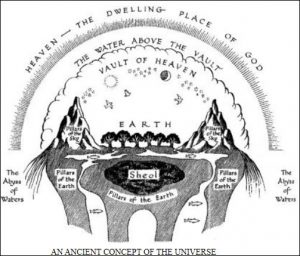


CLV (Chuck Larsen Version): Let there be some solid border that will keep the waters above separated from the waters below.

  1. confer, compare.

Wkl H. Winckler.

  1. confer, compare.

Co C. H. Cornill.

v verse.

Co C. H. Cornill.

[1] Francis Brown, Samuel Rolles Driver, and Charles Augustus Briggs, Enhanced Brown-Driver-Briggs Hebrew and English Lexicon (Oxford: Clarendon Press, 1977), 956.

n neuter

m masculine

[2] Johannes P. Louw and Eugene Albert Nida, Greek-English Lexicon of the New Testament: Based on Semantic Domains (New York: United Bible Societies, 1996), 677.

[3] Charlton T. Lewis and Charles Short, Harpers’ Latin Dictionary (New York; Oxford: Harper & Brothers; Clarendon Press, 1891), 752.

[4] William MacDonald, Believer’s Bible Commentary: Old and New Testaments, ed. Arthur Farstad (Nashville: Thomas Nelson, 1995), 33.

BDB A Hebrew and English Lexicon of the Old Testament by F. Brown, S. R. Driver and C. A. Briggs

KB The Hebrew and Aramaic Lexicon of the Old Testament by Ludwig Koehler and Walter Baumgartner

[5] Robert James Utley, How It All Began: Genesis 1–11, vol. Vol. 1A, Study Guide Commentary Series (Marshall, Texas: Bible Lessons International, 2001), 25.

[6] Edward E. Hindson and Woodrow Michael Kroll, eds., KJV Bible Commentary (Nashville: Thomas Nelson, 1994), 11.

14 A Commentary and Critical Notes, I, 33.

15 Free, op. cit., pp. 23–24.

[7] Lee Haines, “The Book of Genesis,” in Genesis-Deuteronomy, vol. 1:1, The Wesleyan Bible Commentary (Grand Rapids, MI: William B. Eerdmans Publishing Company, 1967), 26.

[8] Herbert E. Ryle, The Book of Genesis in the Revised Version with Introduction and Notes, The Cambridge Bible for Schools and Colleges (Cambridge: Cambridge University Press, 1921), 8–9.

Genesis 1:6

Genesis 1:6b

BHS (Biblia Hebraica Stuttgartensia): וִיהִ֣י מַבְדִּ֔יל בֵּ֥ין מַ֖יִם לָמָֽיִם

ESV (English Standard Version): and let it separate the waters from the waters.

NLT (New Living Translation): to separate the waters of the heavens from the waters of the earth.

Definitions: (bādal), ni. separate o.s.; go over to (+ אֶל); be excluded from (+ מִן); be singled out; hi. separate; make a distinction; segregate (#976); בְּדִיל (bedîl), tin, plumb line (#974); בָּדָל (bādāl), piece (#977); מִבְדָּלוֹת (mibdālôt), nom. singled out, selected (a mixed form with the vowels of the ni. part. and the consonants of the hi. part.) (hapleg.; #4426).[1]

Hiphil—(1) to separate, to disjoin, Lev. 1:17; as two places by a veil, fence, wall. Ex. 26:33; Eze. 42:20; Gen. 1:6, things previously mixed together; Gen. 1:4.[2]

My translation from the MT: To be a barrier between the waters above and the waters below


LXX (Septuagint): καὶ ἔστω διαχωρίζον ἀνὰ μέσον ὕδατος καὶ ὕδατος

BETS (Brenton English translation Septuagint): and let it be a division between water and water

NETS (New English Translation Septuagint): And let it be a separator between water and water

OSB (Orthodox Study Bible):  and let it divide the water from the water

My LXX translation: To be a barrier between the two waters


VUL (Latin Vulgate): et dividat aquas ab aquis

DRB (Douay Rheims Bible):  and let it divide the waters from the waters

NAB: (New American Bible): to separate one body of water from the other.

My VUL translation: To be a barrier between the two waters


English Translations with variant readings:

CEV: God said, “I command a dome to separate the water above it from the water below it.”

EMPH: and let it be a means of dividing、 between waters and waters

GNB: “Let there be a dome to divide the water and to keep it in two separate places”

LB: And God said, “Let the vapors separate to form the sky above and the oceans below.”

NCV: “Let there be something to divide the water in two.”


Observations & Discussions

An Interesting Cross Reference for thought: Isaiah 59:2 “but your iniquities have made a separation between you and your God, and your sins have hidden his face from you so that he does not hear.”


CLV (Chuck Larsen Version): And God declared, “Let there be some solid border that will keep the waters above separated from the waters below.”

CLV In the beginning God created heaven and earth but the earth was invisible and incomplete. And darkness covered the abyss. The spirit of God was brooding over the abyss’ darkness so God issued a decree that there should be light, and there was light. God saw the light and declared that the light was very good. Then God named the light “day” and he named the darkness “night.” And it was evening and it was morning: Day One! And God declared, “Let there be some solid border that will keep the waters above separated from the waters below.”

  1. niphal

o.s. oneself (in lexical definition)

  1. hiphil
  2. niphal
  3. hiphil

hapleg. hapax legomenon

[1] Willem VanGemeren, ed., New International Dictionary of Old Testament Theology & Exegesis (Grand Rapids, MI: Zondervan Publishing House, 1997), 603–604.

[2] Wilhelm Gesenius and Samuel Prideaux Tregelles, Gesenius’ Hebrew and Chaldee Lexicon to the Old Testament Scriptures (Bellingham, WA: Logos Bible Software, 2003), 103.

Genesis 1:6

Genesis 1:6c (Only LXX)

BHS (Biblia Hebraica Stuttgartensia): The last phrase is not in the TM

ESV (English Standard Version):  Not included here

NLT (New Living Translation): …and that is what happened

The NLT is obviously not leaning solely on the BHS. It had to get this from the LXX or the VUL. However, it puts this phrase as part of verse 7.


LXX (Septuagint): καὶ ἐγένετο οὕτως.

BETS (Brenton English translation Septuagint):

NETS (New English Translation Septuagint):

OSB (Orthodox Study Bible):

My Translation: Thus, it came to be or Thus, it happened.


The LXX adds at the end of this verse, “and it was so.” This formula, which appears in vv. 11, 15 and 24, in each case after the words of Divine fiat, seems more suitable here than at the close of v. 7, as in the Hebrew text.

  1. and it was so] This formula is here out of place. See previous note.[1]


VUL (Latin Vulgate): This phrase is not in the Latin vulgate

DRB (Douay Rheims Bible): This phrase is not in the DRB

NAB: (New American Bible): Then God said, “Let there be a dome in the middle of the waters, to separate one body of water from the other.” And so it happened:

It’s strange that the NAB should have it if it is supposed to favor the VUL.


English Translations with variant readings:


GNB: Let there be a dome to divide the water and to keep it in two separate places”—and it was done.

NJB: God said, ‘Let there be a vault through the middle of the waters to divide the waters in two.’ And so it was.


Out of 40 english translations compared. Only the GNB, NJB, and the NAB are the only ones with the final phrase found in the LXX.


Observations & Comments:

If verse five closes the work of the first day, verse 6 starts the 2nd day. Day six begins with a need to separate the waters but we don’t see the two waters in the first day or do we?


CLV (Chuck Larsen Version): And so it was.

CLV In the beginning God created heaven and earth but the earth was invisible and incomplete. And darkness covered the abyss. The spirit of God was brooding over the abyss’ darkness so God issued a decree that there should be light, and there was light. God saw the light and declared that the light was very good. Then God named the light “day” and he named the darkness “night.” And it was evening and it was morning: Day One! And God declared, “Let there be some solid border that will keep the waters above separated from the waters below.” And so it was.

[1] Herbert E. Ryle, The Book of Genesis in the Revised Version with Introduction and Notes, The Cambridge Bible for Schools and Colleges (Cambridge: Cambridge University Press, 1921), 9.

sewa motor jogja
© Chuck Larsen 2019. Powered by WordPress.