service genset jogja
Haggai 1:7

Where Am I Going?

One more time, Haggai 1:7 says, “Thus says the LORD of hosts: Consider your ways.” This phrase appears six times in the book. It’s a call to reflect on life as a whole and my own life in particular. Socrates said, “The unexamined life is not worth living.” I would argue that the wise man of scripture is the one who is always “considering” his ways or examining his life. Many Christians hold a little disdain for Philosophy. They shouldn’t! Philos means love and Sophia means wisdom. It’s the wise man in Proverbs who loves wisdom.

I looked briefly at the first two most significant considerations man has in the last two days: “Where did I come from?” and “Why am I here?” But there is another one that’s just as important. “Where am I going?” Martin Heidegger believes that man is a “being-unto-death.” Others feel we are headed for a final “nothingness.” If one assumes the evolutionary hypothesis regarding man’s origin, this is our destiny. But like Dr. Norm Geisler says, “Christians have a greater long-range optimism. They believe that God’s kingdom will come, and His will shall be done ‘on earth as it is in heaven.’ Christians believe history is moving in a specific direction and will accomplish God’s purposes. Bible-believing Christians believe ‘there is a heaven to gain and a hell to shun.’ They believe in what C. S. Lewis called ‘the great divorce’ of heaven and hell, which will provide eternal bliss for those who say to God, ‘Thy will be done,’ and an eternal woe for those to whom God says, ‘Thy will be done.’”

In the modern science of Anthropology (The study of mankind), the issue of man’s origins are usually ignored. If there is comment on man’s origin it’s always from the evolutionary point of view. It is so presented that whoever might consider the case for the creator must be of somewhat lesser intelligence. But Biblical Anthropology studies a much wider field. It begins with the most significant questions of life and gives us the answer upon which we can build hopeful and meaningful lives.

It’s simple: No God,  No purpose! Know God, Know Purpose! Man came from God! Man was created to worship God, and man was created to live forever.

Chuck
“For the wages of sin is death, but the free gift of God is eternal life in Christ Jesus our Lord.” Romans 6:23

Haggai 1:7

Why Am I Here?

Haggai 1:7 says, “Thus says the LORD of hosts: Consider your ways.” This phrase appears six times in the book. It’s a call to reflect on life as a whole and my own life in particular. Socrates said, “The unexamined life is not worth living.” I would argue that the wise man of scripture is the one who is always “considering” his ways or examining his life. Many Christians hold a little disdain for Philosophy. They shouldn’t! Philos means love and Sophia means wisdom. It’s the wise man in Proverbs who loves wisdom.

The most profound reflection is “where did I come from?” I discussed that briefly yesterday. Another question is “why am I here?” Jean-Paul Sartre answered that question by contending that “all of life is an empty bubble on the sea of nothingness.” Of course that proceeds from the answer to the first question. If there is no creator, there is no purpose. If all life evolved by chance, life can have no true significance or meaning beyond the day to day pains and pleasures of life.

Those who believe Genesis 1:1, “In the beginning God…” answer the second question much differently and therefore, they view life much differently. Christians often speak of the abundant life in which we exist to glorify God and to enjoy Him forever. I am always astounded when unbeliever’s find themselves facing questions that are totally unanswerable because they assume the validity of the evolutionary hypothesis regarding the first question. Even Sigmund Freud said, “Only religion is able to answer the question of the purpose of life. One can hardly go wrong in concluding that the idea of a purpose in life stands and falls with the religious system.”

It’s simple: No God, No purpose! Know God, Know Purpose!

Chuck
“Do not abandon wisdom, and it will watch over you. Love wisdom, and it will protect you.” Proverbs 4:6

Haggai 1:5

Where Did I Come From?

They key challenge from Haggai is to “consider your ways.” It appears six times in the book. In a way it’s a call to reflect on life as a whole and my own life in particular. Socrates said, “The unexamined life is not worth living.” I would argue that the wise man of scripture is the one who is always “considering” his ways or examining his life. Many Christians hold a little disdain for Philosophy. They shouldn’t! Philos means love and Sophia means wisdom. Philosophy is the love or the pursuit of wisdom when rightly understood.

“Where did I come from?” Is the first and most important reflection on life. If we see ourselves as coming through a random evolutionary process we will view all life from this foundational premise. It says nothing plus infinite time plus chance equals everything that exists today. Even though I’ve argued in favor of this perspective in the past, it has never been completely convincing to me. Even though it’s the predominant view in our world, it is the most unsatisfactory view I can imagine. Thankfully, there is another option.

Tozer writes, “Everything has an origin. When you hear a bird sing, you know that once that bird was packed in a tiny little egg. It came from somewhere; it came from an egg. Where did the egg come from? It came from another little bird. And that bird came from another little egg, and that egg came from another bird, and so on, back, back, back to the heart of God.” Behind everything that exists is an intelligent Being who started it all. God’s Word, the Bible, begins with the answer to the most important question of philosophical reflection for all of life. It says, “In the beginning God…” He not only started the process but continues to guide it with some ultimate purpose in mind.

Chuck
“For the LORD gives wisdom; from his mouth come knowledge and understanding.” Proverbs 2:6

Haggai 1:5

Think About it!

Haggai calls God’s people to reflect on their lives. At least six times in this short book God says “consider your ways.” He wants us to think about how we are living. It’s one thing to ask about what you believe, but it’s another thing to ask if what you say you believe is really acted upon in the way you live. He suggests that be looking at what you do, you can readily discern your major priorities. Haggai points to the fine houses they are living in and contrasts them with the broken down temple, God’s house. He’s saying “think about it. Doesn’t your actions really indicate what you truly believe in?” Jesus once said “where your treasure is, there will your heart be also.” I think Haggai is making a similar point.

I don’t think any warning could be more relevant for us today in a world that is running rampant with more things to do and activities to be involved in. We all live at such a hectic pace today and we often get so caught up with it that we have no time for God. When this happens we truly lose out on what matters most in life. We spend all our energy climbing the ladder that we find is leaning against the wrong wall.

The people were planting but harvesting little. They ate, but would never have enough. They would earn wages that would be stored in a bag with holes. The end result of all the effort was more dissatisfaction and discontentment. It reminds me of Jesus’ words to the woman at the well in Samaria. “Whoever drinks of this water, will thirst again.” The things of earth will never satisfy.

God doesn’t dwell in buildings today. But being in God’s presence in worship and knowing Him intimately in our daily lives deserves our top priority.

Chuck
“Seek Ye First the Kingdom of God… and all these things will be added unto you.” Luke 11:31

8 Sermons

Minor Prophets Series

This series began on March 13, 2011 & covers 8 of the 12 minor prophets: Amos, Joel, Hosea, Micah, Habakkuk, Zephaniah, Haggai and Zechariah. There was a break between Habakkuk and the last three messages to focus on the Easter 2011 series.


Sermon Videos
Click a link below to watch the video. Click the same link again to close.


Sermon Audios
Click a link below to listen to the audio. Click the same link again to close.

1) Amos (audio)

2) Joel (audio)

3) Hosea (audio)

4) Micah (audio)

5) Habakkuk (audio)

6) Zephaniah (audio)

7) Haggai (audio)

8) Zechariah (audio)


Sermon Outlines
Click a link below to view the outline.

1) Amos (outline)

2) Joel (outline)

3) Hosea (outline)

4) Micah (outline)

5) Habakkuk (outline)

6) Zephaniah (outline)

7) Haggai (outline)

8) Zechariah (outline)

Zephaniah 3:11-12

Contented People

Zephaniah 3, verses 12 &13, begin with the promise to “leave in your midst a people humble and lowly.” They will never lie, cheat or steal! But the interesting thing about the description of these folks is the last part: “they will eat and lie down and none shall make them afraid.” They will enjoy the daily foods, the safety and security of their homes, and nothing will upset their peace and calm.

True contentment isn’t the product of great wealth. It’s the byproduct of few wants. I like the way David began Psalm 23, “The Lord is My Shepherd, I shall not want.” It’s not the things that we have that make life rich and worthwhile. The wise man knows that contentment is not having everything you want, but enjoying everything you have. Someone said, “Contentment is an elusive commodity in today’s society, yet it is one of the distinguishing marks of the Christian. What determines contentment? Does it depend on circumstances, church or country? Dissatisfaction, discouragement and division are often symptoms of discontentment in our souls. Contentment must be equated with confidence in the sovereignty of the great I AM over His creation.”

Two little teardrops were floating down the river of life. One teardrop asked the other, “Who are you?” “I am a teardrop from a girl who loved a man and lost him. But who are you?” The first teardrop replied, “I am a teardrop from the girl who got him.” Life is like that. We cry over the things we can’t have, but we might cry twice as hard if we had received them. Paul had the right idea when he said, “. . . I have learned the secret of being content in any and every situation . . .” (Phil. 4:12, NIV).

Chuck
“But godliness with contentment is a great gain.” 1 Timothy 6:6

3 John 4

Honor Your Mother 4

The Apostle John writes a very short little letter (3 John) to a young disciple named Gaius. He sees this young man as a son and refers to him as his “child” throughout the letter. He commends this son for living “the truth.” Of course, to John, the truth was living according to the teachings of Jesus. He applauds and encourages this young man for his faithful love and hospitality and commitment to Christ’s commands to love God and love others. He says in verse 4, “I have no greater joy than to hear that my children are walking in the truth.” Isn’t that the most profound truth for all parents? The watch our children live ungodly, selfish lives, makes our hearts sick. But to see our children follow in the ways of the Savior gives us wonderful joy.

One of the things that my father used to exhort me and my brother about was how we treated our mother. One of the worst whippings I ever received was when I dissed (disrespected) my mother in front of a neighbor lady. I didn’t know my Dad had come home for lunch and was wiping his shoes off on the porch and over heard it all. I don’t remember exactly what I said, but I remember him throwing the door open and calling me out into the garage and taking his belt off and explaining to me, in no uncertain terms, the importance of respecting my mother. Fortunately for me, my sons were so much better in the way they treated their mother than I was. And nothing could have pleased me more. I couldn’t have more joy than to watch my sons honor and respect their mother as they always have.

The best mother’s day memories for our family are of when the boys were still at home. They always seemed to go out of their way to make their mother have a special experience on Mother’s day. They wanted her to know how much they loved her. They still do that today! That truly fills my heart with pride and joy! Nothing could give me greater joy!

Chuck
“Children, obey your parents in the Lord, for this is right. Honor your father and mother – this is the first commandment with a promise.” Ephesians 6:1-2

Exodus 20:12

Honor Your Mother…

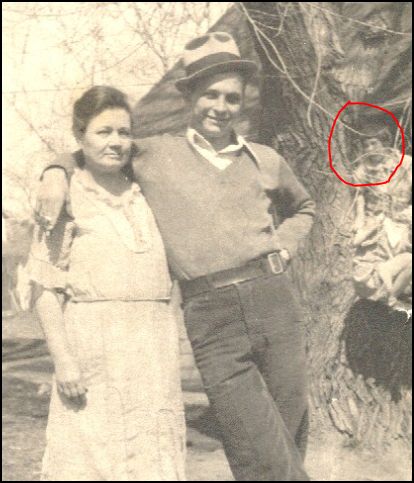
Flowers have been a regular custom on Mother’s day for my father and his father. I remember my father giving my mother a palate of pansies every Mother’s day. He would present them to her after church and then plant them for her with her. I just learned two weeks ago that his father would give his wife (my grandmother) the same gift, but he would give them to her in the front yard of their house on 47th and Seward in Omaha by planting them himself in a large planter that he had purposely built for that reason. I learned that from an 85 year old cousin that grew up next door to my grandparents. Her mother was my grandmother’s sister. She is in the tree behind my father and his mother in this picture.

As we look forward to celebrating Mother’s day this coming Sunday, I thought you might be interested in hearing how Mother’s Day started. Here’s what I learned about it.

Anna M. Jarvis (1864–1948) first suggested the national observance of an annual day honoring all mothers because she had loved her own mother so dearly. At a memorial service for her mother on May 10, 1908, Miss Jarvis gave a carnation (her mother’s favorite flower) to each person who attended. Within the next few years, the idea of a day to honor mothers gained popularity, and Mother’s Day was observed in a number of large cities in the U.S. On May 9, 1914, by an act of Congress, President Woodrow Wilson proclaimed the second Sunday in May as Mother’s Day. He established the day as a time for “public expression of our love and reverence for the mothers of our country.” By then it had become customary to wear white carnations to honor departed mothers and red to honor the living, a custom that continues to this day.

Chuck

“Honor your father and your mother, that your days may be long in the land that the LORD your God is giving you.” Exodus 20:12

sewa motor jogja
© Chuck Larsen 2019. Powered by WordPress.