service genset jogja
Ecclesiastes 7:15, 1 Peter 2:20-21

Life Isn’t Fair

In his observations about life Solomon has repeatedly suggested that life just isn’t fair. In Ecclesiastes 7:15, he comes right out and says it. He writes, “In my vain life I have seen everything. There is a righteous man who perishes 19 unfairin his righteousness, and there is a wicked man who prolongs his life in his evildoing.” I guess this is one truth that we all learn fairly early in life; it just isn’t fair! I remember arguing with my mother about how my friend, Butch, could stay up till 9pm when I had to go to bed at 8:30 on a school night. When she said, “you’re not Butch! Go to bed!” I said, “It’s just not fair.” Usually, what we mean when we say that is we are not getting what we want or we are being forced to do something we do not want to do. Solomon’s meaning is a bit more profound.

Life certainly was not fair in Jesus’ case. One of his closest friends betrayed him. The chief priests, the teachers of the law, and the elders made up the Sanhedrin, the supreme religious and legal court in Judea. Yet, instead of giving Jesus a fair trial, they drug him off in the middle of the night for an illegal trial. They manufactured evidence against him and convicted him and condemned him to death. There was nothing fair about the trial and conviction of Jesus. Jesus came to earth and did only good. He taught of God’s love for us. But he was beaten and mocked by his enemies.

It’s a fact of life; it’s just not fair! Coming to grips with this truth is an essential step for spiritual maturity, becoming more like Jesus. Good people sometimes get sick and die young. Someone with fewer qualifications and less experience may be hired instead of you. A tree may fall to the left and damage your car instead of falling to the right and landing in an open yard. Steve Moore says, “If you accept the fact that life isn’t fair you can free yourself from many of the negative emotions that spin out of control when you suffer injustice.” When life is unfair, remember what Jesus endured and what Peter said about that. 1 Peter 2:20-21 says,” “If you suffer for doing good and you endure it, this is commendable before God. To this you were called, because Christ suffered for you, leaving you an example that you should follow in his steps.”

Ecclesiastes 7:14, 2 Corinthians 5:7

Prosperity & Adversity

We all know both prosperity and adversity. It is the human condition! We are more likely to question God in times of adversity. Seldom, if ever, do we ask God why something good happens. It’s almost always when trials come. 18 prosperityActually, in 30+ years in Christian ministry, few and far between have been the times when people have asked why God allowed such and such prosperity to come their way. On the other hand, hundreds of times I’ve been asked why God would allow such and such adversity to strike. Solomon gives us perspective on the issue in Ecclesiastes 7:14. He writes, “In the day of prosperity be joyful, and in the day of adversity consider: God has made the one as well as the other, so that man may not find out anything that will be after him.”

Job, of course, taught us the correct perspective also when he acknowledged in his time of trial that it is the Lord who gives and it is the Lord who takes away. When his wife suggested that he simply curse God and die, Job rebuked her asking if it’s right to accept good from God and not bad. Solomon tells us to rejoice in times of good fortune but not in times of adversity. We are to “consider” during times of adversity. What do we consider? God is sovereign over them both. Wiersbe says, “God balances our lives by giving us enough blessings to keep us happy and enough burdens to keep us humble. If all we had were blessings in our hands, we would fall right over, so the Lord balances the blessings in our hands with burdens on our backs. That helps to keep us steady, and as we yield to Him, He can even turn the burdens into blessings.”

We’re reminded in the Bible not to boast about tomorrow because we have no idea what tomorrow may bring. It is this reality that keeps us humble. Don’t forget that it’s the fear of the Lord that is the beginning of wisdom. The phrase in Ecclesiastes 7:14 tells us that God hides the future from us. We must learn to walk by faith not by sight. That’s exactly what 2 Corinthians 5:7 says. God revealed Himself to us in Christ. In Christ we see God’s love for us. In Christ we also see God’s promises for an eternal future, beyond our lives under the sun. We may not know what tomorrow will bring, but we do know who holds tomorrow. It is all a matter of faith. Am I going to trust God in the good times as well as the bad times? One writer put it this way, “We cannot have a meaningful relationship with Him if we are not willing to trust Him. That choice to trust is what the Bible calls faith. That faith is a lot like a muscle—it develops with use, and deteriorates without it.” Adversity is like weight lifting. It helps build a stronger faith.

Ecclesiastes 7:13, Proverbs 9:10

Making Peace with God

What is better, wealth or wisdom? Of course Solomon has been expounding on the better things in life through the first 12 verses of Ecclesiastes chapter seven. His last comparison was with wealth and wisdom and wisdom won. A 17 peacelarge inheritance is a good thing but a large inheritance accompanied by wisdom is much better and if the choice is between a large inheritance and wisdom, wisdom will win out every time. But to Solomon wisdom is not the accumulation of facts, or the ability to manipulate numbers, or the exceptional physical ability that makes one great at sports, or the personal characteristics which make a person popular. No! it’s clear that to Solomon, the wisest man in the world, “the beginning of wisdom is fear of the Lord.” Notice Proverbs 9:10, “The fear of the LORD is the beginning of wisdom, and the knowledge of the Holy One is insight.” (See also. Psalm 111:10, Proverbs 1:7 and proverbs 4:7)

Ecclesiastes 7:13 begins with the exhortation, “Consider the work of God.” According to Phil Ryken, this is “…a call to a careful observation of the way God works. The man who wrote Ecclesiastes—took careful notice of the world around him. He studied the seasons of life, learning when it was time for this and time for that. He watched the way people worked and played. He saw how they lived and how they died. Here in Ecclesiastes 7 he invites us to consider God’s work in the world.” The presupposition in this exhortation is that there is a sovereign being who created everything and everyone around me. It is a call for all of us to humbly acknowledge that it’s all the work of His hands. It is a call for us all to “fear” or to have reverence for the Lord God who is almighty. Solomon asks a question to help us attain the true fear of the Lord; “Who has the power to straighten out what God has made crooked?” the form of the question assumes the answer: No one!

God makes things the way they are. We must humble ourselves to His divine will. The word for “crooked” is not referring to something that’s perverted or morally out of line, but is referring to the trials and hardships that we each have in our unique lives. We might love to change our lots in life, but true wisdom comes to terms with life as God has designed it for us. Ryken continues his commentary, “We struggle with the physical limitations of our bodies. We suffer the breakdown of personal or family relationships. We have something that we wish we did not have or do not have something that we wish we did. Sooner or later there is something in life that we wish to God had a different shape to it.” Whatever the particular hurt and pain that has become our lot in life, True wisdom makes peace with a sovereign God.

Ecclesiastes 7:11-12, 1 Timothy 6:9-10

More on Money

We’ve all heard it said that money is not the most important thing in life but it sure does beat whatever is in second place. In Ecclesiastes 7:11-12 compares the value of money with the value of wisdom. First it acknowledges that 14 moneywealth passed down to the next generation is a good thing. Everyone would acknowledge this. But Solomon argues that, wisdom along with an inheritance is even better. He then says that both money and wisdom provide shelter. But the shelter that wisdom provides is far better than the kind of shelter money provides. So then these verses continue Solomon’s teaching on the “better” things in life. I think Solomon is saying that wisdom is better than money because money has the potential to destroy life rather than preserve it. One of the founders of Dallas Theological Seminary, W. H. Griffith Thomas said, “Making of money is necessary for daily living, but money-making is apt to degenerate into money-loving and then the deceitfulness of riches enters into and spoils our spiritual life.”

Paul gave his young disciple similar instruction in 1 Timothy 6:9-10. He said, “People who want to get rich fall into temptation and a trap and into many foolish and harmful desires that plunge men into ruin and destruction. For the love of money is a root of all kinds of evil. Some people, eager for money, have wandered from the faith and pierced themselves with many griefs.” Money may be a shelter in some ways but its roof and walls are full of holes. You can never fully trust it. But wisdom is a much more secure shelter. Strong men can’t rob you of it. Deceitful men can’t cheat you out of it. No economic down turn can take it away from you. David Jeremiah said it this way, “It’s interesting how few people we see who possess both wisdom and wealth. Wealth without wisdom can result in misery; wisdom can give perspective on the right use of wealth. One is actually better off poor than to have wealth with no wisdom.

What wisdom does that wealth can’t do is give us a quality of life totally independent of our financial status or circumstances. Jesus reminded us in Luke 12:15, “Take care, and be on your guard against all covetousness, for one’s life does not consist in the abundance of his possessions.” As old and common as these clichés are they are still true: Money can buy land, but not love; bonds, but not brotherhood; gold, but not gladness; silver, but not sincerity; hospitals, but not health; condominiums, but not character; houses, but not homes; timber, but not truth. Money can purchase commodities, but not comfort; ranches, but not righteousness; ships, but not salvation; and hotels, but not heaven. To save your money you must share it; to love it is to lose it; and to invest it forever, you must put it in things eternal.

Ecclesiastes 7:10

Living in The Past

Some years ago, loaded with old comic books and radio tapes from the 1930s, some five hundred people flowed into Tempe, Arizona, for a three-day national nostalgia convention. The conclave featured comic book collectors 13 past2who swapped “Captain Marvel” for “Superman No. 1” or simply paid up to $200 for a rare copy of the first “Batman” series. They also watched movies from the silent screen era and listened to radio broadcasts from the thirties and forties. One of the DVD sets often offered by PBS to raise money for their broadcasting is the oldies but goodies music from the 40s, 50s, and 60s. Nostalgia is big business in our culture. I often immerse myself in yester yore when things were so much simpler, values were much clearer, and worries and responsibilities were easier.

In Ecclesiastes 7:10, Solomon is still talking about making better life choices. Here, however, he assumes that his readers have a specific perspective that must be confronted. Usually we think that Solomon is addressing a younger generation, but in this verse it sounds like he’s speaking to the older generation, challenging us not to fall into nostalgic reflection that may cause us to look at our present situations or even the present generation as something less than the past. Solomon writes, “Do not say, ‘Why were the former days better than these?’ For it is not from wisdom that you ask this.” George Ball said, “Nostalgia is a seductive liar.” Yes, when I’m honest, nostalgia really is looking back with love and longing at lives we couldn’t wait to leave. Alexander Dumas exclaimed, “Oh, the good times when we were so unhappy.”

Some once said, “You may be old at 40 and young at 80; but you are genuinely old at any age if: You feel old; You feel you have learned all there is to learn; You find yourself saying, ‘I’m too old to do that’; You feel tomorrow holds no promise; You take no interest in the activities of youth! You would rather talk than listen;
You long for the ‘good old days,’ feeling they were the best.” When Bill MacDonald comments on this verse he says, “Another foolish activity is living in the past. When we constantly harp on ‘the good old days’ and wish they would return because they were so much better, we are living in a world of unreality. Better to face conditions as they are and live triumphantly in spite of them. Better to light a candle than to curse the darkness.”

Ecclesiastes 7:8-9

Fools Rush In

Life is usually made up of choices that we make along the way. All of our choices have consequences and change our destinies. It was this reality that Robert Frost so poignantly pointed out to us in his little poem, “The Road Not Taken.” After he had made his choice to travel on one road rather than the other, he says, “I shall be telling this with a sigh somewhere ages and ages hence: two roads diverged in a wood, and I, I took the one less traveled by, and 12 fools1that has made all the difference.” We all know what this is like because we’ve all looked down the roads that diverge from yellow woods and made our choices. In Ecclesiastes 7, Solomon has been pointing out that some choices bring about better results in life than others. His presupposition is that we still stand at the crossroads of choices that we still make every day. He wants us to take the road that leads to a fuller more meaningful life. He said that a good name is better than great riches. He said it’s better to go to a funeral than to go to a party. He said sorrow is better than laughter. He said that it is better for a man to hear the rebuke of the wise than to hear the song of fools. Then he told us that where a road comes out is more important than where it begins. To slow us down to weigh the choices we make a little more carefully, he tells us in Ecclesiastes 7:8, “…the patient in spirit is better than the proud in spirit.”

We’ve all heard the phrase, “fools rush in where angels fear to tread.” I thought it was Elvis Presley who first said it in his song, “I can’t help falling in love with you.” Musically, however, it was first included in a song written by Johnny Mercer in 1940. Ever since it has been repeatedly used in songs by many others; Frank Sinatra, Ricky Nelson, Bob Dylan, Mamas & the Papas, Charles Manson, Smashing Pumpkins, Brian Adams and even Bow Wow Wow! It’s also to be found in too many more to mention in literature as well as music. Its modern origin, I believe is in Edmund Burke’s speech in which he talked about the causes of the French revolution in 1790. Abraham Lincoln used it in his speech about slavery and revolution in 1854. Even James T. Kirk used it in In Star Trek VI: The Undiscovered Country. He said: “I’m a great one for rushing in where angels fear to tread.” So am I! it more often than not leads to irreversible consequences.

The phrase “proud in Spirit” refers to emotional, passion driven responses. Ecclesiastes 7:8-9 makes that clear. It says those who are “patient in spirit are better than the proud in spirit. Do not be quick to anger, for anger lodges in the bosom of fools.” Jude warns us about the rebellious that are quick to rush in to war where angels fear to go. In Jude 9, Michael is said to have patiently waited for God to act. There is no shame and regret in patience like there often is in impetuous pride. It’s patience that produces character (Romans 5:4). It is foolish pride that brings about regret and longing looks down roads that can never be reversed (Proverbs 16:18).

Ecclesiastes 7:8, Zechariah 4:

Small Beginnings

Just to review, Solomon has given us four “better than” statements in the first six verses of Ecclesiastes chapter seven. He said that a good name is better than great riches. He said it’s better to go to a funeral than to go to a party. 11 small2He said sorrow is better than laughter. And then he said that it is better for a man to hear the rebuke of the wise than to hear the song of fools. The fifth “better than” statement is found in Ecclesiastes 7:8. Solomon said, “Better is the end of a thing than its beginning.” Many commentators see this verse as another pessimistic declaration from a bitter, disillusioned old man. I think he is making a positive observation about life in general.

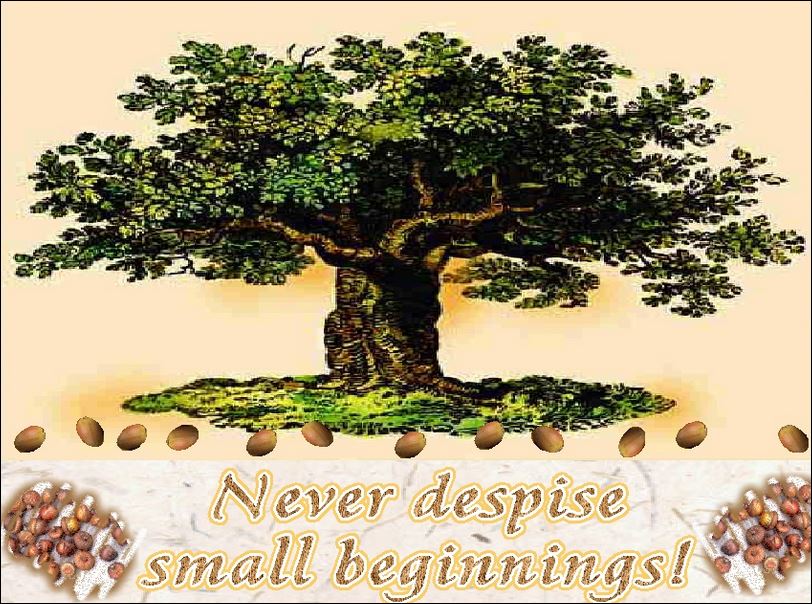
Things don’t always start out the way we’d like them to. Also, there are often many setbacks along the way. When Solomon talks about the end of something, he’s not referring to simply the end of a particular event or even a period of time. He’s talking about its result or the end product. Let me quote Ryken again, “Many things that do not seem all that promising at the beginning turn out well in the end. This is always true of anything that has the blessing of God.” He then quotes Romans 8:28, “We know that for those who love God all things work together for good.” This was especially true for the building of the second temple in Israel after the return from the Babylonian captivity. Those who remembered Solomon’s magnificent temple were disappointed in the one being rebuilt. The Lord gently rebuked and encouraged them. In Zechariah 4:10 He said, “Do not despise this small beginning, for the eyes of the Lord rejoice to see the work begin.”

God loves to see good works, no matter how small, begin. Those founded on Godly principles nearly always receive God’s blessing. I have a good friend who moved to Nebraska to start an organization called AIM. It stands for Applied Information Management. Many of you will know who I’m talking about. Back in 92, (1992 not 1892!) he was the only employee of the organization. I spent many hours with this friend, and although I never fully understood what AIM did, I got to know him. Everything he did he did from a solid ethical, moral, and yes, even biblical perspective. His character and conduct provided a solid godly foundation upon which that organization was built. I just talked to one of the VPs at AIM. It produces over 8 million dollars of revenue every year, and employs over 75 people. From this small beginning AIM has expanded into other states as well. My point is when things are done God’s way don’t let small beginnings or temporary setbacks discourage you. I could use my church as an example as well. The vision and prayers of just a handful of people over 40 years ago have blessed us with a congregation of over 700 people who touch the lives of others in our community in too many ways to mention. I think this is what Solomon meant when he said “better is the end of thing than its beginning.”

Ecclesiastes 7:5-6

Snap, Crackle & Pop

Solomon has given us three “better than” statements in the first three verses of Ecclesiastes chapter seven. He said that a good name is better than great riches. He said it’s better to go to a funeral than to go to a party. He said 10 snap2sorrow is better than laughter. And next, in Ecclesiastes 7:5 he gives us the fourth “better than” statement: “It is better for a man to hear the rebuke of the wise than to hear the song of fools.” Verse six compares the song of fools with “the crackling of thorns under a pot.” The fire produced by thorn branches make a lot of noise but don’t produce any lasting heat. The snap, crackle and pop of the songs of fools might win our attention at the moment, but will ultimately desert us in our greatest moment of need and teach us nothing about the true meaning of life.

Kathy gave me “The History of Rock and Roll” for my birthday. It is a 10 part series produced by PBS. She knows I’m a child of the 60s! Since I broke my arm, I’ve had some time to watch it. Honestly, I’ve never felt more convicted of the foolishness (stupidity?) of my fascination with the music of my youth. From Chuck Berry, Little Richard, Jerry Lee Lewis and yes, even the king himself, Elvis, all the way through Metallica, Black Sabbath, and Kiss up to the punk rock era and into the 90s, and beyond there’s nothing but the snap, crackle and pop of gimmick after gimmick to momentarily grab our attention. Yes, the talentless screaming and ranting and ravings accompanied by the lewd lyrics and antics of the performers can be described in no other way than the songs of fools. The series ends with the 90s, but thinking of Miley Cyrus makes me think that the world is still obsessed with snap, crackle and pop of fools. There is actually a contemporary rock band called, “Snap, Crackle & Pop.”

Solomon’s song in Ecclesiastes may not contain much snap, crackle or pop, but it stands as a timeless example of the music that matters: a rebuke from the wisest man in the world inspired by God to bring lasting warmth as we walk together through the valley of the shadow of death. Ryken summarizes this truth well: “This is why the Preacher says it is much better for us to hear the rebuke of the wise. Someone who cares enough to confront will tell us to get serious about life and death. Listening to the constructive criticism of a godly friend can save our soul. Wise people will say all of the things that Ecclesiastes says. They will tell us that living for pleasure and working for selfish gain are striving after wind. They will tell us that God has a time for everything, including a time to be born and a time to die. They will tell us that two are better than one in facing all of the toils and trials of life. They will tell us that because God is in Heaven and we are on earth, we should be careful what we say. They will tell us that money will never satisfy our souls. In short, they will teach us not to live for today but to live for eternity.”

sewa motor jogja
© Chuck Larsen 2019. Powered by WordPress.