service genset jogja
Philippians 4:2

Broken Relationships

My ex-brother-in-law died last week. I had the privilege of performing his youngest daughter’s wedding a couple years ago. He was not there. I asked her why and she said she didn’t want him around. He had broken, in 12 brokenone way or another, every friendship or every relationship he had in life. Later, I saw my other three nieces and nephews (his children) at a birthday party and he was not there. I asked them how he was doing and none of them had any idea. He had just deserted them. They wanted nothing to do with him. I remember him well and can remember his abusive behavior to my sister and his abusive behavior towards others as well. He was not a very nice man! All his life he lived alienated from those who had loved him the most. There will be no funeral for him.

He was not a very happy man either. Nothing will kill our joy in life more than to live with animosity and bitterness towards another. In Philippi there were two women who were at odds with each other over some issue. We don’t know what that was, but according to many commentators these two women lead a serious division in the church and Paul knew the pain and misery they were causing to all involved. God’s love can’t exist in an environment where hatred and animosity exist. So before he finishes his letter he addresses these two women by name in Philippians 4:2. They have gone down in history for thousands of years because of their disagreement. He says, “I entreat Euodia and I entreat Syntyche to agree in the Lord.” Their names are both hard to pronounce but Harry Ironside called them, “Odious and Soon-touchee!”

They were probably both right at some point. That’s usually the case. Proverbs teaches us that when we hear one side of the story it sounds right until we hear the other side. The problem is each party focuses solely on their own “rightness” and refuses to hear the other side. I often tell married partners “You can be right or you can be married. You take your pick.” Yet both parties are always wrong when the problem festers and becomes divisive. Paul implores each of them not just one. He entreats each one individually. He had spent some time talking about how Christ’s mind worked and called on these women to think like Christ. It is clear to me that Paul is not calling them “in the Lord” to agree on each detail of their debate but for both to take the mind of Christ. Christ’s mind is a humble mind. It’s the mind of one who did not cling to his glory as God, but emptied Himself for us. It’s a plea for humility and self-sacrifice in our relationships with others. No marriage will survive without it. No family will survive without and no Church will survive without it.


Philippians 3:18-19

Rules, Rituals & Religion

I’ve suggested that the “enemies of the Cross” that Paul is referring to are those who add rituals, customs, performances or sacrifices as necessary ingredients to salvation. If the Cross is not 11 religionsufficient in and of itself then whatever must be added becomes a “work” which saves us. This contradicts the major teachings of the New Testament that “it is by grace you are saved, through faith. It is a gift of God, not of works, lest any man should boast” (Ephesians 2:8-9). But when Paul goes on in Philippians 3:18-19 to describe these enemies of the cross he says, “Their end is destruction, their god is their belly, and they glory in their shame, with minds set on earthly things.” Many misunderstand this passage. They say it pictures the enemies of the cross as sexually immoral, gluttons, whose only interests are the pleasures, possessions and privileges to be had in this world. The “end” of such people may very well be “destruction.” But that destruction will not be because of their immorality or gluttonous behavior. It will be because they did not avail themselves of the grace of God offered at the cross of Calvary.

What does it mean to have your belly be your god? I’d argue that this is a reference to the Jewish ritual eating habits. When Paul wrote to the Corinthians he had a large section dedicated to eating habits. When God called Peter to go to Cornelius’ house, Peter wouldn’t go because of the pagan eating habits. But God showed him three times that all foods are clean. In Mark 7:18-19, Jesus was doing battle with the religious leaders who attacked him for what Jesus may have eaten. He says, “Do you not see that whatever goes into a person from outside cannot defile him, since it enters not his heart but his stomach, and is expelled?” The most important part of this passage is what follows. Mark adds a meta-comment. He said, “Thus he (Jesus) declared all foods clean.” In Romans 16:17-18, Paul is again doing battle with those who are upsetting the believers with their teachings about legalistic observations. He says, “I appeal to you, brothers, to watch out for those who cause divisions and create obstacles contrary to the doctrine that you have been taught; avoid them. For such persons do not serve our Lord Christ, but their own appetites.”

The next phrase in the Philippians passage says that the enemies of the cross “glory in their shame.” Moises Silva, in his exegetical commentary understood that the Greek word for “shame” has been “interpreted with specific reference to Jewish practices. According to this interpretation, the term alludes to the sexual organs and thus indirectly to circumcision.” At the beginning of Chapter 3, Paul made it clear that the circumcisions of the legalists were actually their mutilations. Their mark of pride became their mark of shame! Paul counted his own circumcision as rubbish. Finally, the passage says their “minds are set on earthly things.” Paul’s mind is on the “upward call of God.” His whole purpose and passion in life as expressed is clearly to know Christ and the power of His resurrection. Earthly things are rituals, rules, and religion!

Philippians 3:18

Enemies of the Cross

Paul calls the believers in Philippi to keep their eyes on those who walk (conduct their lives) in the light of the grace of God and focus their attention on Jesus. They will live a certain kind of life. The most important 08 enemiescharacteristics that you should look for is evidence of the Holy Spirit. That’s seen in the fruits of the Spirit as Paul records them in Galatians. The first three are really obvious in people. They are love, joy and peace! People that live their lives loving God and loving others have joy filled lives. Those whose lives are filled with love and joy live in peace with God and with others. One might not think that Paul lived in peace with others because of the constant attacks on him. But that would be to misunderstand Paul. Jesus also was actually the “Prince of Peace” but he had many enemies also. Paul tells us in Romans to be at peace with all men as far as it depends on us. It wasn’t Paul or Jesus who disturbed the peace. It was those who hated them and the Gospel message.

It broke Jesus’ heart that there were so many who rejected Him and he even wept over Jerusalem knowing what was to befall the city because of its rejection of Him as their Messiah. It broke Paul’s heart to see how many people in the Jewish world as well as the Greek and Roman world rejected the Good News about Jesus. There were many who hated Jesus because of His message. There were many who hated Paul because of His message. There have always been enemies of the Gospel. Paul tells the Philippians and all Christians of every generation to keep an eye on those who preach the Gospel of salvation by Grace apart from the law and see the fruits of the spirit and follow them. But in Philippians 3:18 he tells them to look out “For many, of whom I have often told you and now tell you even with tears, walk as enemies of the cross of Christ.”

“Enemies of the cross of Christ” is a fascinating term and is often misunderstood. In the Old Testament, especially in the book of Psalms, as well as in much early Jewish literature the enemies of God’s people were referred to frequently as goyim, or dogs! Paul intentionally turned this phrase on the legalists. He said that they were the true “dogs” (Philippians 3:2). The major controversy in the entire early church as seen in the book of Acts as well as most of the epistles is the role of “law” in a Christian’s salvation. Paul finds it essential to continually repeat his message of salvation by grace through faith alone. To Paul, Jesus paid it all on the cross of Calvary. Enemies of the cross are those who continually try to add something to the free gift of salvation through faith! Anyone who adds a ritual, a custom, a performance or a sacrifice to the cross as a necessity for salvation becomes an enemy of the Cross. Jesus either paid it all, or he paid none! This understanding assures that God alone gets the glory!

Philippians 3:17

Watching Others Walk

07 walkersPaul moves on to exhort the Philippian believers to “note those who walk in this way, and follow this pattern you’ve seen in us.” (See Philippians 3:17). It’s interesting to notice the way people walk. I remember the old Monty Python comedy routine of the “ministry of silly walks.” John Cleese and others would walk in silly, weird, or clumsy ways to illustrate certain aspects of people’s lives. The way we walk does say a lot about our lives and languages have strived to be precise in describing walks. There are so many different kinds of walks. There are proud walks, there are confident walks, and there are walks of shame. You can slouch, sneak, creep or swagger. Boice says, “The need to describe such forms of walking has enriched language. Roget’s Thesaurus lists dozens of English synonyms for walking. The Zulu language, according to Eugene A. Nida of the American Bible Society, contains at least 120 distinct words for similar ideas—to walk pompously, to walk with a swagger, to walk crouched down as when hunting, and so on. These truths are an acknowledgment that the way people walk reveals something of their ambition, state of mind, and values.”

I expect it’s for this reason that Paul exhorts believers to “walk worthy of their calling.” In Ephesians 5 we’re told to walk “wisely.” In 1 Thessalonians we’re told to walk with “respect.” And in 1 John 1:7 we’re old to walk in the “light.” We are to watch how people “walk” in Philippians 3:17. What we should look for is those believers who have followed the pattern set by Paul and his team (Timothy, Titus, Luke, etc.) who the Philippians had known from the beginning. Richison says that the word “note” in this verse, “…is a military word meaning to reconnoiter, to look, watch or mark. Paul challenges the Philippians to reconnoiter the array of Christians in their purview to detect growing Christians.”

Those who are growing in the “grace and knowledge of our Lord and Savior Jesus Christ” are easy to recognize. They live vibrant, exciting lives, pressing on in the things that really matter in life. In his commentary on the Holy Scriptures, Lange quotes Menken who says, “The ever recurring exhortation of the apostle to rejoice in the Lord, was adapted to assure them that Christianity is something bright, cheerful, and joyful, to make them certain, confident in their knowledge and walk in opposition to those who imagine that one must mix a bitterness, narrowness, and legal servitude with the mildness, breadth and freedom of the new covenant and its gospel.” Paul tells us to “watch out” for one and use them as negative examples. He then tells us to look out for those who live joyful lives in the Lord and follow them!

Philippians 3:15-16, 2 Peter 3:18

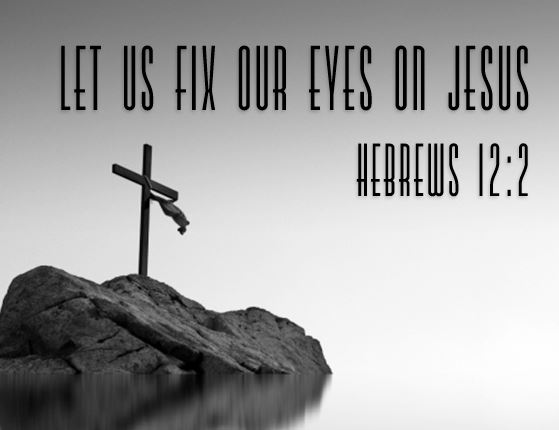
Keeping Our Eyes on Jesus

Paul’s great passion in life was to “know Christ” more and more. He expressed that clearly in Chapter 3 of the book of Philippians. He said that he was “pressing on” to know Christ better and to become more like Him in 06 fix our eyeshis day to day life. Knowing Christ is the key to spiritual growth. Even after 30 years of knowing Christ, Paul says he does not believe he has arrived at this goal of full knowledge of Jesus or that he has attained a moral perfection in himself. He still had much to learn and far to go to become like Christ. Peter echoes these same truths in 2 Peter 3:18 when he exhorts us to “Grow in the grace and knowledge of our Lord Jesus Christ.” In Philippians 3:15-16 Paul talks to those Christians who understand the need to grow in their knowledge of Christ and who understand that maturity is a process that will never be fully completed until Jesus returns and issues the “upward call” into His presence. It’s only then, when we see Him as He truly is, that we’ll become like Him.

These two verses say, “Let those of us who are mature think this way, and if in anything you think otherwise, God will reveal that also to you.” I see the point of this exhortation is to live our lives in view of the inevitable “upward call” that Paul talked about in Philippians 3:14. If this is a correct observation (which I think it is) then Richison is right when he says, “A good indication whether we are mature in Christ is our orientation to the upward-call. The upward-call is the life orientation towards living for and meeting our Lord.” He then asks his readers, “Are you mature in your life-orientation?”

The final phrase is also important. It concludes, “Only let us hold true to what we have attained.” According to my old New Testament Theology Professor, the late Harold Hoehner, “Quite literally, this expression means ‘to keep step with the same’—as in military marching. In context it means that Christians should keep following those things that effectively work in their lives to promote spiritual transformation.” There are all kinds of things to separate believers into various camps and to cause division in the church. But Paul believes if we’re all marching on, in step, towards increased knowledge of who Jesus is and what He did for us, we’ll find love, peace, joy and the other fruits of the spirit working in our midst. We’ll be united in love as we grow together in our pursuit of a deeper understanding of the Grace of our Lord Jesus Christ. It’s as simple as keeping our eyes on Jesus! Then, marching on together toward Him!

Philippians 3:14

The Upward Call

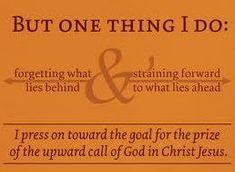
Paul talks about “pressing on” in Christ. He wants to know Jesus better. Knowing Jesus in an intimate personal relationship will build his faith and confidence in God’s promises and deepen his assurance of his eternal 05 one thingdestiny. He wants to “take hold” of Christ since Christ has “taken hold” of Him. Then Paul talks about “pressing on” towards Christ. As he grows to know Christ better, his assurance increases and thus his life is changed. He becomes more and more like Christ. As Christ has “taken hold” of Paul, he was justified in Christ. Christ paid the penalty for his sin and he is completely forgiven and assured of his place in heaven. The certainty of his justification moved him along in the progressive process of actually becoming like Christ in his own life. Justification is the positional truth for every believer. We are forgiven and assured of our place in heaven based, not on our own efforts, but on what Christ accomplished for us on the Cross. Sanctification is the process by which the truth of Christ works its way into every nook and cranny of our lives and we become more like Christ.

Paul then argues in Philippians 3:14, that he will press on in his growth in knowing Christ, thus in his growth in becoming like Christ, until the Lord actually calls him home. He says, “I press on toward the goal for the prize of the upward call of God in Christ Jesus.” The word prize might be translated “wreath” or “crown.” A garland like wreath was placed on the head of the winner of the public games in Greece much like a medal is awarded at the Olympics today. This wreath didn’t look like much the rewards that went along with it were what really mattered. The victor was welcomed home with a parade, he no longer had to pay taxes, and they made a statue of him in his home town.

The “upward call” is the time when the believer is called “home” to heaven. He is welcomed by those who have gone on before him. There are no taxes in heaven, but I’m also pretty sure there aren’t any statues either. This event is often referred to as the “glorification” of the believer. Since he’s been justified and all sin forgiven. He’s lived a life growing in his knowledge of Christ and in his becoming like Christ; he is now rewarded with the fulfillment of God’s plan of actually making us like Christ in Glory. This is how it works in our lives as well: In regeneration we are freed from the penalty of sin; in sanctification, becoming like Christ, we are freed from the power of sin; in glorification (reward and glory in heaven) we are freed from the presence of sin. In all of its pain and misery fostered on the human race, Christ has conquered sin once and for all on the cross, and through his resurrection has conquered death for us all – once and for all!

Philippians 3:7-8, Isaiah 64:6

Bodily Waste & Dirty Clothes

Grant Richison begins his comments on Philippians 3:7-8, he opens by saying, “In the immediate context we have seen the autobiography of an intensely religious man. Paul has just listed seven 29 my good worksaccomplishments he thought would commend him to God. He supposed he could gain God s favor by his religion.” Then he goes on to explain the next two verses. He says, “Verses seven and eight give Paul s estimate of his scrupulous religiosity in one word—manure.” Paul writes, “But whatever gain I had, I counted as loss for the sake of Christ. Indeed, I count everything as loss because of the surpassing worth of knowing Christ Jesus my Lord. For his sake I have suffered the loss of all things and count them as rubbish, in order that I may gain Christ.”

Paul had all the qualifications of an expert Jewish expert. He was a man who stood head and shoulders above his contemporaries as far as religious knowledge, zeal, and position were concerned. His heritage was pure and his credentials above reproach. But Paul wrestles with a category to put all his many qualities in. Where shall I store these things so that I understand their value? Most English translators euphemize this phrase by using words like “rubbish” or “”garbage.” But the truth is “dung” or “excrement” is the literal meaning of the Greek word. Previously, these things made his life what it was. It gave him status, wealth, respect and much more. He comes up with the word “manure” because now they were worthless to him because everything he needed came through his faith-connection with Jesus. The category he chose to store his accomplishments in was the same category that Isaiah chose for storing his “righteousness.” Isaiah 64:6 says, “When we display our righteous deeds, they are nothing but filthy rags.”

Richison continues his comments, “Paul came from the right nation—Israel, the right race—Hebrews, the right sect—Pharisee; he had the right drive— zealous. He was always up on his sacrifices. He was scrupulously righteous. Yet all that was manure (dung). All these things were weights, not wings. They were the rags of religion, the relics of superstition.” In his commentary, James Boice talks about his days in Switzerland when an epidemic of typhoid broke out in a beautiful little mountain town near the Matterhorn. It took them some time to find the source of the disease. He says, “The water main passing through the town had a crack in it, and the animal refuse from the fields was dripping into the crack and from there into the main water supply. The typhoid bacillus had bred there, contaminating the pipe and the pure mountain water that passed through it.” Like the refuse from the fields our works of righteousness seep into our lives and contaminate us. They do not make us healthy. They make us sick. And as John Piper observes, “It’s true—gloriously true—that none of God’s people, before or after the cross, would be accepted by an immaculately holy God if the perfect righteousness of Christ were not imputed to us.”

Philippians 2:29

How to Honor a Man

One of the greatest needs in our world today is for godly men and women to step forward in their service to others and to be bright shining lights of what true Christianity should look like. We are always more inspired by 21 herosan example than by instruction. Many of our idols and heroes today are deficient in character and have serious flaws. Our athletes often struggle with gambling and illegal drug abuse. Yet we hold them up as examples to our young. The actors and actresses in our society are often immoral and unethical yet they are highly esteemed and nearly worshipped by their following. Politicians are often found trapped in personal promotion and even dishonest gain, yet we insist on re-electing them to office time and again. Paul wraps up his discussion about sending Timothy and Epaphroditus to Philippi by encouraging them to “…receive him in the Lord with all joy, and honor such men” (Philippians 2:29). These are the kind of men that we should follow and honor. But we must be careful not to just try to do what they did; we need to seek to understand their heart. Find the source of their strength and tap into that ourselves.

Young people often chose an idol, or icon, to model their life after. They copy their hero’s every movements. Kent Hughes observes, “Many boys copy the way a great batter steps into the batter’s box—how he hikes up his belt, taps each cleat with his bat, spits through his teeth exactly sixteen inches to the left of the third base line, and then steps into the box, cracks his neck, brushes the bill of his hat with his left hand, and assumes his stance. Some girls imitate the wardrobe of a much admired older girl—her casual panache, her poise, her walk.” But this is to miss the very aspect of that individual that made them worth following. You must go deeper in people’s lives to find what matters most.

Phillips Brooks once observed all the young preachers who were copying Billy Graham. They would try to model their delivery after Billy’s but they missed what mattered most. In reality, one will never become a great preacher by copying the cadences of Billy Graham, or a major leaguer by chewing tobacco, or a beautiful woman by changing nail polish. Spiritually, as Brooks rightly observes: “If you really reverence a great man, if you look up to and rejoice in his good work, if you truly honor him, you will get at his spirit, and doing that you will cease to imitate his outside ways. You insult a man when you try to catch his power by moving your arms or shaping your sentences like his, but you honor him when you try to love truth and do God’s will the better for the love and faithfulness which you see in him.”

sewa motor jogja
© Chuck Larsen 2019. Powered by WordPress.