service genset jogja
Galatians 3:10

Eager to Serve

In the strife associated with the incorporation of Gentiles into the newly formed church, a church council was held and reported in Acts 15. The result was to open wide the doors of ministry to the gentiles. When Paul excitedly 11 serve othersreported this truth to the believers in Galatia he said that his ministry to the gentiles was endorsed by Peter, James and other apostles in Jerusalem but it was accompanied by a solemn request. Galatians 2:10 gives us that request: “Only, they asked us to remember the poor…” It was an interesting request because Paul finishes this verse by saying that serving those is need was “…the very thing I was eager to do.” As a church we too are “eager to do” that. We maintain a benevolent fund to help with needs. We participate in the Food Pantry in Blair as well as other organizations in Omaha. We’ve recently, with the leadership of some key individuals, have purchased a home in Omaha to house missionary couple who will impact a neighborhood for Christ. We send teams on foreign trips as well to serve others. Indeed, we are eager to help meet other’s needs also. Anyone can do this!
A reporter, Ron Wilson, wrote this story for the San Antonio Express-News (August 5, 2006): Jackson Rogers, ten, raised enough money to put up a house for the homeless. The young entrepreneur said he took on the fund-raising project for Habitat for Humanity in February when he accepted $100 and a challenge from his pastor at First Presbyterian Church. “My pastor gave me a hundred dollars and told me to do something good to help someone,” said Jackson, one of several congregants who accepted their pastor’s challenge. They were told to use the money for good and then report on what they did. At first Jackson’s father was hesitant about letting his son take up such a daunting task, but Jackson was determined. “I was discouraging him from volunteering because I didn’t know what the pastor intended. But he pulled away from me and ran down there,” the father said. Jackson knew he wanted to help a homeless family. But he wasn’t sure how to do that, so he asked his dad. What they came up with was a letter-writing campaign asking for donations to raise $50,000 to build a house through Habitat for Humanity.

Jackson then wrote a letter in his own handwriting on notebook paper. “I used the hundred dollars to buy stamps and paper,” he said. He then sent out letters to friends and family. One woman was so touched by his letter that she passed it on to several of her friends and colleagues. Soon, people from Tennessee, Virginia, and Idaho were sending in checks. The 170 people who responded contributed a total of $43,000. When the congregation at First Presbyterian learned the little miracle-worker was $7,000 short of his goal, people chipped in the rest. “A little person can do something really good. You don’t have to wait to be an adult,” said Jackson’s mother.

Zechariah 3:10, 1 John 4:11

Pay it Forward

I’m often surprised by biblical themes that make it into the movies. You never know where they are going to show up and seldom do the credits point out the original source of the idea. In the movie, Pay It Forward, Trevor 10 pay it forwardMcKinney (Haley Joel Osment) takes up his seventh-grade teacher’s challenge to make the world better. Trevor proposes a chain letter of good deeds. He will do good deeds for three people and then instruct each recipient to “pay it forward” by doing good deeds for three other people, who are instructed to pay it forward, and so on.

Based on Catherine Ryan Hyde’s book by the same name, the movie captures our attention as we dream along with Trevor of a utopian society where everyone takes care of each other. This utopian day dream was given to a prophet named Zechariah who recorded it for us in Zechariah 3:10. It says, “In that day, declares the LORD of hosts, every one of you will invite his neighbor to come under his vine and under his fig tree.” Everyone at that time, the time of Messiah’s rule, will take of the challenge of being their brother’s keepers. In his commentary on this verse, M. J. Boda says, “Zechariah encourages us to a utopian scheme that ultimately will transform the world—one taught by God, enabled by Jesus, empowered by the Holy Spirit, and carried out by the community of faith.” As Christ’s body in the world today, we should strive for this goal.

Our conviction of having received from God motivates us, or should motivate us to pass on what we have received from God to others. 1 John 4:11 is a famous verse, but I think the intent of paying it forward is often overlooked. It reads, “Beloved, if God so loved us, we also ought to love one another.” What does love involve? One commentator answered that question this way: “To begin with, it means possessing the characteristics of love described in 1 Corinthians 13. Can we say, “I am patient and kind, I am not jealous or boastful, arrogant or rude; I am not selfish or irritable or resentful; I am not happy about wrong, but I rejoice in the right; I bear all things, believe all things, hope all things, endure all things”? Moreover, love will involve having a servant’s heart, a willingness to count others better than yourself and to serve and look out for their interests as well as your own (Gal 5: 13b–14; Phil 2: 3). Certainly Jesus himself is our supreme model here: think of how he stooped to wash his disciples’ dirty feet!”

1 Corinthians 12:12

One Body – Many Parts

Paul used the body allusion to communicate the need of working together to the Corinthian believers and to us as well. In 1 Corinthians 12:12 he talks about the one body composed of various parts. He writes, “For just as the 09 one bodybody is one and has many members, and all the members of the body, though many are one body, so it is with Christ.” Actually the first 30 verses of Chapter 12 of 1 Corinthians could be neatly outlined using the “one body” idea. Verses 12–14: one body, each part doing what it should, when it should, communicating with the head. Verses 15–19: one body and diversity—desiring one another’s gifts. Verses 20–24: one body and discrimination—disparaging one another’s gifts. Verses 25–27: one body and development—depending on one another’s gifts. Verses 28–31: one body and discretion—desiring the greater gifts.

Sir Michael Costa was conducting a rehearsal in which the orchestra was joined by a great chorus. About halfway through the session, with trumpets blaring, drums rolling, and violins singing their rich melody, the piccolo player muttered to himself, “What good am I doing? I might just as well not be playing. Nobody can hear me anyway.” So he kept the instrument to his mouth, but he made no sound. Within moments, the conductor cried, “Stop! Stop! Where’s the piccolo?” It was missed by the ear of the most important person of all. The other instrument players may be so wrapped up in their own performances as to not miss a piccolo player, but the great conductor, the one who’s leading us, the one to whom we all must give an account always hears our solos.

The whole point of Paul’s body illustration is to drive home the truth of how much we need one another to be as effective as God wants us to be. Dizzy Dean, famous baseball pitcher, once was hit by a line drive directly on his toe. Not too big a deal. But he didn’t give it adequate time to heal and instead kept pitching. Because of the pain he felt whenever he put any weight on that toe, he changed his delivery. This put additional stress on his pitching arm, and forced him into retirement. A “little thing” like a stubbed toe ended up having major and unforeseen consequences.

Acts 2:44-45

Interdependence!

The Evangelical Dictionary of Christian Education (EDCE) defines Interdependence as follows: The principle of interdependence states that individual members of a …group or community do not operate in isolation but 08 interdependencecontinuously affect each other, as well as the group as a whole. Interdependence in …groups is contrasted to the negative factors of individualism, which puts self at the center of an individual’s world and exalts personal rights and self-gratification over the well-being of others.”

In Acts 2:44-45, we read, “And all who believed were together and had all things in common. And they were selling their possessions and belongings and distributing the proceeds to all, as any had need.” This is not a verse supporting communism; it is a verse talking about meeting each other’s needs in community. The EDCE (see above) adds, “…there was an assumption by the apostles that believers would minister to one another as they grew in their knowledge of Jesus Christ (Rom. 12:5; 10:24; James 5:16; 1 Peter 1:22; 4:9). The type of interdependent life together that the early church practiced was proclaimed by Jesus Christ (John 13:34–35) and modeled by him… Many, if not all, of the profound lessons the disciples learned from Christ unfolded out of their intimate relationships with one another (see John 13:14).”

We need to learn to lean on each other in our times of need. We need to learn to set aside our pride and receive from others. We need to learn to set aside our own personal interests and accept responsibility for one another as well. When God asked Cain where his brother, Abel, was, Cain said that he didn’t know and then asked, “Am I my brother’s keeper?” God’s response to Cain tells us that His expected answer to that question is just the opposite of what Cain expected. He thought he’d escape responsibility, but it’s clear that the answer to that question should be “yes, Cain, you are responsible for your brother’s care.” The EDCE goes on to gives some suggestions on how to foster interdependence: “First, for true interdependence to exist and flourish there must be a putting aside of individualism that focuses on self and the advancement of personal interests. Second, man-made barriers of nationality, race, class, education, and gender must be overcome. One mark of …moving toward Spirit-empowered interdependence is the way members of different backgrounds experience a sense of belonging and freedom to relate to each other. Third, interdependence can be nurtured by practicing corporate experiences…as group members participate with one another in disciplines such as prayer for one another, singing, sharing burdens, and even eating together, a sense of unity and oneness will be generated.”

1 Corinthians 12:12-18

Stop the Insanity!

A visitor to a mental hospital was astonished to note that there were only three guards watching over a hundred dangerous inmates. He asked his guide, “Don’t you fear that these people will overpower the guards and escape?” 05 stop the insanity“No,” was the reply. “Lunatics never unite.” I’m sorry to say that I’ve met a lot of “lunatics” in the church. Being unable to unite in an effort with others they focus on their own interests and lose the impact of what it’s like to work together for the accomplishment of a common goal. Not only do they miss the thrill of seeing God work through the concerted effort of the body, the also lose the strength, support, and joys that sharing their lives with others will bring.

There is strength and safety in the plurality of effort. For safety reasons, mountain climbers rope themselves together when climbing a mountain. That way, if one climber should slip and fall, he would not fall to his death. He would be held by the others until he could regain his footing. The church ought to be like that. When one member slips and falls, the others should hold him up until he regains his footing. We are all roped together by the Holy Spirit.

Paul often refers to the church as a body. Each of us fill a different role; some are hands, some are feet, some are noses, some are eyes, and some are mouths (See 1 Corinthians 12:12-18). In his Illustrations for Biblical Preaching, Michael Green gets even more specific. He says, “In any flesh-and-bones body, there are a variety of cells. There are nerve cells, blood cells, muscle cells, and many others, each having a distinct function. The body operates smoothly, not because the cells get together and vote on what to do, but because each one does what it was designed to do. It is the function of the head to bring all these different functions together, so that the body operates effectively as each cell gives itself to the task of functioning according to its design. Certainly the body would not operate properly if its cells chose to go their own way. Do you know what we call a rebellion of the cells of your stomach? We call it indigestion! A revolt of your brain cells is called insanity. Any time the cells in our body don’t operate properly, it means that the body is sick, that something is wrong with it. Many of the problems in the church today are a result of our forgetting that the church is a body with a head, Jesus Christ.” He has given us a mission; Make Disciples! We must reject the insanity of individualism in the world and work together to accomplish this mission.

1 Corinthians 3:6

God Gives The Growth

When referring to the way he and Apollos were co-laborers for Christ, Paul resorts to an agricultural analogy. He may very well have been thinking of Jesus’ teaching regarding Himself being the vine and believers being the 04 god gives the increasebranches and that no branch can accomplish anything in and of itself. It must be nourished through its connection to the vine. In 1 Corinthians 3:6, Paul writes, “I planted, Apollos watered, but God gave the growth.”

I like what Ogilvie says in The Preacher’s Commentary, “They were not in competition with each other but were partners in a common venture, team members in a common task. And while their work was very important, it was subordinate to the role of God, who provided the increase.” Paul’s focus in this passage clearly infers that divisions in the church “had been caused by giving more devotion to the servants than to the Lord.” This is still a major problem in the church today. It might even be worse because of the mass media. We have TV preachers, radio preachers, as well as publishers promoting popular preachers. Ogilvie goes on to say, “The personality cult has been a part of our secular life in politics, business, education, and medicine. In each of these fields there are strong personalities who gather around themselves disciples to their way of thinking and acting. This fact of life has affected the church and has had a divisive effect. It results in ministers and churches and denominations competing with each other. The divided church is created by our forgetting that we are all servants and ministers of the one Lord and that both the field and the harvest are His.”

I cannot help but think also that we today are fellow workers with Apollos and Paul. Even though thousands of years have passed, the same “building” is being worked on today that they began in the first century. Christ is still the foundation and we’re all building the superstructure. Actually, Christ is building His church; we are co-workers together with Him. This work will continue until the Lord returns. We’re not building something new or different. Paul warns the builders not to attempt to lay any other foundation than the one already laid; Christ Jesus. We are all in this together all the way back to Paul and forward with all those who will come after us. Throughout all history some will plant and some will fertilize and some will water and some will harvest. But we must never forget that “it’s God who gives the increase.”

1 Corinthians 3:9

It’s God’s Field

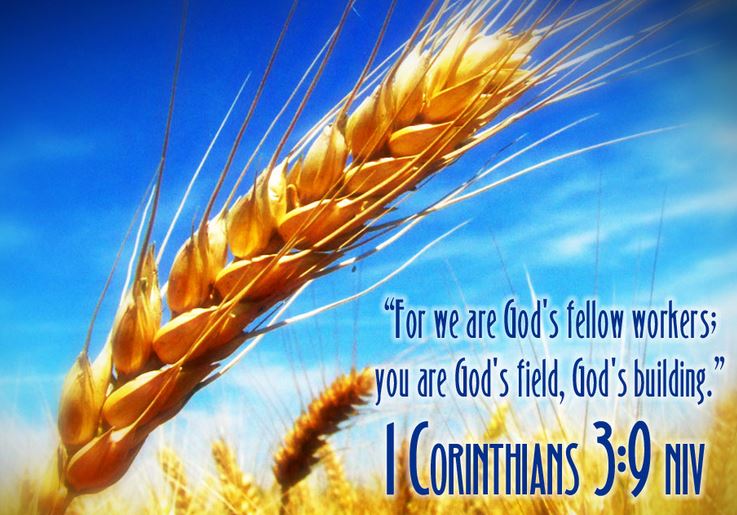
In the first 10 verses of 1 Corinthians Chapter 3, Paul focuses on the divisiveness of the church at Corinth and exhorts the believers to learn to work together for the accomplishment of God’s mission. 1 Corinthians 3:9 says that 03 gods fieldwe indeed are co-workers and we’re all working in the field, but the field is God’s field, not our own. Paul wants the church to grasp the synergistic relation of the different apostolic workers. They share the burden and Paul invites the various members of the church to join in the calling to work together for the common goal of making disciples. What matters, looking back at Jesus’ use of the vine and branches analogy, is the fruitful cultivation of the harvest. Paul wants them, as he and Apollos and Cephus have done, to set aside their individual preferences to form a more cohesive union towards the accomplishment of God’s mission.

I like what Hays says in commentary, “It is easy to give lip service to this principle, but hard to live out its practical implications in the church.” It’s so easy for us to become embroiled in turf wars instead of working cooperatively to cultivate God’s field. When that happens the field becomes endlessly subdivided into unproductive isolated efforts with each part doing its own thing. The role of individuals is not nearly as important as the participation of each part of the body. When we all focus on watching out that no one else interferes with our little patch of the field, it destroys the overall effort. As Hays continues, he says that Paul is saying to his readers, then and now, “No, don’t you understand that the whole field belongs to God and that we are called to work together to bring in the eschatological harvest? Individual leaders are insignificant; they are just field hands.” We are all just field hands.

While in Israel we visited the Church of the Holy Sepulchre in Jerusalem. There’s probably no better example (except maybe the 1st century church at Corinth) of the foolishness of turf wars and bitter jealousies. The Church of the Holy Sepulchre is built on one of the two suggested sights for the burial of Jesus. Although the garden tomb seems to be the more likely place, tradition has supported the Church. Today this church is divided up into different sections under the jurisdictions of the different Christian groups that want to claim a piece of the purportedly holy place: Greek Orthodox, Armenian Orthodox, Roman Catholic, Ethiopian Orthodox, and so forth. Jesus came to break down barriers that divide people, not to create them.

1 Corinthians 3:9

Co-Workers

1 Corinthians 3:9 says that we are “co-workers.” Some translations say “workers together.” Others say “fellow workers.” The Good News Bible says that “we are partners, working together.” The traditional King James says “we are laborers02 colaborers2 together with God.” But I still like “co-workers” best. We are working, along with God, in the building of His church on the one foundation laid by the apostles; the Lord Christ Jesus. One commentator says, “Within the context of this passage, co-worker means that God allows us to PARTICIPATE TOGETHER WITH HIM IN HIS KINGDOM’S work.” We all have the same mission. It’s called the “Great Co-mission.” Jesus commanded us all to embrace this mission and join together with the various gifts, passions, abilities, personalities and experiences that God gave us for the furtherance of this mission of “making disciples.” Jesus said, “Go therefore and make disciples of all the nations, baptizing them in the name of the Father and of the Son and of the Holy Spirit, teaching them to observe all things that I have commanded you; and lo, I am with you always, even to the end of the age.” (Matthew 28:18–20 NKJV)

This mission bonds us together and unifies our efforts. The commentator quoted above goes on to say, “It is God’s agenda, not ours and we work together to achieve our common goal. That’s what it means to be co-workers. We have the same objective and we are working together to achieve it.” Many of us remember the rescue of 18 month old Jessica McClure who was trapped in an abandoned water well for over 58 hours. This happened in Texas a few months after we moved back to Michigan. One reporter said that the rescue was performed by “up to 50 on-site mining engineers, firefighters, paramedics, drillers, jackhammer operators, law-enforcement officers and other support people.” The common goal brought out “the higher quality and better part of the human soul and the human spirit.” Williams said.

Many of the workers normally competed with one another in the oil drilling business. But all petty jealousies and completion were set aside to accomplish something more important; the physical salvation of a little girl. “The biggest thing … was the teamwork of the people involved,” David Lilly recalled.” It worked beautifully. Every person there was just willing to do everything above and beyond (their duty). There was no arguing or bickering.” A final report said “One-time business partners turned bitter rivals were working side by side, and even hugged one another after the rescue.” In the matter of making disciples we are co-workers. We are all in the same boat.

sewa motor jogja
© Chuck Larsen 2019. Powered by WordPress.