service genset jogja
1 Corinthians 15:51-52

The Trinity: Believe it or not!

I did a search through my entire theological library on “The problem of the trinity.” It had 23 different articles that referred to the trinity as a problem. I think that is a major problem (no pun intended!). Gabriel Marcel made a 23 trinityvery helpful distinction between a problem and a mystery. He suggests that problems demand a solution, whereas mysteries call for meditation. This clarifies the issues surrounding any discussion regarding the trinity. Marcel goes on to suggest that problems often demand extensive study (like knowing words to solve a crossword puzzle), but mysteries demand a different kind of reflection. Geisler says it requires “intensive” study as opposed to “extensive” study. Intensive study focuses upon the fact, extensive study seeks new facts.

Geisler’s summary is interesting. He says, “In view of this distinction, the Trinity should be treated as a mystery, not a problem. Once the basic elements are understood, we should not attempt to unscrew the inscrutable. We should not analyze it, but admire it; we should not dissect it, but devote ourselves to it. It is an object of worship, not scholarship. As has been well said, if one tries to understand it completely (as a problem), he may lose his mind, and if he does not believe it sincerely, he may lose his soul! Once we understand God’s attributes and ineffable nature, we need more reverence, not more research.”

The Bible uses the term “mystery” several times. But it doesn’t mean what we usually think of when we hear the term. J. V. McGee said, “What is a mystery in Scripture? It is not a whodunit or a mystery story, and it is not something you wonder about, like, Was it the butler who committed the crime? It is not something Agatha Christie wrote or a Sherlock Holmes story, by any means. A mystery in Scripture means that God is revealing something that, up to that time, He had not revealed.” McGee goes on to say that one of the key ingredients of a biblical mystery is that “…it cannot be discovered by human agencies, for it is always a revelation from God.” One of the more profound mysteries in Scripture is the mystery of the resurrection. Paul says, in 1 Corinthians 15:51-52, “Behold! I tell you a mystery. We shall not all sleep, but we shall all be changed, in a moment, in the twinkling of an eye, at the last trumpet. For the trumpet will sound, and the dead will be raised imperishable, and we shall be changed.” Mysteries are to be believed, not understood!

Deuteronomy 6:4, John 5:19, 12:49

From the many: ONE!

Throughout Church History people have argued about the very essence and nature of God. The scriptures speak to us of one God, but existing in three persons. The word “trinity” is not in the bible, yet the concept in 22 mezuzaunmistakable. Understanding it has always been our problem. It doesn’t teach that there are three Gods. John Philoponus taught this view. He asserted that there were three Gods but they were only loosely connected, like Peter, James and John were as Jesus’ disciples. This error denied the unity of the Trinity and has been rejected by orthodox believers. On the other hand Sebellius taught the opposite. There is only one person of the God head, but that single person manifests himself in three ways: father, son and spirit. Sebellianism or Modalism has also been rejected by orthodoxy.

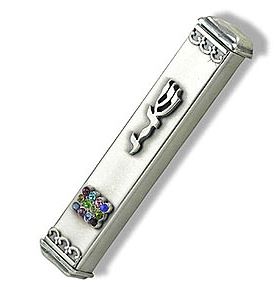
The Shemah is a passage in Deuteronomy recited ritually and regularly by Jews worldwide. Many of us in Israel purchased a mezuzah. It’s a small box that’s attached to the frame of the door entering into a residence. Inside is the Shemah (along with other passages). It is usually engraved with the first letter of the word “hear” in Hebrew, Shemah. (See the picture at www.chucklarsen.com) The Shemah , Deuteronomy 6:4, says, “Hear, O Israel! The Lord is our God, the Lord is one.” The Hebrew world for one is “echad.” It also means united, consistent, whole, or a unity of parts. This statement stresses not only the uniqueness of God but also the unity of God. James uses the Greek equivalent when he writes in James 2:19, “You believe that God is one; you do well. Even the demons believe—and shudder!”

The essential oneness of God does not deny the existence of three persons within the Godhead. It emphasizes unity. They worked completely together and said the exact same things at all times. Jesus said this to his distractors at least four times. Jesus said all his deeds were the same deeds as the Father. For example, in John 5:19, Jesus says, “Truly, truly, I say to you, the Son can do nothing of his own accord, but only what he sees the Father doing. For whatever the Father does, that the Son does likewise.” He acknowledged that He taught only what the Father taught. In John 12:49, Jesus says, “For I have not spoken on my own authority, but the Father who sent me has himself given me a commandment—what to say and what to speak” (see also John 8:28, 14:10). Please do not miss Jesus’ prayer for us. In John 17:21, he prayed for you and me. He said, “I pray that they may all be one. Father! May they be in us, just as you are in me and I am in you. May they be one, so that the world will believe that you sent me.” It’s only in this unity that people will see God.

1 Thessalonians 4:17-18, Hebrews 3:12-13, Hebrews 10:24-25

Coming Alongside

It’s often hard being a pastor. People really expect a lot from us and we’re not all equipped with the same gifts. We don’t all serve in the same ways. I believe Paul was aware of that when he explained the responsibility of those 03 alongsidewith certain gifts. He says, God “gave the apostles, the prophets, the evangelists, the shepherds and teachers, to equip the saints for the work of ministry, for building up the body of Christ.” Paul realized that if one person, or even if just a few people, are called upon to do all the “work of the ministry” they would do a poor job and would eventually burn themselves out. A pastor’s role should be to equip the congregation to care for the needs of the many members. How the congregation is to care for itself is expressed in the many “one another” passages in the bible. One way we are called to take care of one another is through encouragement.

The Greek word for encouragement is “parakaleo.” It literally means “to come along side.” While in the Navy I made a Mediterranean cruise and two western pacific cruises. When at sea for a long time, ships often run low on fuel, food or fresh water. They may also need a particular part because of some kind of damage. These needs are met by other ships that “come along side” and transfer to the depleted vessel whatever is needed to get on with its mission. It’s the same for us Christians. In the course (cruise) of life we too run low on resources. We need other Christians (vessels) to come along side and help us out. We often need to be refueled, resupplied, or fixed.

There are three kinds of encouragement we might need. The first is when we suffer a loss in life or are “broke” by life’s painful circumstances. Paul addressed the Thessalonians when they saw their loved ones die. He explained that we need not let the grief of such a loss overwhelm us. He wanted them to know that their loved ones were not lost, but were with the Lord and one day we’d see them again. He said, “we who are alive, who are left, will be caught up together with them in the clouds to meet the Lord in the air, and so we will always be with the Lord.” He adds “Therefore encourage one another with these words.” (1 Thessalonians 4:17-18). We are also called to encourage one another in their service to the Lord and God’s people. We need to be refueled at times. The author of the book of Hebrews tells us, “and let us consider how to stir up one another to love and good works, not neglecting to meet together, as is the habit of some, but encouraging one another…(Hebrews 10:24-25) Further we are to encourage one another to live godly lives as well and stay away from sin’s ravages. Hebrews 3:12-13 says, “See to it, brothers and sisters, that none of you has a sinful, unbelieving heart that turns away from the living God. But encourage one another daily, as long as it is called “Today,” so that none of you may be hardened by sin’s deceitfulness.”

Romans 12:4-6

Far Better Together

There were three temples in Israel built on the same sight. The first is the most famous and was built by Solomon and is called Solomon’s temple. The temple during Jesus’ day was Herod’s temple because Herod the Great was the 18 better togetherone who built it for the Jews. The second temple was Nehemiah’s temple. The book of Nehemiah documents all the work that was done by the Israelites in rebuilding the wall around the city before getting to the actual work of rebuilding the temple. According to chapter three, he starts with the North wall and sheep gate. He proceeds counterclockwise to the west, then to the south and then the east part of the wall. Ten gates are repaired along the way. The work was done by all! Each person from the Priests to the royal officials to the lowest of citizens all contributed to the rebuilding of the wall. There was a place for everyone. The rebuilding of the entire wall was accomplished in record time.

There’s no telling what can be accomplished if people embrace a common goal and work together to accomplish it. Paul tells us that each of us have a different function to serve in the church today and that each of us is a necessary part of it. He compares the church to a human body with each part having a specific role to fill. When one part of the body fails to accomplish its purpose the whole body suffers. But when all parts function under the unified direction of a common cause, good things always happen. In Romans 12:4-6, Paul says, “For as in one body we have many members, and the members do not all have the same function, so we, though many, are one body in Christ, and individually members one of another. Having gifts that differ according to the grace given to us, let us use them…”

We’re not nearly as productive when we try to stand alone as we are when we unite with others for the accomplishment of a common task. Geese in route to warmer climate often travel thousands of miles. Swindoll mentions several in-flight habits geese have that make this possible. Those in front rotate. When the lead goose gets tired it slips back into the “V” formation and another moves up to takes its place. They flap in such a way that each flap of the wings creates uplift for the bird immediately following it. The whole flock gets 71 percent greater flight range than if each goose flew on its own. The geese at the rear of the formation are the honkers. It serves to announce their presence and to encourage those leading the way. Whether we’re leaders, flappers or honkers we’re in this journey together!

1 Timothy 3:15, Ephesians 2:19-20

A Family Affair

We belong to God by creation. We belong to Christ by redemption and we belong to the Church as a whole being part of God’s family. 1 Timothy 3:15 says, “The family of God is the church of the living God. It is the pillar and 17 family affairfoundation of the truth.” Paul tells the Ephesian believers that they are not Jewish, they are not gentiles, they are not strangers to one another any longer, but they are “citizens together with God’s holy people.” He then says to them, “you belong to God’s family.” (Ephesians 2:19-20). It’s interesting that the language of the New Testament regarding entrance into God’s family uses two key phrases. We are born into God’s family by faith. Jesus told Nicodemus that he had to be “born again” to enter into God’s family. It also speaks to us about being adopted. We are not part of God’s family until we come to faith in God’s Son, Jesus, at which time we become brothers and sisters in one big happy family of God’s redeemed children.

It’s not enough for a Christian to believe. Being a “believer” is not the end of it all. Every believer must also be a “belonger.” It is through belonging in a family that we grow up. We learn to relate to one another, to forgive one another, and to understand one another and to serve one another and to care for one another. It requires good healthy nourishment for us to grow up spiritually strong and mature in God’s family. God’s Word is our food. Jeremiah says, “Your words were found, and I ate them, and your words became to me a joy and the delight of my heart, for I am called by your name…” That means he’s in God’s family. Job said, “I have treasured the words of his mouth more than my portion of food.” Jesus also said that His food was to do the will of the Father (John 4). God’s Word, the Bible, is often referred to as food. God’s Word is bread (Matt. 4:4), milk (1 Pet. 2:2), meat (:Heb. 5:12–14; 1 Cor. 3:1–2), and honey (Ps. 119:103). As we meditate on God’s Word, the truth is “digested” inwardly and we receive strength ( Josh. 1:6–9). When we are babes, we receive the Word from others who have “digested” it for us (1 Thess. 2:7–8); but as we grow spiritually, we learn to feed ourselves and enjoy the full diet of the Word. We can enjoy the “meat” as well as the “milk.”

I wanted my sons to eat right. I try hard to get my grandsons to eat the healthy food, to drink their milk, eat their vegetables and meat. But too often, they only want mountain dew and candy! (So do I!) But God, being the good father that He is (Perfect!) wants what’s best for us. I love the way The Message translates Proverbs 15:14. It says, “An intelligent person is always eager to take in more truth; fools feed on fast-food fads and fancies.” As members of God’s family, He wants us to grow up and learn how to live with each other in the way that pleases Him and brings a healthy and wholesome relationship with the rest of God’s family.

Ephesians 2:19-22

All in the Family

The Bible makes our belonging clear. We belong to God. He made us! We belong to Jesus; he redeemed us, bought us back! We belong to the Family of God, the Church, and we also belong to each other. That truth must affect the 16 gods familyway we live together. That’s why Paul exhorts the Ephesians to “tell each other the truth, because we all belong to each other in the same body.” You belong to me. I need you! I belong to you. You need me!

I remember that during the night of the first Passover, each family was to take one lamb into their house and then they were to share it at a meal together, one lamb per family. When John the Baptist appeared on the scene at the opening of a brand new era he pointed at Jesus and explained that Jesus was the one lamb, the Lamb of God that takes away the sins of the world. The Passover sacrificial lamb was all pointing directly toward the one “lamb of God.” There’s a great communal truth found in the Passover lamb. Out of Egypt, that is, out of the world, God called a people for His very own. They were to become a new family, a new nation, a new kingdom of priests. They were no longer slaves, but set free! They now “belonged” to each other in a very special way as they shared the “one lamb” for the entire family. I’d argue that Christians belong to each other more than they belong to their nation. They belong to each other more than they belong to a sport’s team. They belong to each other more than they belong to their race. They belong to each other more than they belong to the human race as a whole. There is a kingdom within a kingdom, so to speak. We are a new people, in an old world. We are a new family called out of a kingdom in slavery to sin. We are a new “construction” in which each part is totally dependent on the other parts. You see there is only one lamb for the whole family, the Lord Christ Jesus. In Ephesians 2:19-22, we read, “you are fellow citizens with the saints and members of the household of God, built on the foundation of the apostles and prophets, Christ Jesus himself being the cornerstone, in whom the whole structure, being joined together, grows into a holy temple in the Lord. In him you also are being built together into a dwelling place for God by the Spirit.”

Even the Lone Ranger had Tonto! (Johnny Depp makes a terrible Tonto!) He really wasn’t the “Lone” Ranger at all. At best he was the “Almost Lone Ranger.” But even then in every episode he was helping out others and serving the cause of justice. I’m sure he knew that a campfire is a lonely place if you have no one to share it with. God made us to depend on each other, and to need each other. From the very beginning he said “it’s not good for man to be alone” (Genesis 2:18). David Jeremiah wrote, “Loneliness is a warning light on an inner gauge that confirms we’re running short on a primary fuel we require to run efficiently.” We need each other in the same way we need food, water, air and shelter.

Luke 24:27, Matthew 16:18, 1 Peter 2:6-7

An Open Mind

Jesus claimed to be the subject of all three major sections of the Old Testament. During His post-resurrection appearance to the two disciples on the road to Emmaus the text informs us that Jesus taught them how all the 18 peter statuescriptures spoke about him “beginning with Moses and all the Prophets…” (Luke 24:27). This phrase captures the customary Jewish division of two of the three major parts of the Old Testament; the law and the prophets. But then in Luke 24:44, Jesus adds the third section of the Old Testament: the writings. The writings include the book of Job, Proverbs, Ecclesiastes, the Song of Solomon, and the Psalms. The Psalms being the largest part of the writings it’s often used to refer to the entire collection of writings. This is how Jesus used it when He said, “These are my words that I spoke to you while I was still with you, that everything written about me in the Law of Moses and the Prophets and the Psalms must be fulfilled.”

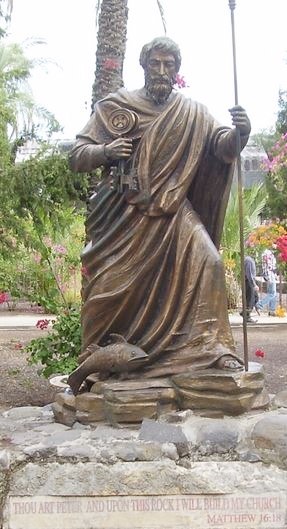
Now to understand what Jesus meant in His New Testament teaching, we must be familiar with the Old Testament prophecies relating to the Messiah or we will make some serious mistakes. When we visit Israel we always stop at the Church of the Primacy of St. Peter. This structure quotes Matthew 16:18 as being the basis upon which Peter is the first Pope and the foundation upon which Jesus will build his church. (See picture at www.chucklarsen.com) This verse says, “Thou art Peter and upon this rock I will build my church.” This interpretation leaves out the context of the conversation where Peter makes his great profession as Jesus being the Messiah prophesied in the Old Testament.

Isaiah, the great Messianic Prophet, spoke for God in Isaiah 28:16. He said, “Behold, I am laying a stone in Zion, an approved stone, set in place as a precious cornerstone for the foundation.” Peter identified Jesus as the Messiah, therefore Peter recognized Jesus as the cornerstone upon which the church would be built. Peter, himself, never thought of himself as the rock upon which the church would be built. He said so himself in 1 Peter 2:6-7. He says quoting the Isaiah passage, “For it stands in Scripture: Behold, I am laying in Zion a stone, a cornerstone chosen and precious, and whoever believes in him will not be put to shame.” Peter knew the Old Testament and the messianic prophecies and didn’t fail to understand Jesus’ words in connection with the Law, the Prophets, and the writings.” Luke 24:45 tells us that Jesus “opened their minds to understand the Scriptures…” Jesus still opens minds today when His teachings are taken in light of the Scriptures of the Old Testament.

Acts 20:35

Givers & Takers

It was strange to learn that the last quote of Jesus is not to be found in any of the Gospels. It’s recorded in the book of Acts and all the way into the book at Chapter 20. Acts 20:35 says, “In all things I have shown you that by 12 give takeworking hard in this way we must help the weak and remember the words of the Lord Jesus, how he himself said, ‘It is more blessed to give than to receive.’ ” I always smile when I read this verse because it reminds me of a joke. A professional boxer was converted to Christ. He felt it was wrong to continue hitting people but only knew boxing as a profession. When he sought counsel of the deacons in his church, one of them responded, “Don’t see why you can’t continue. Bible says that it’s better to give than to receive.”

There are two kinds of people in the world; givers and takers! Proverbs 30:15 says “The leech has two daughters: Give and Give.” The leech is a reference to the bloodsucking horseleech that was common in Palestine. The ugly creature serves as an emblem of insatiable greed. If it could speak, it would say, Give! Give! Give! The leech is like the fictitious vampire sucking the very life blood from all it comes in contact with. Christians should be just the opposite! We should all be givers.

In his little book “Christian Living Beyond Belief,” McManis says, “God has commanded the church, and Christians in particular, to give. Jesus said, ‘Give’ (Luke 6:38). Paul commanded Christians to give financially to the church (1 Corinthians 16:1–4; Romans 12:8, 13). John exhorted believers to give to those in need (1 John 3:16–18). Hebrews 13:16 says God is pleased when we give to others. Giving is a basic Christian virtue. Giving to God and others reflects the very nature of God. God’s greatest act of loving sacrifice entailed an act of ‘giving’—‘for God so loved the world that He gave’ (John 3:16). One of the most telling barometers of a person’s spiritual maturity is their quotient for giving. God has repeatedly commanded Christians to be giving people, for they are recipients of the greatest gift ever given—salvation in Christ.

sewa motor jogja
© Chuck Larsen 2019. Powered by WordPress.