service genset jogja
Matthew 19:17

I’m Glad You Asked: Can you explain Matthew 19:17?

In this passage, and others, Jesus tells someone that if they would inherit Life or eternal life, they must “keep the commandments.” I would argue that this complements Matthew 5:48 where Jesus tells us that we must be “perfect as our father in heaven is perfect.” The rich young ruler in this story didn’t understand the breadth and depth of the law requiring not only external conformity but a change of heart. In Luke 10, Jesus told the religious leader that he too could inherit eternal life if he kept the law. Jesus then asked him what the law said. He rightly responded, “You must love the Lord your God with your whole heart, soul, mind and strength and your neighbor as yourself.” Jesus said, “That’s right! Do this and you will live.”

But the scriptures make it clear that “all have sinned” and no one can perfectly live up to the standards of God’s law. “All have fallen short,” Paul writes to the Romans. D. A. Carson says, “Surely Jesus is painting a picture of human beings that is far more radical than all the pictures they draw of themselves. No one is able to save himself. We human beings break God’s holy law from our very heart. We forfeit fellowship with God. Our relationship to him is characterized by sin: we face him in the perfection demanded by the Decalogue and the Sermon on the Mount.”

It is clear to me that God is attempting to bring the rich young ruler as well as the religious leader in Luke to repentance. That’s the state where people understand and acknowledge the depth of their sinfulness and realize that all the good works in the world are worth exactly what Isaiah says they are worth; “filthy rags.” It is the bottom of the barrel for every man woman and child. It’s the recognition of the vast chasm that exists between my own goodness and God’s standard. it’s the end of the line for works righteousness, but it can be the beginning of real life for all who admit it. Luke tells us that the lawyer, instead of saying, “Dear God, I can’t be perfect…” he “desired to justify himself” and proceeded to argue with Jesus about defining a “neighbor.” I’m convinced that if he, or the rich young ruler, had broken and admitted their state, the door to eternal life would have been opened to them. It’s also opened to all of us the same way!

Chuck
“But Jesus looked at them and said, ‘With man this is impossible, but with God all things are possible.’” Matthew 19:26

Philippians 2:12

I’m Glad You Asked: How do you “work out” your salvation?

Philippians 2:12 has caused some stress to many Christians. It says, “Therefore …. Work out your own salvation with fear and trembling…” Many have suggested, and some churches even teach, that good works will earn your salvation. But even taking the verse out of context as I did above, one can see that it does not say “work for your salvation,” or “work at your salvation,” or even “work toward your salvation.” It says “work out your salvation.” Surely, you can see that the word “your” is a possessive pronoun. It introduces something that is already possessed by the ones being addressed. You already have “salvation,” the exhortation is not to earn it, but to work at making the salvation that you already have totally reflected in the way you live. It is Paul’s way of telling the Philippians to demonstrate through their conduct, the thinking, their talking, and their general attitudes that God has saved them and He is “at work in them.”

Further taking the verse in its context we can see that Paul is really quoting from Deuteronomy 32. Philippians 2:15 explains the reasons behind Paul’s exhortation. It says, “That you may be blameless and innocent, children of God without blemish in the midst of a crooked and twisted generation, among whom you shine as lights in the world.” The words “children” and “blameless” and the phrase “a crooked and depraved generation” are also in Deuteronomy 32:4-5. Moses reminded Israel of the great deliverance from Egypt and in preparing them to occupy the land, knowing that he would not be with them, charged them to live as God’s chosen people as obedient Children of God. Paul was in prison and could have been martyred at any time. He reflected on Moses’ last words to God’s people, and issued a similar charge to those he would leave behind. Just as Israel was exhorted to “work out” their great salvation in their conduct in the land, so too are believers to “work out” their great salvation in their conduct in life.

We are justified in God’s eyes through our faith in His Son. He declares us righteous. This is what the scriptures mean when it asserts that “you are saved…” But the scriptures also tell us that we are yet “being saved.” It’s this process of pursuing a righteous lifestyle that is called sanctification. God wants our practice; how we live and conduct ourselves, to match our position; sinless in God’s eyes.

Chuck
“Whoever says he abides in him ought to walk in the same way in which he walked.” 1 John 2:6

Luke 12:40, 1 Thessalonians 5:2

I’m Glad You Asked: What are the End Time events?

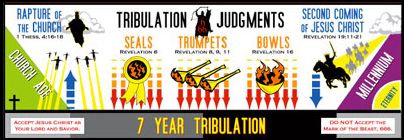
The study of Eschatology, or the End Times, has always fascinated people. The scriptures make it clear that we live in a world that is not destined to remain forever. There are several different views regarding this. I am rather boring on this issue because I still subscribe to the standard dispensational views. The way I understand it is that the rapture marks the beginning of the End Times. It is where the true believers who are “alive and remain” are caught up together with them [those who already died as Christians] in the clouds to meet the Lord in the air…” (1 Thess. 4:17). This is the time of the resurrection where the Christian receives his resurrected body. There are various views as to what this will look like and when it will happen. But most commentators believe it is immediately followed by the great tribulation on the earth, while a great celebration takes place in heaven with the resurrected believers often called the “marriage supper of the Lamb.” During the tribulation is when the seals, trumpets and bowls of revelation occur.

After the seven years of great tribulations on earth, the Lord along with the resurrected believers will return to earth and set up the Millennial Kingdom. Some argue for a very literal 1000 years, others see it as a “long period of time.” It will be God’s answer to the Lord’s Prayer that has been prayed millions if not billions of times over the centuries: “Thy Kingdom come, thy will be done on earth…” There will be one final uprising of Satan and evil, but will be overturned by the Lord and His forces that will set up what we know as the “Eternal State.”

We must always keep in mind that our understanding of the End Times has never been part of the test for orthodoxy. There are many different opinions held by true believers. But it seems that everyone agrees that the most important teaching regarding the End Times is Jesus’ exhortation to be ready at any moment. He tells us in Luke 12:40, “You also must be ready, for the Son of Man is coming at an hour you do not expect.” The word “maranatha” is a Syriac expression that means: “our Lord comes.” It was used as a greeting in the early church. When believers gathered or parted, they didn’t say “hello” or “goodbye” but “Maranatha!” If we had the same upward look today, it would revolutionize the church. O that God’s people had a deepening awareness of the imminent return of the Savior!

Chuck
“For you yourselves are fully aware that the day of the Lord will come like a thief in the night.” 1 Thessalonians 5:2

Genesis 15:6

Give a brief explanation of the dispensations.

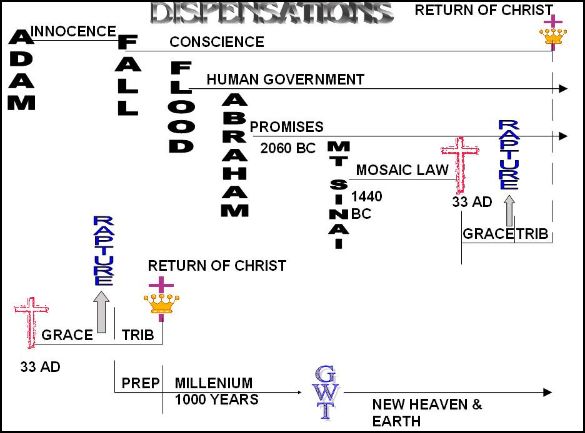
According to “dispensationalists” a dispensation is a period of time during which God administers His program with humanity in a particular way. Commentators are in disagreement as to how many – if any – of these “administrations” can be supported by the Scripture (which must remain the final authority), but it seems most agree there are seven periods during which God related to man or will relate to man in the future.

The first dispensation is called the dispensation of “innocence.” Adam & Eve lived in a state of purity and innocence and enjoyed pure communion with God in the Garden. After the fall the dispensation of “Conscience” carried through to the time of the flood. God related His will to man through his conscience. After the flood commentators recognize the dispensation of “Human Government” where God committed the rule of man to “self-government.” But the dispensation of “promise” began with the call of Abraham. He was called upon to live a life of obedience while looking forward to a future fulfillment of a wonderful promise. The Dispensation of “Law” was administered to God’s people through Moses. It established God as the legitimate lawgiver for mankind. This period ended at the death of Jesus Christ, which ushered in the dispensation of “Grace.” God now relates to man solely through His Son, Jesus Christ, and all mankind can find complete forgiveness and wholeness with God. Some would argue that this period is followed by another dispensation called the “Great Tribulation” but I’d argue that the Tribulation period is a time in which man is also tested by God’s Grace. The 7th and final dispensation, according to classic dispensationalists is the dispensation of “Kingdom Rule.” Some argue it’s 1000 years in length during which time the Lord, Himself, will reign as King on earth.

Although the content of God’s revelation changes during various eras of human history, the basis upon which man relates to God never changes. That basis is FAITH! From Adam & Eve in the garden their relationship with God was determined by their trusting God and His word regarding the tree of good and evil. Noah and his family trusted God to be leading in healthy ways of relating to the world through their conscience. Abraham trusted God and acted on his faith. The law included the sacrificial system through which man could find forgiveness for sin if he believed. Today, in the era of Grace, we too can find all we need for a healthy and happy relationship with God through faith in what He has revealed to us in the Person of His Son.

Chuck
“And he believed the LORD, and he counted it to him as righteousness.” Genesis 15:6

Revelation 6:9-11

Will anyone be saved after the Rapture?

A “Pretribulationist” is one that believes Jesus will return for His Church before the great tribulation falls upon the earth as prophesied in Daniel, Ezekiel and Revelation. This view has been made popular by the “Left Behind” series of novels by Tim Lahaye and Jerry Jenkins. The removal of the Church from the earth as a prelude to the “Day of the Lord” is often referred to as the Rapture. The removal of all believers in the present age before the coming of God’s judgment is often supported by 1 Thessalonians 5:17. It says, “But you (plural – believers) are not appointed to incur God’s wrath (Judgment), but to be saved through Jesus Christ.” For all believers in today’s economy, the judgment of God for sin has been placed on His Son Jesus Christ. Paul encourages us to realize and appreciate the truth that “Jesus paid it all” (As we often sing on Sunday!)

After the rapture there will be a time of God’s judgment that will fall upon the earth in various ways. This is often referred to as the “Great Tribulation.” The question today asks if anyone during this period, after the church is gone, will turn to faith and be saved. Most commentators turn to Revelation 6:9-11 to support their belief that the answer is “yes.” The opening of the fifth seal records what John saw, “…under the altar the souls of those who had been slain for the word of God and for the witness they had borne.” The focus seems to shift from the events on earth to a group of martyrs in heaven. They are there because they were brutally martyred for their “testimony.” We can assume they are not the martyrs of the Church age because the Church has been “raptured.” Therefore, Ryrie observes, “They must be those who were saved after the Rapture.” These believers were then martyred for their faith during the great Tribulation. Wiersbe agrees with Ryrie’s position. He sees the Holy Spirit as the restraining force against evil in today’s world as He (the Spirit) works in and through the Church. But at the Rapture, the Church will be removed and evil will have an easier road. Yet, He clearly says, “Of course, the Spirit will still work on earth, since people will believe and be saved after the rapture.”

But for us who believe now there will be no such trials and tribulations. Thus, as Paul, quoting from the Book of Isaiah, exhorts those in Corinth to preach the Gospel message to everyone because now is “the day of salvation” (2 Corinthians 6:2). Now is the time to come to faith in Jesus Christ. And now is the time to share the Gospel!

Chuck
“… Wait for his Son from heaven, whom he raised from the dead, Jesus who delivers us from the wrath to come.” 1 Thessalonians 1:10

1 Corinthians 15:55

Do We Go Right To Heaven When We die?

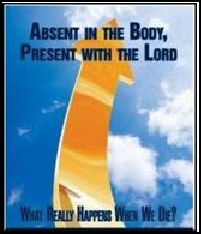
In the first chapter of Philippians Paul expresses his desire to “depart.” Since he’s in prison and faced possible martyrdom, we can assume that referred to dying. He writes, “My desire is to depart and be with Christ, for that is far better. But to remain in the flesh is more necessary on your account.” He knew that he had a purpose in life, and if God desired to keep him here on earth, God’s had more for him to do. Yet, he’d rather go be with the Lord. When a believer dies, he or she will immediately be in the presence of Christ. The soul does not go to sleep until the physical resurrection. There is no such thing as “soul sleep.”

The body sleeps. As a matter of fact the early church coined the term “cemetery” from the Greek word for “Inn.” It describes the place where strangers would stop for a temporary rest before continuing on their way to their ultimate destination. The body is put to rest in a cemetery until the final resurrection when the soul and body will be reunited as a unit once again. Moller rightly adds, “Thus this resurrection does not only imply the soul’s continuation after death. Man in his totality, spirit, soul and body, rises from the dead. Other religions have a teaching of life after death, but not of a resurrection as taught by the Bible. In most cases, the body is seen as a prison from which the soul must be delivered after death. “This is a unique Christian doctrine.

in 2 Corinthians 5:8, Paul also said that he’d much rather be absent from the body and present with the Lord.” I don’t think this is a death wish, or an exclamation of on how Paul was fed up with life and wanted to get out of it. Paul did not struggle with suicidal tendencies. He was absolutely certain that death was not the end of all things. He was convinced that there was life after life. As a matter of fact, I believe Paul was convinced that death brings the believer into a much fuller, richer and more abundant life. It’s a life that’s lived in the very presence of the Lord. If you are a believer, the Bible promises you that the instant you leave this body, you will enter paradise to begin eternity with Jesus. Just as Jesus said to the thief on the cross, so too he speaks to us. “This day you will be with me in Paradise!” At the resurrection your body and soul will be reunited to live forever with the Lord.

Chuck
“O death, where is your victory? O death, where is your sting?” 1 Corinthians 15:55

2 Peter 1:21, 2 Timothy 3:16

How Did We Get The Bible?

I read the preface to Vincent Bugliosi’s book, “The Divinity of Doubt” and found a clear presentation of the presupposition that every agnostic must subscribe to in order to worship at the altar of doubt. He said, “if there is a God, he has chosen to keep those he created in the dark about him. So we are all handicapped, mentally handcuffed, in our desire to understand the mystery of life.” I come from a whole different perspective. God’s existence and greatness is obvious through the things he has created. Further, God’s love for us, those he has created, is clearly communicated to us in His Word, the Bible.

The Bible as we have it today was originally written in Greek, Aramaic and Greek by men who were inspired by God. 2 Timothy 3:16 says, “All scripture was breathed out by God.” The words of the Bible came from God and were written by men. Peter says it this way, “For no prophecy was ever produced by the will of man, but men spoke from God as they were carried along by the Holy Spirit.” The Scriptures contain the words God wrote to us using the individual personalities of the men who wrote them: Moses, David, Isaiah, Jeremiah, Matthew, John, Paul, etc. As the Holy Spirit moved these men along they used their own vocabularies, personalities, writing styles, and experiences in composing the text. The Scriptures are not mechanically dictated, although one might see the 10 Commandments written by the hand of God himself on the stone tablets. So the Scriptures were inspired by God, and then written by men.

God’s Word has been miraculously preserved through hundreds of attempts to destroy it. Norm Geisler writes, “Diocletian attempted to exterminate it (c. A.D. 302/3–305), and yet it is the most widely published book in the world today. Biblical critics once regarded much of it as mythological, but archaeology has established it as historical. Antagonists have attacked its teaching as primitive, but moralists urge that its teaching on love be applied to modern society. Skeptics have cast doubt on its authenticity, and yet more men are convinced of its truth today than ever. Attacks on the Bible continue to arise from science, psychology, and political movements, but the Bible remains undaunted.” The Word of God, the Bible, will be around long after Vincent Bugliosi and all the agnostics and atheists in the world are dead and gone.

Chuck
“The grass withers, the flower fades, but the word of our God stands forever” Isaiah 40:8
(See also1 Peter 1:25).

Sex – 2 Sermons

This is two part sermon series which was part of a larger series called “I’m glad you asked.” For the summer months of 2011, we asked the congregation for questions that they might have on the bible. There were about 70 questions submitted. I answered many in my daily devotions and the ones on sex I answered in this two part series. These sermons were preached at CBC on July 24th and July 31st.


Sermon Videos
Click a link below to watch the video. Click the same link again to close.

1) Sex and the Single Life

2) Sex and the Married Life


Sermon Audios
Click a link below to listen to the audio. Click the same link again to close.

1) Sex and the Single Life (audio)

2) Sex and the Married Life (audio)


Sermon Outlines
Click a link below to view the outline.

1) Sex and the Single Life (outline)

2) Sex and the Married Life (outline)

sewa motor jogja
© Chuck Larsen 2019. Powered by WordPress.