service genset jogja
Romans 12:5

What is the purpose of service?

When we think of “serving” we almost always think of what we do to help others. However, Jesus gave us four powerful illustrations that teach us how important it is for us to be contributing members of the church, not for the sake of others, but for our own wellbeing. Jesus made it clear that we are all dependent on Him, and also on one another, in many different ways. Paul says being connected is God’s plan for us. The letter to the Romans 12:5 says, “Christ made us one body and individuals who are connected to each other.” Paul also says “in Him you also are being built together into a dwelling place for God by the Spirit” (Ephesians 2:22). As parts of a building we all support each other, with Christ being the chief cornerstone. If we’re not vitally connected, carrying our weight in the building, we are left without support ourselves. We need each other. I fill a role and I’m fulfilled as I fill my role!

Jesus teaches us that we’re also a body. Some of us are ears, eyes, toes, hands, feet or any number of other parts or organs of a living body (See 1 Corinthians 12 for this illustration). Paul teaches us that each part is different and has a different function, yet each part is absolutely necessary for the functioning of the whole body. Each individual part is responsible to Christ, the Head, and contributes to the functioning of the whole – that’s service! I need every other part, and every other part needs me! We are all necessary parts if the body of Christ is to function as it should.

The Bible also teaches us that we are vines connected to branch. We are members of a spiritual family. When we fail to serve as we’re created to serve, the body suffers, and we ourselves forfeit the meaning and purpose in life that God has planned for us. If we’re not doing our part as a building we don’t the support ourselves when we need it. If we’re not connected and contributing to the living function of the body we are the ones that pay the price. In a literal body a part that’s not connected to the others usually dies! Vines wither and die if not drawing nourishment from the branch. Family members not loving and living are orphaned or at best prodigals and don’t experience the connectedness God wants for all of His “children.”

Chuck
“We…though many, are one body in Christ, and individually members of each other.” Romans 12:5

1 Corinthians 2:9

Will we work in heaven?

I like to think that there are lots of things we’ll be doing in heaven. We’ll renew old acquaintances. We’ll enjoy great fellowship with family members who have gone on before us. I like to think I’ll be able to finally trace my genealogy all the way back to Japheth, and even to Adam. We’ll get to meet the great heroes of our faith. I have lots of questions for Paul and Moses as I’m sure you do as well. Most importantly, we’ll get to have a personal relationship with our Creator and our Redeemer Himself. There will be worship beyond our imagination in heaven. There will be sights, sounds, smells, sensations, as well as tastes that defy our current imagination. Paul says in 1 Corinthians 2:9 that our senses haven’t experienced these things yet. He writes, “eye has not seen, nor ear has heard, nor has it entered into the mind of man, what God has in store for those who love Him.” But it goes on to say that “spirit has revealed these things to us.” I think that means we know what’s coming, but we’ll have to wait till we get there to experience it all.

If there’s such a thing as time in heaven, I don’t have any idea how much time all of this will require. But, I believe there will be time for work as well. But, work will not be work! I think heaven will be much like God’s perfect creation at the fall. Just as Adam was given complete stewardship and even dominion over all of creation so too will the residents of heaven have meaningful and significant roles to play. Jesus made it clear that those “who have been faithful over a few things, I will make rulers over many things” (Matthew 25:23). I don’t think we can call this “work.” The word contains such negative connotations. It only became dismal and difficult after the fall. Instead of having “work” to do, we’ll have “dominion” to exercise.

Ephesians 2:6 says we have been “seated in heavenly places” with Christ. Just as we are saved now, but yet “will be saved” in the future, I like to think there’s an experiential aspect of the “heavenly places” where we are figuratively now, but will be literally then. Scientists now know that there are more galaxies in the universe than there are people that have ever been born on earth, or who will ever be born! Why did God create all that? What is their purpose, and what is their future? Could it be for our eventual dominion? And we will have all eternity to explore, giving glory to Him in it all, and pleasing Him with our faithful stewardship of the things entrusted to us! (I can dream can’t I?)

Chuck
“What no eye has seen, nor ear heard, nor the heart of man imagined, what God has prepared for those who love him.” (1 Corinthians 2:9)

Galatians 4:15

Should a Christian donate organs?

Should a believer donate organs is a question that needs two answers. First, if the organ donation doesn’t involve death of the donor, I’d expect that answer should be yes. We should be willing to sacrifice for the lives of others. I know this coming verse is a figure of speech and we shouldn’t take it too far, but Paul applauds the Galatians for the depth of their love for him. He refers to it as a “blessing.” He writes in Chapter 4, verse 15, “What then has become of the blessing you felt? For I testify to you that, if possible, you would have gouged out your eyes and given them to me.” James explains the principle of sacrificing for the welfare of others this way: If a brother or sister is poorly clothed and lacking in daily food, and one of you says to them, “Go in peace, be warmed and filled,” without giving them the things needed for the body, what good is that? So also faith by itself, if it does not have works, is dead” (James 2:15-17). These passage aren’t specifically addressing giving parts of one’s body to others, therefore, I’d argue it’s not sin to choose not to, yet it’s a power act of love to choose to do so. After all, Jesus gave His entire Body for our sins. No, greater love has any man, than to give up his life for another.

Should a believer donate his body parts after death is another question. Some argue that since the body is “the temple of the Holy Spirit” we should not do this. I think that adds to Paul’s intended meaning of that passage. Yet it’s clear that “thou shalt not kill.” What actually defines death is not universally agreed upon. A blanket living will might give permission to withhold or withdraw treatment under circumstances in which we would choose treatment for ourselves or our loved ones. I believe we can donate our organs to save the lives of others after we die as long as death has been determined by every criterion “including complete loss of brain function.”

Other believers argue for keeping the body intact in the grave as we look forward to the resurrection. But the scriptures make it clear that “dust thou art, and unto dust shalt thou return.” Jesus was the greatest example of self sacrifice for the welfare of others. He charged us with “loving others as we love ourselves.” He speaks of caring for those who can’t care for themselves and goes on to say “whatever you did for one of the least of these…you have done for me” (Matthew 25:40). Since organ donation is not specifically contradicted in Scripture it should be considered permissible and is a legitimate option for a true believer.

Chuck
“And as you wish that others would do to you, do so to them.” Luke 6:31

1 Corinthians 15:20

When I’m resurrected will I have the same body?

I’m convinced that Christians will have a real physical body in the afterlife. It seems that Jesus did. After His resurrection, He said in Luke 24:39 “See My hands and My feet, that it is I Myself; touch Me and see, for a spirit does not have flesh and bones as you see that I have.” Jesus had flesh and bones, and so will we. We also find that he ate fish as a demonstration of his truly physical body as well. Thus, we too will follow in the same fashion in the resurrection.

Of course there were differences between his earthly body and his resurrected body. He could appear and disappear at will. He ascended into the clouds with a jetpack or without being “beamed up” to a starship. He could move through walls. He could mask his appearance so that he would not be recognized, then he could make himself recognizable also. Paul says that all believers will be changed. He calls Christ “the firstfruits” of those who are asleep in 1 Corinthians 15:20. It reads, “Christ has been raised from the dead, the firstfruits of those who have fallen asleep.” The raisings of Lazarus, Tabitha, and the widow’s son are not true resurrections, but simply revivifications. They were brought back to their old lives and old bodies only to die again. The resurrected body is imperishable and it’s immortal.

Paul sees Jesus’ resurrection as the pattern for those who are to follow. Geisler writes, “The contrasts that Paul makes do not suggest a disembodied state, but a perfected body. He says, ‘We shall all be changed, in a moment, in the twinkling of an eye’ (vv. 51–52). This change is from perishable to imperishable, mortal to immortal, dishonor to glory, weakness to strength. The body is perfected, not by doing away with it, but by removing its imperfections. When Paul says that to be absent from the body is to be present with the Lord (see 2 Cor. 5:6), we can easily see that he means absent from this earthly body. At the resurrection, we will be reunited with it as it is made an immortal body.” Further, there will be continuity between our earthly bodies and our heavenly bodies. Just as Jesus was recognizable, so too will those who follow be recognizable. We will still be ourselves, but the best “ourselves” we could possibly be!

Chuck
“For as by a man came death, by a man has come also the resurrection of the dead. For as in Adam all die, so also in Christ shall all be made alive.” 1 Corinthians 15:21-22

Luke 23:43

Did both thieves hurl insults at Jesus on the cross?

I believe you’ll find that in both Matthew and Mark the two thieves were said to both have been ridiculing Jesus at the beginning. During the six hours of suffering, however, and probably during the last three hour especially, one thief had been watching the Jesus was dying and noticed that indeed something extremely unusual was taking place. The centurion at the foot of the cross made the same observation when he remarked, “surely this is the Son of God.” He understood that the one dying on the middle cross was not dying for any crime he had committed, but was indeed dying for the sins of others. It was at this point that He turned to Christ in faith and said, “Lord, remember me when you enter into your kingdom.” Jesus assured him that in this very day, they would be together in paradise.

I get great comfort in the fact that both thieves indeed did curse God as they hung on the cross together and it very well could have been with his dying breath that he repented and asked for salvation while expressing his faith in the Savior. We sometimes refer to the thieves as the good one and the bad one. They were both bad ones. According to the Roman authorities neither one of them were fit to live on this earth another day. The so-called good thief lived his entire life in sin, just as the so-called bad one did. There was no behavioral difference! But because of his last breath expression of faith in Jesus he became a saved thief. Obviously, he had not deposited any works in the kingdom he was about to enter, but there was a strong word from the Lord that he’d be admitted. In 1 Corinthians 3:15 Paul says, “If anyone’s work is burned up, it will be lost, but he will be saved; yet it will be like an escape through fire.” The thief on the cross escaped through fire!

Many of us have been to funerals for our loved ones who have never expressed personal faith in Christ. They often have lived rebellious, sinful lives and have spurned and even ridiculed our faith in Jesus, just as these two bad thieves did. But there is always hope! No one knows what transpires in the hearts and minds of those who lie dying.

Chuck
“Truly, I say to you, today you will be with me in Paradise.” Luke 23:43

1 John 5:13

Do you believe in Eternal Security?

Briefly, yes. I do believe in Eternal Security. A true believer can be confident that his or her eternal destiny is secure. However, there is a difference between assurance and security (see devotion from July 12th). The true question involves our faith. Do we truly believe? We are often exhorted in Scripture to evaluate ourselves to see if our faith is true and sure. Paul urged the Corinthians: “Examine yourselves to see whether you are in the faith; test yourselves. Do you not realize that Christ Jesus is in you—unless, of course, you fail the test?” (2 Cor. 13:5). Peter teaches, “Be all the more eager to make your calling and election sure. For if you do these things, you will never fall” (2 Peter 1:10). Jude adds, “Keep yourselves in God’s love as you wait for the mercy of our Lord Jesus Christ to bring you to eternal life” (Jude 21).

Our security in Christ is sometimes blurred by our lack of personal assurance. When we quiver in our depravity and begin to doubt, it’s truly important to reflect on where our security comes from. It doesn’t come from our feelings of assurance. It comes from our “faith” in God’s Word and our confidence in His keeping His promises to us. Paul writes to the Romans in 15:4, “Everything that was written in the past was written to teach us, so that through endurance and the encouragement of the Scriptures we might have hope.” John declared, “I write these things to you who believe in the name of the Son of God so that you may know that you have eternal life” (1 John 5:13). There are many assurances in the Bible with affirmations that our salvation, once truly received by faith in Christ, can never be lost and we can be confident of that in this life.

God does not wish that we live life always trying to prove ourselves as worthy. God wants us to live as members of His eternal family, once a true child, always a true child. Once we’re truly His, “no one can pluck us out of his hands.” Some who argue against this, see this as offering license for believers to continue in a life of sin. But to me, this is as absurd as saying that because we have Blue Cross/Blue Shield insurance, we will chew on razor blades or guzzle hydrochloric acid.

Chuck
“I have written these things to you who believe in Jesus Christ, so that you will know for certain that you have everlasting life.” 1 John 5:13

2 Corinthians 5:1

Is cremation alright biblically?

I don’t think it’s going to make a whole lot of difference after death what we do with the human remains. Death is found for the first time in Genesis chapter 3 and God said, “Dust thou art and unto dust thou shalt return.” He was of course addressing the physical bodies only. 2 Corinthians 5:1 tells us that when “the tent that is our earthly home” (our bodies) are destroyed; we have an eternal home made by God. God will not lose anyone! Even those who have been devoured by fire, lions, tiger, bears or sharks. Revelation 20:13 tells us “And the sea will give up the dead who were in it.”

The official position of the Jews today, according to the Encyclopedia of Judaism, is this: Reverent treatment of the body and speedy interment are biblically-ordained precepts. Cremation, freeze-storage of the body, and above-ground burial crypts, are all in violation of Jewish law and practice.” Yet, I might argue that there were several possible cases of cremation in the old Testament. Saul’s body and the bodies of his son’s were taken from the walls at Beth Shan and cremated. According to 2 Chronicles 16:13-14, it appears King Asa might also have been cremated. We read there, “They laid him on a bier that had been filled with various kinds of spices prepared by the perfumer’s art, and they made a very great fire in his honor.” Many argue that this is not reference to cremation but it sounds like it and it puts cremation in a positive light. Embalming is a requirement of the law today, I believe, and every corpse handled by a funeral parlor is necessarily injected with preservatives. I agree with J. Vernon McGee on this. He says, “I think the undertakers like to include it, whether it is required or not. …But if it has to be done, that settles the question.”

I would personally not choose to be cremated because of the figures of speech that are used in the Bible regarding the disposition of the remains of those that have died. One figure is that of “sleep.” According to 1 Thessalonians 4:13f, the body of a believer is put into a sleeping place (the word cemetery comes from this word), to be awaken and raised at the coming of the Lord. The other picture is that of 1 Corinthians where like a seed, the body is planted, and then brought back to life with incorruptible characteristics. Yet, the bible makes it clear that no matter what condition the body is in at the Lord’s return, its resurrection is assured.

Chuck
“So is it with the resurrection of the dead. What is sown is perishable; what is raised is imperishable.” 1 Corinthians 15:42

Revelation 21:4

I’m Glad You Asked: Will we mourn for love ones when we’re in heaven?

Just thinking about leaving behind loved ones can bring dreadful feelings of loss. How could anyone possibly be happy in heaven without a dear child, parent, or spouse? Loved ones can come to mean so much to us that we can’t imagine any kind of happiness without them. Heaven must have some sense of loss if we have to leave loved ones behind and even more profound loss thinking that loved ones will never join us in heaven. Some argue that even Jesus mourned for the lost children of Jerusalem in Luke 19:14 when he looked out over the vast city knowing that they would not be with Him in heaven.

First, Jesus’ mourning for them was part of the expression of God’s great love and mercy to them through which Jesus was to carry out the act of redemption for all mankind on the cross. We don’t see a resurrected Jesus weeping for those who have rejected God’s love. In this life, we should mourn for those our loved ones who are not lost and deeply desire their salvation and as Jesus acted to save those he wept for, we too might be moved by our compassion to share the way to eternal life with our loved ones. Second, the assumption behind the question is that we are more loving and merciful than God. Yet we know that He is infinitely more loving and merciful than we are! John 15:13 tells us clearly and we recognize the truth of it; “there is no greater love, than to lay down one’s life for a friend.” Yet, God & Jesus are happy in heaven even though they know not everyone will be there.

Hell does not have the power to veto heavenly bliss for believers. I don’t believe that the fact that some reject the way of salvation will in any way diminish the joy the saved will experience. The wicked will have no power to hold hostage the joys of the redeemed. A totally loving and merciful God made provision, yet they rejected it. He is a perfectly just God. Geisler observes “We would not be happy in heaven if we knew that others had been unjustly kept out. However, we can be happy in heaven the same way we can be happy eating while knowing that others are starving—namely, if we have offered them food but they have refused to eat it.” Further, I think we will change the way we think in Heaven. We will see things from a totally different perspective. The way we see things today will be no more!

Chuck
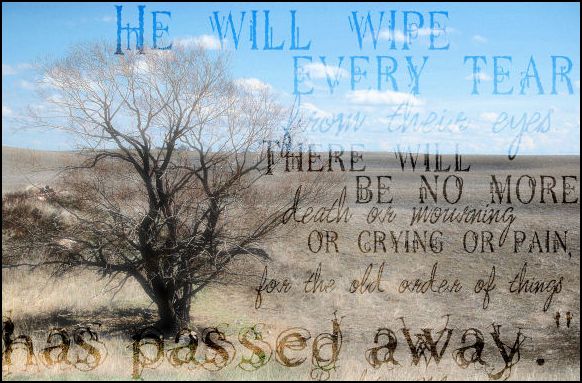
“He will wipe away every tear from their eyes, and death shall be no more, neither shall there be mourning, nor crying, nor pain anymore, for the former things have passed away.” Revelation 21:4

sewa motor jogja
© Chuck Larsen 2019. Powered by WordPress.