
service genset jogja
James 3:18

A Harvest of Righteousness

22 harvestWisdom from above is impartial or steady and consistent according to James 3:18. Kent Hughes recounts a conversation he once heard between Groucho Marx and William Buckley. Groucho excused a contradiction by quoting Thoreau, “consistency is the hobgoblin of little minds.” Hughes says, “At which Buckley rolled his eyes and faced the camera with a winning grin as he corrected Groucho with the exact quotation: ‘A foolish consistency is the hobgoblin of little minds.’” Heavenly wisdom is that which is consistent through all the trials of life. The next word that James uses to describe heavenly wisdom is “sincerity.” Many commentators agree that if you combined the idea of these two words together, you will get the idea of undying loyalty. This is consistent with the first chapter of James where he argues that those of “divided interests” or the “double minded” will reap no rewards.

The Promised Land was offered to the former slaves from Egypt. All they had to do was follow God through the direction of Moses. Yet the first generation from Egypt never quite understood what God was asking of them and ended up pining for the “kept” comforts and foods of Egypt. When things got difficult for them they would throw in the towel and give up the good fight. That’s why God tells them in Numbers 32:11, “Surely none of the men who came up out of Egypt, from twenty years old and upward, shall see the land that I swore to give to Abraham, to Isaac, and to Jacob, because they have not wholly followed me…”

There are times when my emotions flutter all over the place. One day I’m on the top of the world and the next day I’m down in the dumps. It stinks when you’re in the dumps and everyone around you smells it! My truth is that the biggest enemy is not out there somewhere, it is right here, it’s me! We often understand the word “temperance” to do with alcohol and other lifestyles, but the Greek word (kratain) literally means to grab hold of or to grasp.” When someone loses it we often hear someone say, “get hold of yourself!” We get this idiom from this word. David Jeremiah says that, “The word is used only seven times in the New Testament. In almost every situation, it is used to describe the importance of gaining control and reigning over our passions and desires.” Inconsistency and half-heartedness reaps no reward, but, as James concludes this section in James 3:18, “And a harvest of righteousness is sown in peace by those who make peace.”
James 3:17-18, Proverbs 25:11

Beautiful Word!

In the third Chapter of James he uses three illustrations to explain the power of the tongue. It’s like a bit in the horse’s mouth, able to control the entire animal. It’s like a rudder on the stern 19 healing wordof the ship capable of changing the direction of the entire vessel. The third illustration pictures the destructive nature of the tongue comparising it to a small spark or flame capable of burning down an entire forest. One cannot help but notice that the bit and the rudder speak to us of the positive potential use of one of the smallest parts of our bodies, the tongue. The first speaks to us of the potential danger, yet we shouldn’t miss the idea that fire, in the fireplace, is also a power for good. When it comes to the use of our tongues it can be used for good or for evil. Proverbs 15:4 says, “Kind words bring life, but cruel words crush your spirit.”

What a great opportunity we have to do so much good with such a small thing as our words. As a Grand Parent, I often think my parenting days are over. But the truth is, they never end. At long last, I’m learning some of the more important lessons regarding raising healthy and happy families. Addressing grandparents and great grandparents, Dennis Rainey, the founder of the Family Life Seminars, says, “With kind acts and encouraging words, older people can influence the course of their family’s future. The opposite is true as well: A bitter, cynical old person can sow a legacy of low self-esteem, despair, and pessimism.”

Solomon, the man recognized by many as the wisest man in the world, said in Proverbs 25:11, “A word fitly spoken is like apples of gold in a setting of silver.” Think about that! Just as an artist labors over his craft so too does a wise person delicately chose his words. Apples of gold possibly refer to a love gift; broach, bracelet, necklace or pendant, finely fashioned of the two most precious medals known to man. David Jeremiah writes, “It is a blessing beyond description to see the spirits of a person rise, the life restored to their eyes, as a result of a healing word from your own lips. Such words are as sweet and healthful as honey (16:24), and as beautiful as apples of gold in a setting of silver (25:11). The next time you marvel at a beautiful and costly display of precious jewels and artwork, remember that is how God sees a powerful word spoken at just the right time.”

James 3:17-18, Psalm 141:3

Posting a Sentry

Continuing with the description of heavenly wisdom, James 3:17-18 teaches us that it is “first of all pure. It is also peace loving, gentle at all times…” That last phrase makes it perfectly clear to me how much I lack wisdom. I can 18 the sentrybe gentle, but I’m surely not gentle “at all times.” Is it even possible? Looking at different translations for this phrase we find the New International Version says we are to be “considerate.” The Living Bible says we are to be “courteous.” The Jerusalem Bible says it’s “kindly.” Archbishop Trench, one of the great linguists, said that there was no word in English or Latin to adequately translate this word. But one aspect of all these words or phrases that stand out to me is that this aspect of heavenly wisdom deals the way we speak to one another. Many of the problems in families are the direct result of using the wrong words and using them in a harsh manner.

Earlier in the same chapter, James uses three illustrations to talk about the power of our speech. He says our tongue is a small thing but the use of it brings about serious results. The first two illustrations that James uses deals with the power of the tongue to accomplish good. It’s like the bit in a horse’s mouth. Just a little thing, appropriately placed in the horse’s mouth could be used to harness the power of the entire animal. Next, he introduces the idea of a ship’s rudder. Just a little pressure on this smallest of instruments attached to the stern of the ship can change the direction of the entire ship. The third illustration, however, is one that points out the deadly potential of the tongue. The smallest spark or flame can start a fire that destroys an entire forest. Proverbs 16:27 says, “A worthless man plots evil, and his speech is like a scorching fire.”

Fred Smith says, “In Scripture the tongue is referred to as fire, one of the greatest discoveries of mankind. By it we do many things. Yet unmanaged it becomes one of the most destructive. The management of the tongue starts with the management of the heart, for out of the heart the tongue speaks. For the tongue to have freedom, the soul must have purity. It must be purged of pride, greed, hostility, or the poison of the heart will come out of the mouth.” Psalm 141, verse 3, gives us an appropriate prayer with regard to this kind of wisdom. The Psalmist prays, “Set a guard, O LORD, over my mouth; keep watch over the door of my lips!”

James 3:17-18

Sowing Seeds of Peace

Not only is the wisdom that comes from above, heavenly wisdom, pure, but it is also peace loving. Living in a family that’s free from strife is a huge blessing. No family is perfect, of course, but we all know the calm that comes 17 peace seedsafter a storm and how much we prefer peace to strife. In Genesis 13:8, a wise old man named Abraham recognized the strife that existed with his nephew Lot. The older gentleman, the one who had the resources through whom his nephew was blessed was the one who initiated the action to establish peace between the household members. He said, “So Abram said to Lot, Let there be no strife, I beg of you, between you and me, or between your herdsmen and my herdsmen, for we are family.”

First of all notice that Abraham didn’t ignore the issue. There was a problem and he recognized it and brought it up to be dealt with openly and honestly. In the book of Ezekiel God condemns those who won’t face the truth when strife is at hand: Woe to those who proclaim ‘peace’ when there is no ‘peace.’ Jeremiah makes a similar cry against those refusing to face the situation honestly. Jeremiah 6:14 says, “They dress the wounds of my people as if they’re not serious and say peace, peace, when there is no peace.” Just putting a band aid on a serious wound will only make it worse in the long run. We have the tendency to act like everything is OK, when it isn’t. We often avoid the reality of a situation in the home, at school, at work, in the church with others simply to maintain peace. But as one writer remarks concerning this tendency, “Their avoidance heals the wound only slightly and prepares the way for greater trouble.” Loving peace means we’re willing to pay the price that is necessary to establish and maintain true peace in our relationships in our families and everywhere else in life as well.

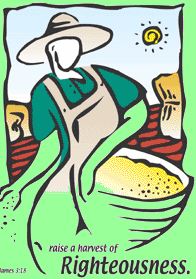
In James 3:17, wisdom is also said to be a “willingness to yield to others.” Balancing the confrontation issues with a yielded spirit is one of the more difficult things to manage in all of our relationships. Abraham set the perfect example. He courageously brought up the issue that needed to be dealt with and he then magnanimously offered a gentle, humble solution to the problem. He offered his nephew Lot first choice of all the land. This is a remarkable thing seeing that God had appeared to Abraham and told him that He had given this land to Abraham. But Abraham wouldn’t lay claim to something if it would upset the peace with his family. James concludes is passage by saying, “those who are peacemakers will plant seeds of peace and reap a harvest of righteousness.”

James 3:17, 4:8

Cleanse Your Hands!

The wisdom to live in healthy and wholesome families comes from God. It’s not an accumulation of a vast collection of facts and figures nor is it the piling on of experiences, one after another. Whereas knowledge and experience 16 come clean2help serve us in life, wisdom from above is only acquired from above. The beginning of wisdom, the Bible teaches, is “fear of the Lord.” It begins with a humble recognition of the supremacy of God and the sub ordnance of man. James in 3:17, describes this heavenly wisdom. He says, “…the wisdom that comes from above is first of all pure, then peaceable, gentle, open to reason, full of mercy and good fruits, impartial and sincere.”

The wisdom upon which we can build healthy family relationships as well as healthy relationships with others begins with purity. When we think of this concept we mostly think of our sexual conduct. It’s interesting that wisdom is “first of all” pure. It begins with it. Purity opens the channel to God’s wisdom. We cannot be what God wants us to be if we’re not willing to put away sexual sin. Sexual sin will always keep us from God and God from us. In Chapter 4, James urges his readers to “draw near to God, and he will draw near to you.” Yet he adds immediately the procedure that’s necessary for an honest open communion with God. He says, “cleanse your hands…” Hand washing was a coming clean, confession and repentance, for sins already committed. If we’re going to open a channel to God through which His wisdom can flow into our lives and families, we must come clean of sexual impurity.

Yet it’s not enough to stop a sinful conduct. It’s also a matter of the heart and mind. James goes on in Chapter 4 and adds to his exhortation. He says, “Cleanse your hands, you sinners, and purify your hearts, you double minded.” The prominence of pornography in today’s world corrupts our hearts and minds and bars our contact with God. No one can draw near to God with unclean hands or an unclean mind. The wisdom we need to live healthy and happy lives evades us at every turn. It only comes from above and one cannot connect with God with impure lives and impure minds. We are all so tempted to divorce our private thought lives from our religious lives and hope that never the twain shall meet. But God allows no such bifurcation of our lives.

James 3:13-18

Wisdom and the Family

Wisdom is the “motor oil” of every family dynamic. Without it, your family will freeze up, lock up, or blow up. When we think of “wisdom” we often think of knowledge. Einstein was a very “wise” man. We think of experience. The 15 humility & wisdomone who has been around a long time and has been through it all has become wise. Time in and of itself, however, does not bring wisdom. There is a vast difference between age and wisdom. The late Howard Hendricks told his class about an acquaintance that had one year of experience 25 times. He said, “There’s a difference between having 25 years of experience and having one year of experience 25 times.” It’s not doing the same things over again that produces wisdom. Also, knowledge is not wisdom. You can learn billions of facts and figures and even understand advanced mathematical formulas, but that does not constitute wisdom. Wisdom is more than experience and it’s more than knowledge. In fact “knowledge” can be totally contradictory to God’s description of wisdom. It simply makes us proud and arrogant (See 1 Corinthians 8:1).

The first chapter of Proverbs teaches us that “The fear of the Lord is the beginning of wisdom” (Proverbs 1:7). It’s mostly concerned with our relationship to God and to others that is the central focus of Biblical Wisdom. It’s not until we recognize our place in the master scheme of things and surrender ourselves to God’s will that we begin to grow wise. The wise person is praised in the Bible, especially in the book of Proverbs. He or she is honored by God. It’s not the arrogant winner, the self-sufficient millionaire, or the prideful successful celebrity that receives the title of “wise.” No it’s those who surrender to the greatness of God and worship Him. Wisdom and Humility go hand in hand. The wisest man ever to live, Solomon, connects the two in Proverbs 15:33. He writes, “The reverent and worshipful fear of the Lord brings instruction in Wisdom, and humility comes before honor.”

Unlike the secular system we live in, to God one cannot grow wise until he or she grows humble. James, the author of the Epistle, writes (James 3:13) “If you are wise and understand God’s ways, prove it by living an honorable life, doing good works with the humility that comes from wisdom.” Wisdom begins with the fear of the Lord. It then proceeds to produce humility, and finally results in thoughts and actions in our relationships with those around us. When James defines wisdom in some following verses (James 3:17-18), we see that wisdom finds its description in a person’s relationship with God and with others. He says, “But the wisdom from above is first pure, then peaceable, gentle, open to reason, full of mercy and good fruits, impartial and sincere.”

Colossians 2:12-15

Baptism & Shame!

We live in a culture that produces a population of people who care way too much what others think of us. Praise and acceptance might be the highest two deities in our world today. No one is exempt from this pressure. We all design our lives and 12 shamemake choices that help us avoid shame at all costs. I don’t think this is anything new. The societal pressure of our culture or any culture, past, present, or future, molds us to fit comfortably into the world around us. We like to fit it. We like to be accepted. This is one of the reasons that many disciples left Jesus in the course of His earthly ministry as well as the thousands of years that have followed. Just as Peter said, “I don’t know him” around a campfire, we too feel that pressure to disassociate ourselves from Christ in the company of those who disapprove.

The New Testament’s main objective in our lives is to conform it to Christ’s likeness. It involves identification with Him and His sufferings. The author of the book of Hebrews exhorts us to stick to our path. He writes, “And let us run with endurance the race God has set before us. We do this by keeping our eyes on Jesus, the champion who initiates and perfects our faith. Because of the joy awaiting him, he endured the cross, disregarding its shame” (Hebrews 12:1-2). Further, he exhorts us to “pick up our cross and follow Him” several times in the Gospels. Lepers, those shamed by their disease, were forced to live outside the camp in the Old Testament. It was in this realm that Christ was executed. The book of Hebrews goes on in 13:13 to say, “So let us go to him outside the camp. Let us be willing to suffer the shame he suffered.”

I believe that the first step in following Jesus is a public identification with Him in water Baptism by immersion. Immersion is important because it illustrates the going down as in death as Jesus did. Paul makes this connection in Colossians 2:12-14. He writes, “…having been buried with him in baptism…” Baptism is our identification with Christ’s shameful death on the cross. But the resurrection, pictures so perfectly in immersion, speaks powerfully of new life. Paul goes on, “Baptism…in which you were also raised with him through faith in the powerful working of God, who raised him from the dead. And you, who were dead in your trespasses … God made alive together with him, having forgiven us all our trespasses…” As a result of Jesus’ death, burial and resurrection, the shame of our identification in His death is turned into the glory of our identification with His resurrection. The tables are thus turned. Those who cause shame for identification with Christ in this world are the ones to be shamed in the end. Paul goes on in verse 15 and says, “He disarmed the rulers and authorities and put them to open shame, by triumphing over them.”

Luke 12:50

Baptism: Metaphor of Submission

When we allow the Bible to use language in all its normal ways, many, if not all, the difficulties in translation are resolved. It’s the insistence on a “literal” hermeneutic that causes such problems and has brought about so many 11 lay it downdifferent translations. Many groups insist on taking everything in as literal sense as possible. This of course leads to God having the body of a man. Albeit a huge man! The mystery of the incarnation gives us God in the flesh in His Son, Jesus Christ, but God’s essential existence is incorporeal. If we must take everything literally we lose the power of Christ’s words. The “Armor of God” consisting of shield, helmet, boots, breast plate and sword actually become that accoutrements of a crusading army destroying everything in its past at the cost of dealing specifically with the spiritual nature of our warfare. Whereas the Bible is not a metaphor, as many liberal scholars will argue, but it definitely contains metaphor. Metaphor is essential for a human understanding of divine truths. Jesus spoke extended metaphors in the form of parables frequently. His purpose was to open the minds of his listeners to his truth or to hide the truth from the religious literalists of the day.

Literal interpretations of some passages destroy the intended meaning. How do you “gird up the loins of your mind?” (1 Peter 1:13). How can their literally be “an anchor for the soul?” (Hebrews 6:19). Jesus’ and the rest of the bible’s masterful use of this figure of speech make the hearer, as I. Howard Marshal says, “think for himself, often by means of some deliberate ambiguity. It gives us something as a model for something else without making explicit in exactly what way it is supposed to be a model. We could say of metaphor …Its mission is to break through the wall of conventional values that encloses us, to startle us into seeing the world through fresh eyes.” On the other side of Marshall’s observation is the reality that Jesus often spoke in parables in order to conceal truth from unbelieving ears.

Getting back to baptism as a metaphor, consider Jesus words in Luke 12:50. He said, “I have a baptism to be baptized with, and how great is my distress until it is accomplished!” It’s not hard to understand that this is an “immersion” into the sufferings of the crucifixion that Christ has in mind. In Mark 10:38, Jesus says to his disciples, “You cannot drink the cup I am drinking, can you, or be baptized with the baptism into which I am being baptized?” The cup represented Jesus’ appointed destiny. His drinking the cup represents His perfect submission to God’s will for His life. Our baptism, conveying the idea of our identification with Christ, represents our submission to God’s will for our lives. James and John exclaimed “we can!” Jesus acknowledged their claims and fore told that James would be the first of the twelve to be martyred and John would suffer extensive exile.

sewa motor jogja
© Chuck Larsen 2019. Powered by WordPress.