service genset jogja
Philippians 3:1

Finally, Rejoice in the Lord

Paul begins a new section at the beginning of Chapter 3. We know that because his hinge phrase throughout the book always begins with rejoice! So in Philippians 3:1 he says, “Finally, my brothers, rejoice in the Lord.” 23 rejoiceThe phrase beginning with “Finally” has been used as an occasion for humor, most at the expense of us preachers. One little boy whispered to his father during the sermon, “What does the past mean when he says ‘finally’ dad?” His father answers, “Absolutely nothing, son.” Paul uses the word to introduce a hinge idea regarding rejoicing again in the middle of his letter. In other words he still has some more to say. He goes on for two more chapters. But the word really doesn’t mean the same thing we mean when we say “finally.” It’s actually a transitional marker identifying the movement to a new subject.
The interesting thing here is that if his readers were looking for something entirely different they would be disappointed. He’s still talking about the joy we experience in living the Christian life together. He’s building up this theme of joy over and over in this epistle. He will come to a great crescendo in Chapter 4 when he says, “rejoice in the Lord always, again I say, rejoice!” He has been talking about joy in various ways in the first two chapters, but this is the first time he connects it with the little phrase, “in the Lord.” As we all know we can’t always rejoice in our circumstances because they are not always what we’d choose for ourselves. We all face trials and struggles in life and during those times it seems almost ridiculous to be told to “rejoice.”

We can always “rejoice in the Lord.” We know that He conquered sin and death and in the end we will all be victorious over the sicknesses, sorrows, and diseases of the world. So, like Job, we know that God is good all the time and that even in hard times we can still rejoice. The better we know our “Good God” the easier it is to “rejoice in the Lord.” He enables us to live above our circumstances not under them. When we come to grips with the love and goodness of our God even in the times of trials it helps make everything else so insignificant. Over the years of my Christian life I’ve let myself become a victim of my circumstances and have sacrificed my joy to the demands and pressures of the world. Yet when I come to my senses, I realize the greatness and goodness of our God and can put the “light and momentary” afflictions of this life into the divine perspective which helps maintain my joy in the Lord.

Philippians 3:1, Nehemiah 8:10

Joy and Safety

It’s interesting to see how many times the idea of “joy” and or “rejoicing” appears in this short little letter. Nearly 20 times! To repeat something over and over like that might seem a little tedious to us. I’m sure that Paul 24 joy of the lordnot only wrote about the theme of joy but had preached about it often in Philippi as well as at every stop in his missionary travels. Grant Richison observes, “To go back and forth over the same truth again and again is to plot and slog slowly through detail. Most people consider this drab, dull and monotonous.” Yet to the Apostle Paul it was not dull, tedious and boring repetition. It was instead something he called “safe.” He says in Philippians 3:1, “Finally, my brothers, rejoice in the Lord. To write the same things to you is no trouble to me and is safe for you.” He never grows weary of telling us to focus on the Lord. He is our source of Joy and as long as we keep our eyes on Him we are safe!

It’s common to hear an older experienced man say something like this to a young upstart: “I’ve already forgotten more than you’ll ever know!” Although an exaggeration to be sure, there is some truth in the fact that forgetting begins the minute we hear something. It helps therefore to make a deliberate effort to repeat and review immediately. Repetition will help fix the fact or image in our minds. It seems that this is what Paul is interested in. He wanted his readers to hear about the joy we have in the Lord over and over again so that we won’t forget it. He wants to drive home the truth about the joy of the Christian life. A veteran pastor said, “When I first began to preach I was so afraid to repeat myself. Now I am afraid I won’t!” How much of a message do people understand? How much do they retain?

The Joy of the Lord is truly a safeguard for our lives. It develops in us the strength to stand against the onslaught of the enemy day after day. There is a frequently quoted passage from Nehemiah that rings true in this context. You might know it. Nehemiah 8:10 says, “The Joy of the Lord is your Strength.” We often sing about the joy of the Lord. There is safety to be found for you and me in the joy of the Lord. It’s like divine armor or a protective wall around us from the bitterness that surrounds us as we walk together through the valley of the shadow of death. If we can learn to live in the joy of the Lord we’ll have a natural resistance to attacks that often take others down. The true taste of the joy of the Lord makes the tempters offerings bland by comparison. Paul repeats himself frequently. He continually urges us to rejoice in the Lord. Rejoicing will serve as a safeguard through all of life.

Philippians 3:2-3

JOY – The Currency of Faith!

I know it’s Halloween but even the stores are gearing up for Christmas. My passage today makes me think of Christmas Carols, especially “Joy to the World.” The joy of the Lord is our strength! As long as we remain firmly seated in God’s love for us we remain firmly planted in the Joy of the Lord. It keeps us safe from temptations and assaults from the enemy in so many 25 joydifferent ways. It’s a shield to us and it protects us and we find safety under its wings. This is why Paul repeats the idea of joy so often in this short epistle. To the casual reader it might become redundant and a little tedious to hear the idea repeated so often, but Paul said in Philippians 3:1 that he has chosen to camp on the idea of the joy of the Lord and to repeat himself because his constant reminders, if heeded, will keep us safe. There are many, many dangers to our joy in the Lord in this world and in Philippians 3:2 he lists three of them. He writes, “Look out for the dogs, look out for the evildoers, look out for those who mutilate the flesh.”

The Jews often referred to Gentiles as dogs because like the wild dogs of the day they fed on unclean road kill and carrion and filth which pictured the unclean in Jewish society. But Paul uses their very term for Gentiles to refer to them. It’s not the Gentiles who were the Goyim (dogs) it was the Judaizers who stood outside the covenant blessings that were promised to Abraham by faith. The Jews considered themselves “righteous” and workers of “the law.” But Paul reverses their charge by pointing out that the Judaizers were actually “evil workers” who distracted others from true righteousness by grace through faith to a works based system which they failed to observe themselves. When Elijah confronted the prophets of Baal in 1 Kings 18, he described the self-mutilation that they practiced to call down the favor of their gods. It’s this very term that Paul uses to describe the circumcision that the Judaizers believed separated them from the Gentiles. It was their greatest source of pride. But Paul reverses all their attacks on the unclean Gentiles and points them directly at the Judaizers. It’s Paul’s warnings not only to the Judaizers of his day but to us if we should venture to add legalistic requirements to the Gospel of God’s marvelous Grace.”

Watch out for the newly legalisms of our day; don’t do this! Don’t do that! There are so many it makes our heads swim and robs us of our joy. Trying to conform to the specific choices of others around us we find ourselves losing the joy of the Lord. But there is safety in the Joy of the Lord! Hughes says, “to be so full of joy that no other offers appeal to us, to have tasted what is good so deeply that we have no taste for the allurements of the tempter, for the joy of the Lord is our strength.” Truly Joy is the currency of those “who worship by the Spirit of God and glory in Christ Jesus and put no confidence in the flesh” (Philippians 3:2).

Philippians 2:23-24

Hope for a bright Future

Paul looked forward to sending Timothy to Philippi in order to hear good news about how the Philippians believers were progressing in their faith. But Paul’s love for them led him to look forward to another visit there 14 bright hopehimself. Philippians 2:23-24 says this, “I hope therefore to send him (Timothy) just as soon as I see how it will go with me, and I trust in the Lord that shortly I myself will come also.” Paul is waiting for the outcome of his sentencing before sending Timothy so that he could carry that news to them. Paul trusted that regardless of what God allowed to fall upon him, he would be able to respond positively either way. He doesn’t boast about a particular outcome but he certainly “hopes” for one! He would love for Timothy to carry the good news that Paul’s situation had improved in Rome.

He not only hoped for a positive outcome he expected one! Trusting the Lord for good news was one of Paul’s most frequently expressed attitudes. He had already expressed this attitude earlier in chapter 1 when he said he was confident that he would be delivered through their prayers for him. Now he’s saying that when that happens, and he’s expecting it to, he’s going to make another trip to Philippi to be blessed by their presence and to bless them in return. In verse 19 of Chapter 2, Paul expressed his confidence in the Philippians. He was expecting a very positive report on their growth and development in Christ-likeness. He was expecting the best for them. It was a result of Paul’s love for them. I love the way the Living Bible gives us 1 Corinthians 13:7. It reads, “If you love someone, you will be loyal to him no matter what the cost. You will always believe in him, always expect the best of him, and always stand your ground in defending him.”

Now he’s expecting the best for himself also. The ancient Pulpit Commentary by H. D. M. Spence-Jones, says that hope “…concerning one’s own future—is generally supposed to be a matter of temperament. There are persons of a sanguine temperament, who always expect the best possible, and sometimes are confident in hope, though on the slightest ground. And others are given rather to foreboding, and their forecasts are of evil. Now, Christianity does not destroy temperament; but it gives a just bent to the outlook of the hopeful, and instills into the despondent a different spirit. Based, as the Christian life is, upon faith, it must proceed to hope. The God who has loved us with an everlasting love will ‘never leave and never forsake us.’ The Savior who has ‘loved his own’ will ‘love them unto the end.’ The Word in which we trust is a Word which liveth and abideth forever.’”

Philippians 2:22, Romans 5:2-5

Proven Character

Sports are an important activity when growing up. Communities spend large amounts of money to provide various sporting experiences for the kids. I’ve been known to criticize the focus on sports in Nebraska, but when 11 romans 5I sit back and reflect on my experiences with it and watching my kids and now my grandkids I’m once again reminded of its value. Sports present us with crucial opportunities in life to develop character. Players with character have stability and can be depended on. They will hang in there even when they are losing. They will try their best even when a come-back is impossible. Paul is talking about the Character of Timothy in Philippians 2:22. He describes him, “But you know Timothy’s proven worth, how as a son with a father he has served with me in the gospel.” Timothy was a teammate who proved himself. Paul could count on him.

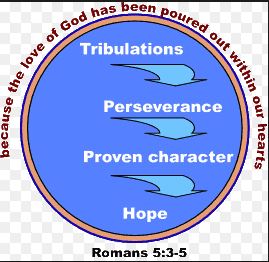
His “Character” had been proven. That means it’s been tried, tested, and passed with flying colors. He has been through the wars with Paul and has come out stronger. His integrity has been firmly established and proven true. Proven character only comes through tribulations, trials and suffering. Paul has already assured the Philippians that he was rejoicing amidst his trials and encouraged them to do so also. We know, with Paul, the ultimate outcome of our lives so we can persist through any trial or hardship. Through pain and suffering comes “proven worth.” Paul explains this in Romans 5:2-5. He writes, “We exult in hope of the glory of God. And not only this, but we also exult in our tribulations, knowing that tribulation brings about perseverance; and perseverance, proven character; and proven character, hope; and hope does not disappoint, because the love of God has been poured out within our hearts through the Holy Spirit who was given to us” (Rom. 5:2–5).

When we speak of Jesus being the Son of God we mean many different things; His deity, His eternity, His very nature and other divine characteristics. But also He was just like His Father. This is so true that He once told an Apostle who wanted to see the Father that if “you have seen me (Jesus), you have seen the Father.” Paul called Timothy his son. Just as God’s Son was given authority on earth, so too was Timothy given authority that Paul had as an Apostle. An important aspect of this sonship is that just as Paul learned character through hardship, he knew that Timothy had learned that lesson alongside of him. Just like Paul, Timothy put himself on the line with all its risks and dangers and through it all cultivated character through trusting God in hard times and suffering. Grant Richison writes, “Character does not come by floating along in life with the flotsam and jetsam.” Character comes as we learn to trust God through hardships. Character is also developed when we trust God enough to step outside of our comfort zone and do something to stretch our boundaries. We love grooves! They are secure. But stepping outside of our little niches in life we can stretch our faith and build character.

Philippians 2:16

Grumble or Twinkle?

We can grumble, grumble (see previous devotions) or twinkle, twinkle, but we can’t do both! Twinkling as bright stars in a dark night sky is to hold “fast to the word of Life” as Paul puts it in 02 babysPhilippians 2:16. The mention in the previous verse of being bright shining stars in a dark sky comes from the Old Testament book of Daniel 12:3. It describes the coming age of the Kingdom of God, ruled by God’s anointed. It will be the abode of all who will “shine like the brightness in the sky above” and who “will turn many to righteousness, like the stars forever and ever.” Hughes comments, “Thus Christians who live in humble harmony as they should, considering others more important than themselves, shine resurrection light in a dark world, especially as they are ‘holding fast to the word of life,’ the gospel of Christ.”

Bright stars, holding fast the good news about Jesus, shine for all to see. There are some who think that they can shine forth a good news gospel to believers but shun the unbelieving community and choose not only not to be of the world but also not to even be in the world. On the other hand there are those who want to shine bright among those in the unbelieving world but relate to their brothers and sisters in Christ with indifference or even negative and critical grumbling spirits. But stars in the night, like the sunshine and the rains from heaven, shine on the just and the unjust. God shines his love on the righteous and the unrighteous. The light of the good news of Jesus should shine forth from every believer to everyone. If it shines at all, it shines on all!

I know those who have convinced themselves that a critical, negative spirit is a virtue. Putting themselves in the place of God’s divine bull dogs charged with protecting the sacredness of the assembly, they frown at and hold disdain for the joy expressed by others. They think that their negativity will be good for the church and make others tow their own particular line of righteousness. It’s a form of spiritual manipulation and psychological blackmail. And it’s a sin. Paul says, (as Hughes quotes in his commentary), “…such conduct impedes the working out of salvation in the church. In fact, it can ruin one’s own soul or the soul of another in the church. It can make the church the cultural joke of ‘a crooked and twisted generation.’” This is why Paul admonished the Philippians and he admonishes us to “work out our salvation” with “fear and trembling.” We can either be the grumbling kill joys like the religious leaders in Christ’s day, or we can be the twinkling stars of joy shining with the good news of Jesus Christ!

Philippians 2:17

The Drink Offering

Paul expressed confidence that God would deliver him from his present imprisonment through the prayers of the Philippian believers. He wanted his freedom!  04 drinkYet, he continued to assert the fact that the matter was not in his hands and that whether he lived or died, the result would be the same! Christ would be glorified! Now in Philippians 2:17 he returns to that motif. First he encouraged his readers to live lives that are worthy of their calling and to have the same mind that Christ had. This would fill his life with true joy. His own situation wasn’t as important as the situation and circumstances of the fellowship of the believers at Philippi. Then he says, “Even if I am to be poured out as a drink offering upon the sacrificial offering of your faith, I am glad and rejoice with you all.”

Paul’s future is in question. He doesn’t know for sure what will befall him in the days ahead but it didn’t matter. He was glad and rejoicing with the Philippians as they grew in Christ likeness and learned how to pursue the mission of the Gospel in one mind with one purpose, striving together, and seeing the good news of Jesus spread. Paul uses the sacrificial image that all Jewish believers as well as pagan idol worshipers would be familiar with. It’s the image of the “drink offering.” Hughes explains that “A priest would offer a sacrifice and then later pour out a sacrificial libation to complement it.” It seems that Paul is referring to the believers as priests in their own right and their sacrificial offering is “faith.” Then Paul adds his libation, or drink offering, to their offering of faith. The commentators aren’t sure exactly what that offering is that Paul is referring to but it may very well be his own death.

Paul exhorts us to think like Christ. In earlier verses he explained how we should be thinking like Christ who had divine glory but set it aside for the well being of others. We must learn to think like Christ in our relationships with each other. But Paul doesn’t merely speak to us with words only; he also gives us a living example. This was Christ’s teaching method as well. He showed them how to be servants by washing their feet and how to relate to children and many other examples throughout his life and ministry. It is clear that Paul sees his offering as a libation to the more significant offering of the Philippians. Their offering is the significant thing; his is the period at the end of the sentence. He saw himself as simply a complement to their sacrifice. They were not a complement to his sacrifice. Even in his metaphors Paul teaches us to “consider others more important than ourselves.”

Philippians 2:18

A Second Libation!

Paul explains how he will be “glad and rejoice” over the Philippians even if the price of their faith had to be paid for with his own life. It was well worth it! It would be nothing more than a libation, or a drink offering, that 05 libationwas poured out over the main burnt offering. According to Exodus the drink offering was wine. Not the sour vinegar wine that Jesus was offered on the cross, but a robust healthy wine. If you did a study of the Old Testament you’d see how this high quality wine was the symbol of joy. I like the thought of the symbolic joy of the drink offering and Paul’s claim that he was glad to offer himself for the cause of Christ to the Philippians to produce their faith and growth in Christ-likeness.

Up to now most of the references to Joy have been about how Paul, in spite of all his struggles, was still able to maintain his own joy. It’s mostly about Paul’s own joy. But then after expressing his own great joy again in verse 17, Paul goes on in Philippians 2:18 to address their joy. He writes, “Likewise you also should be glad and rejoice with me.” Paul literally and liberally invites them to join his double-dose of joy with a double-dip of their own. If it was a song the “joy note” would show up like the chorus. We see it four times in the space of just these two verses (Philippians 2:17-18).

This is an imperative. We see these constructions as commands. So Hughes says, “Also, this first imperative was totally meshed with Paul’s joy and was a command to rejoice in the midst of suffering. What we have here is a partaking of the fellowship of the gospel at its deepest level (cf. 1:5, 7)—a fellowship rooted in the three-way bond of Paul, Christ, and the Philippians.” Suffering is a part of every life. Christ experienced what must have been the most profound physical, emotional and spiritual suffering of anyone. Paul rejoiced to share in the suffering of Christ. He didn’t go looking for the suffering. Christ did not do that either. But when it came, he made it an offering of joy. Christ suffered as the “whole burnt offering” for the sins of the world. Paul suffered as a drink offering added to the blood of Christ in order to advance the mission of Christ. Our suffering should be viewed in a similar way. In the midst of our sorrow, pain, loss, grief, and misery, let us lift up our eyes to God and offer it all as a second libation (drink offering) with joy in knowing we too are contributing to the joy and faith of others that will follow.

sewa motor jogja
© Chuck Larsen 2019. Powered by WordPress.