service genset jogja
Galatians 1:1

The Attack on the Gospel

The first verse in Paul’s letter to the Galatians begins with a defense of his ministry. He preached a salvation “apart from the Law” and that greatly enraged the Jew’s. It even enraged the Jewish converts to Christianity because they were insisting that the Gospel included training in righteous living, i.e., living up to the standards of the law.  Believing in who Jesus was and what Jesus did was insufficient for salvation. One must also strive to keep the laws of Moses. If the Jewish converts to Christianity permitted Paul to preach the pure, unadulterated Gospel of salvation by grace through faith alone, apart from the law, then any pagan any gentile any gross sinner could be saved without having to conform to the standards of Jewish righteousness. Therefore the legalists of the day attacked Paul and his message. They argued that Paul taught license to sin. Paul only proclaimed half of the Gospel. It wasn’t enough to believe one must also obey the law.

The conflict wasn’t just between Paul and the legalists.  It wasn’t just a conflict between personalities or preferences. It was a conflict over the heart of the entire Gospel message. It was a conflict that began in the very first generation of Christianity as witnessed in the book of Galatians which is the first letter written chronologically as well as many episodes in the book of Acts.  It is also is a conflict that continued through every generation and brought the church to a radical revolution over the issue in what is known as the Protestant Reformation. The reformers argued for “sola fide” which means one is saved by faith alone. The established church argued that faith is not enough. Good works are essential for salvation.

The conflict continues today. Many sects and denominations still argue that works are essential for salvation, but what is more dangerous to me is the pastoral focus on works. While some preachers and teachers argue for salvation by faith alone their preaching and teaching takes the focus off of what has been done for them on the cross and focuses more attention on what we do. They pay lip service to salvation by grace through faith alone and say that works are not essential yet week after week continue to preach a message of good works and righteousness. This essentially turns Christianity into just another religion. All religions teach ethical and moral standards. All religions have rituals, regulations and resolutions. Paul’s argument is essentially that Christ did not come to set up another religion but to destroy all religion and open the doors of heaven to all people alike based on a finished work that he accomplished for us on the cross of Calvary.  When Jesus said, “it is finished” he meant it.
 

Genesis 2:2-3, Mark 2:27,28, Matthew 11:28-29

He Gives Rest

In the creation account we read about what God did on the seventh (Sabbath) day. He rested!  Genesis 2:2-3 tells us “And on the seventh day God finished his work that he had done, and he rested on the seventh day from all his work that he had 16 lord of the sabbathdone. So God blessed the seventh day and made it holy, because on it God rested from all his work that he had done in creation.” Tim Keller tells us, “According to the Bible, it is about more than just taking time off. After creating the world, God looked around and saw that ‘it was very good’ (Genesis 1:31). God did not just cease from his labor; he stopped and enjoyed what he had made. What does this mean for us? We need to stop to enjoy God, to enjoy his creation, to enjoy the fruits of our labor. The whole point of Sabbath is joy in what God has done.”

We live in a driven society. Every employer wants to know how good a candidate can be at multi-tasking. I expect that in comparison to earlier, less technological generations, we are all a little obsessive compulsive. We need to keep our lives in perspective. Although the Sabbath, created for man, includes the idea of resting from our labors it is far more than that. It is necessary in order to find inner rest for our souls as well. Keller goes on to say, “We need rest from the anxiety and strain of our overwork, which is really an attempt to justify ourselves—to gain the money or the status or the reputation we think we have to have. Avoiding overwork requires deep rest in Christ’s finished work for your salvation (Hebrews 4:1–10). Only then will you be able to ‘walk away’ regularly from your vocational work and rest.”

In Mark 2:27-28 Jesus called himself “the Lord of the Sabbath.” He’s the Lord of rest! One of my favorite passages is Matthew 11:28-29. Jesus calls us all in that passage when he says, “Come to me, all you who are weary and burdened, and I will give you rest. Take my yoke upon you and learn from me, for I am gentle and humble in heart, and you will find rest for your souls.” After the fall man’s work was never as effective as it was intended. “Labor” in bringing forth children was part of the consequences for sin. “Labor” in the fields that would bring forth thorns and thistles instead of wheat and grain made everything difficult and painful. But the work of Jesus on the cross of Calvary done on our behalf is perfect. It’s complete.  The only real rest to be found in this sinful world is to rest confidently and comfortably in the hands of Jesus. No one or nothing can rip us from his loving care!

Galatians 5:25, Acts 4:33

Giga Grace!

The Greek word for “great” is mega! You know it as we use it to measure large or huge quantities like megatons. Luke tells us in Acts 4:33 that the Apostles had “mega-power” and “mega-grace.” He writes, “And with great power the apostles were giving their testimony to the resurrection of the Lord Jesus, and great grace was upon them all.” The NIV uses the phrase “much grace.” When we think of the idea of sharing our faith with others, sharing our faith story with others, it is very often reduced to a “mega-work” rather than a “mega-grace” experience. We’re often exhorted to tell others, we are ambassadors for Christ, our mission is to make disciples, etc. Of course, these are true, but testifying to the love of God expressed through His Son Jesus should never be done from a guilt or compulsory motif. It becomes a work that is displeasing to God.

There is a radical difference between testifying to God’s love from a “grace” relationship with God and testifying to God’s love from a “works” relationship with God. One writer said this: When the concept of our relationship to God is service-oriented, we will relate to Him as a divine Employer who scrutinizes our activity to make sure it is up to standard. Our focus will be on our performance as we attempt to do the things we believe He requires. This mindset reflects a legalistic view of the Christian life, a view that’s erroneous. God doesn’t want us to focus on our service to Him. When grace rules our lives, we focus on Him. In doing so, we experience intimacy in such a way that service becomes a natural overflow of the love relationship we have with Him. When we focus on our performance, Christian service becomes perfunctory and lifeless. When we are obsessed with Him, our service is literally energized with divine life.

The appreciation of God’s love for us as expressed on Calvary’s Cross must remain the motivation behind our work and service. It must not be motivated out of guilt or performed as a compulsory task. Service is truly a joyful experience! Paul actually tells the Galatians that it’s a dance. He writes in 5:25, “If we live by the Spirit, let us also keep in step with the Spirit.” The mega-fruits of the spirit are nourished, watered and fertilized by God’s mega-grace. As far as love, joy, peace, patience, kindness, goodness, gentleness and self control go there is no “law” regarding these things, they are the fruits that grow from God’s Spirit indwelling our lives. Our walk with the Spirit is a dance. The Spirit leads and we follow with all the love and joy imaginable.

Chuck
For all the previous devotions go to www.chucklarsen.com

Genesis 4:15

The Mark of God’s Grace

Cain’s life is marked by God’s grace everywhere you look. Even though he offered an inferior sacrifice to God, God did not abandon him. That’s grace. God 24 grace of godapproached Cain in a fatherly manner giving advice and counsel concerning Cain’s attitude. That’s grace. God exhorted Cain to resist temptation and live honorably in His presence. That’s grace. After he murdered Abel, the Lord confronted him in his sin and offered an opportunity to repent. That’s grace. Cain resisted God’s grace and failed to repent. Even so, God placed a sign on Cain that would protect him throughout his natural life (Genesis 4:15). Now that’s amazing Grace.

What that mark was has been the subject of debate for millenniums. Some argue that it’s a tattoo of some kind. There’s a website www.bodyart.com which has a blog on “Cain’s Mark.” Some suggest it was a special hairstyle. That’s funny. Others have suggested it was his color, i.e., he was made black. An Eastern Christian writing says “the Lord was wroth with Cain. . . He beat Cain’s face with hail, which blackened like coal, and thus he remained with a black face.” Until recently the Mormon’s taught this and refused admittance of any black man to the priesthood. (How strange is that?) It’s not possible. One ancient Rabbi suggests that God gave Cain a dog that went with him everywhere he was and protected him. I can imagine a huge Doberman with a spiked collar and a surly disposition. Some renaissance painters put a horn in the middle of Cain’s head. I don’t think so! Some argue that the word “mark” should be translated as “sign.” God gave Cain a sign that assured him of his protection from vengeance. Maybe! Who knows?

But whatever the mark was, it is certainly an indication of God’s grace for one of his created beings, even a murderer. God offered Cain His Amazing Grace of forgiveness and restoration. But Cain refused. He offers all of us sinners the same thing. And Like Cain, we all need it. Horatius Bonar wrote in 1861:

Not what these hands have done
Can save this guilty soul.
Not what this toiling flesh has borne,
Can make me whole.

Thy Grace alone, O God;
To me can pardon speak;
Thy power alone, O Son of God,
Can this sore bondage break.

Galatians 1:3, 2 Peter 1:1-2

Grace & Peace to you!

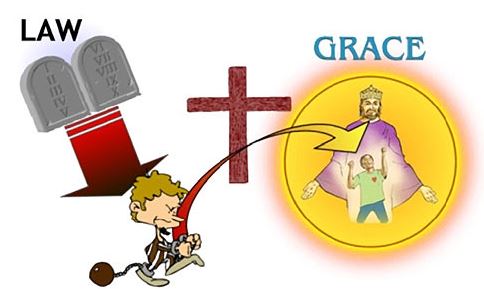
In Galatians 1:3, Paul begins his address to the Galatians who have wandered away from the truth by saying, “Grace to you and peace from God our Father and the Lord Jesus Christ.” The emphatic subject is “Grace.” He’s 03 grace peacecommending God’s grace and Jesus’ grace to his readers who are being beguiled by legalists. They are commending law to them. Imagine them greeting the Galatians from their gospel (which is not a gospel at all). It would say “Law to you.” It argues that God and Jesus send us law to live by through which we can win God’s favor and acceptance. The phrase might be “Law to you, and strife, or stress, or anxiety, from God the Father and Lord Jesus Christ.” Relating to God on the basis of law is a relationship that is totally unsettling, uncertain, and unloving. I’ve known married couples that relate to each other on the basis of law rather than love. It feeds a miserable life.

Paul wants the Galatians from the very beginning of his letter to them to consider the difference between what is being offered by the legalists and what he has preached to them about what is being offered from God through Jesus Christ. With Grace comes peace from God. Peter begins his second letter with an even stronger greeting regarding grace and peace. It took Peter some time to comprehend the extent of God’s grace with which He would deal with sinners. But once he got it, grace and peace became the central theme of Peter’s life as well. He writes in 2 Peter 1:1-2, “Simon Peter, a bondservant and apostle of Jesus Christ, to those who have obtained like precious faith with us by the righteousness of our God and Savior Jesus Christ: Grace and peace be multiplied to you in the knowledge of God and of Jesus our Lord.” His opening greeting acknowledges that our righteousness is that of “our God and of Jesus our Lord.” It’s not a righteousness earned through obedience to a law.

People need God’s grace and peace. Most people are well aware of their failures and shortcomings, even if they are unwilling to admit it. We all know how far short we fall and we know we need help. I’ve heard people say they don’t want grace they want justice. If God gave us justice, as we deserve, we would need “to go shopping for a flame retardant suit.” What we want and need from God is grace and mercy. God extends his gracious hand to the whole world from the cross of Calvary. God is so rich in mercy that he saves us by His grace. God loves everyone. He extends a gracious, merciful hand to everyone. He wants none to perish or none to be fearful of perishing. Through Christ Jesus we find God’s grace and it gives us peace with God. Law brings stress and anxiety. Grace brings eternal life, an abundant life. Grace and peace to you!

Galatians 1:6

Deserting God’s Grace

When one first experiences God’s grace, mercy and forgiveness through faith in Jesus it is a wonderful thing. But something happens to our human psyches after some time passes. We begin to take things for granted and 08 self salvationlook for a new, different, and more earthly pleasure. It doesn’t take long for the aura of our initial salvation to wear off. As a matter of fact it didn’t take very long for the Galatians to turn their attention from their Savior to their own efforts again. Paul says so in Galatians 1:6. He writes, “I am astonished that you are so quickly deserting him who called you in the grace of Christ and are turning to a different gospel.”

The term translated by “deserting” in many modern translations was always confusing to me when I studied the King James. It says, “Removed from.” But it has been widely acknowledged that the phrase “deserting” is actually a Military term. It’s used of those who deserted in time of war. According to Richison, “The Galatians changed from the gospel of grace to the gospel of works. They became renegades from the true gospel and capitulated to another gospel. The present tense indicates that the defection of the Galatians from the gospel of grace is not yet complete. They are still in the process of shifting to another gospel. They are transposing the gospel from grace to legalism. They are altering the gospel itself and thus were deserting or turning apostate from the true gospel. This changes the nature of the gospel into a works gospel.” The late James Boice said, “It is not merely that they have deserted an idea or a movement; rather, they have deserted the very one who had called them to faith. This one is God the Father. Embracing legalism means rejecting God, according to Paul’s reasoning, because it means substituting man for God in one’s life.”

We are “called in the Grace of Christ.” This means that it is the Grace that comes through faith in Christ’s finished work on the cross to which we’ve been called to come for salvation. Christ procured our salvation for us on the cross. It comes to us as a gift. That means it’s all of Grace not of works. Richison adds, “It comes from the unadulterated generosity of God with no strings attached. Christians are the objects of God’s eternal favor. To revert to law is to completely miss this truth. God saves and sustains us by the finished work of Christ on the cross.” Some people today, much like the Galatians of Paul’s day, believe that some form of religious ritual, performance, or sacrifice is essential in order to receive God’s grace. This is patently false! Others might believe that they are saved by Grace through faith in the finished work of Christ on the cross but that works must sustain their salvation. That is also patently false and simply makes our salvation dependent upon ourselves and not on the wonderful, marvelous grace of our God and Father and His Son, the Lord Jesus Christ.

Galatians 3:9-11

The Curse of the Law or the Blessing of Grace?

Along the way in life we can adopt the attitude that we’re either blessed or cursed. I know people who say that if anything bad can happen to them, it will. Others say that if anything good can come today, it will come to me! These represent two different attitudes towards life. The pessimistic outlook sees bad even in good things. When something good comes their way they just wait for the other shoe to drop (so to speak.) The optimist 02 law or gracefinds the good even in the bad things. Thomas Edison was a well-known optimist. Thomas Edison’s manufacturing facilities in West Orange, N. J., were heavily damaged by fire one night in December, 1914. Edison lost almost $1 million worth of equipment and the record of much of his work. The next morning, walking about the charred embers of his hopes and dreams, the 67-year-old inventor said: “There is value in disaster. All our mistakes are burned up. Now we can start anew.”

Paul argues in Galatians 3:9-11 that people of faith should live their lives expecting great blessings. On the other hand those who live by the law find nothing but cursings. He writes, “So then, those who are of faith are blessed along with Abraham, the man of faith. For all who rely on works of the law are under a curse; for it is written, ‘Cursed be everyone who does not abide by all things written in the Book of the Law, and do them.’ Now it is evident that no one is justified before God by the law, for ‘The righteous shall live by faith.’” God loves us! He has our best interest foremost in mind and regardless of our current situation everything is going to work out for our good. With the law, we know we’ve blown it and we’re discouraged and dejected and defeated most of the time. It’s a matter of faith and trust in a good God or a condemning God.

Those who live by faith or much happier and really are more successful in life. Psychologist Martin Segilman of the University of Pennsylvania advised the MetLife insurance company to hire a special group of job applicants who tested high on optimism, although they had failed the normal aptitude test. Compared with salesmen who passed the aptitude test but scored high in pessimism, this group made 21 percent more sales in their first year and 57 percent more in their second. A pessimist is likely to interpret rejection as meaning “I’m a failure; I’ll never make a sale.” Optimists tell themselves, “I’m using the wrong approach,” or “That customer was in a bad mood.” By blaming failure on the situation, not themselves, optimists are motivated to make that next call. It’s that way with people of faith. God is not out to get us (curse!), He’s out to bless us! Now, it’s our choice. We can live under the curse of the law, or we can live under the Grace of God. He expressed His love and concern for us on the cross. If He loved us that much, is there anything He won’t do for us?

Galatians 5:1, Acts 15:10, Matthew 11:29-30

The Unforced Rhythms of God’s Grace

Chapter five of Galatians begins with an exhortation. Galatians 5:1 says, “For freedom Christ has set us free; stand firm therefore, and do not submit again to a yoke of slavery.” I once read about a vast majority of 03 set freeemancipated slaves becaming sharecroppers in the south. They were free but they were afraid to enjoy their freedom. As sharecroppers in some cases they were worse off than they were as slaves. The Judaizers in Galatia were leading the new Christians into a similar situation. They were set free by the greatest of all abolitionists, Jesus Christ. Yet they found themselves again reverting to the mindset of slaves and submitting themselves to legalistic expectations and demands of task masters. But Paul riled them up to demand freedom. He wanted them to “stand firm” in their freedom.

First of all he commands us to “stand firm” in our liberty. He wanted all to hold their ground regarding the doctrine of justification by grace through faith alone. Some wilted under the constant berating of the legalists. Some even surrendered their new found freedom to the religious stipulations of others. The true believer has no obligation under any system of legalism. Christ has set us free. Our freedom was purchased for us at the cross. Gromacki says, “The shackles of sin and selfishness were removed. The power of the gravitational pull of the sin nature downward has been conquered. The believer is now free to become and to do all that God in His wisdom wanted men to be. He can now become a totally functioning human being in body, soul, and spirit.”

Paul also exhorts us not to let the “yoke” of slavery have its way with us anymore. The “yoke” he is referring to is the yoke pressed upon us by the Mosaic Law. Peter stepped out at the Jerusalem Council and used a similar phrase and explains what this yoke is. In Acts 15:10 Peter says, “Now therefore why tempt ye God, to put a yoke upon the neck of the disciples, which neither our fathers nor we were able to bear” (Acts. 15:10). Jesus set us free but called us to His “yoke.” He tells us what that’s like in Matthew 11:29-30. He calls us all out of the yoke of slavery to freedom. He says, “Come to me, all who labor and are heavy laden, and I will give you rest. Take my yoke upon you, and learn from me, for I am gentle and lowly in heart, and you will find rest for your souls. For my yoke is easy, and my burden is light.” I think Eugene Peterson gave us an accurate modern rendition of Jesus’ words here. He translates this passage like this: “Are you tired? Worn out? Burned out on religion? Come to me. Get away with me and you’ll recover your life. I’ll show you how to take a real rest. Walk with me and work with me—watch how I do it. Learn the unforced rhythms of grace. I won’t lay anything heavy or ill-fitting on you. Keep company with me and you’ll learn to live freely and lightly.”

sewa motor jogja
© Chuck Larsen 2019. Powered by WordPress.