I loved fairy tales growing up. Still do. I especially enjoy good fantasy novels where the heroes overcome impossible odds to save the world from some evil, oppressive tyrant. As a young teenager, I couldn’t get enough of these stories. And I loved to  daydream. Whenever I was bored, I would simply imagine myself as a hero in one of these tales, slaying dragons and rescuing princesses.
Most of these stories pretty much followed a remarkably similar plot structure. They begin in a happy kingdom, with a wonderful and honorable king who has a beautiful daughter and life is good for everyone. Yet somehow in spite of this, there is always someone in some dark corner who hates this king and has dedicated his life to finding a way to destroy him and his kingdom. Eventually, he accumulates enough power and resources to put his nefarious plan into action. Unable to attack this great king directly, our villain goes after his lovely daughter.
Upon realizing his daughter has been kidnapped by his enemy, the king puts out a call to his kingdom for a champion to step forward and mount a rescue. Once the news goes out, a valiant warrior boldly steps forward and vows to destroy this enemy and bring the king’s daughter back unharmed. He rides a great distance, braving the elements and the hardships of travel, to the very gates of this wicked tyrant behind which the princess is bound, held captive in a tower. The villain torments her with threats of impending doom, assuring her that everything she loves or could ever hope for is now forever lost to her.
The hero easily crashes through the gates, eager to climb the tower and rescue the maiden but upon entering the fortress, he is confronted by a beast so terrifying, no mortal man can stand against it. This creature towers over the champion, covered from head to toe with thick scales, teeth the size of swords, claws as sharp as spears, a whip-like tail, breathing smoke and fire, forged from the pit of hell itself. The warrior dismounts, draws his sword, and advances on the beast for not only did he make a vow to his king, but he is also deeply in love with the princess.
Hours later, the smoke clears. The ground is littered with bits of broken armor still smoldering from the brutal conflict as the figure of a man covered in blood and soot steps down from the carcass of the slain beast. Despite his broken bones and ribs, he makes his way to the tower and proceeds to climb, coughing up blood with every step. He reaches the princess with strength enough to break her chains, setting her free. How grateful the princess would be after seeing how much the hero suffered for her! Surely, she must know now, beyond a doubt how much he loves her and that she can trust in him completely.
I have come to realize that this story is in fact the story of my life, only not how I imagined it in my youth. In my daydreams, I was always the hero. I was fearless. I slew dragons and I rescued princesses. The king and his entire kingdom would celebrate me and reward me for my courageous exploits. What vanity! No, it turns out in this story, my true life story, I was the damsel in distress. I had been taken captive. I was being held prisoner and I was very much afraid. I could not even escape my own chains let alone fight my way past a towering hell beast. I was completely without hope.
But God sent forth a hero, His champion and Son Jesus Christ. At the beginning of His quest, He announces His purpose to the world in Luke 4:18-19 by reading from Isaiah 61, “The Spirit of the Lord is upon me, for He has appointed me to preach Good News to the poor. He has sent me to proclaim that captives will be released, that the blind will see, that the downtrodden will be freed from their oppressors, and that the time of the Lord’s favor has come.” Christ followed His reading with an announcement that this prophecy was fulfilled that very day. Yes, Christ himself was the hero sent from God to deliver us from our oppression and captivity.
The Apostle Paul confirms this in Colossians 1:13-14 which reads “For He has rescued us from the one who rules in the kingdom of darkness, and He has brought us into the Kingdom of His dear Son. God has purchased our freedom with His blood and has forgiven all our sins.” Through the sacrifice He made on my behalf, He demonstrated how much He loved me and I know I can trust in Him completely and am confident that my story ends with “and they lived happily ever after.” Like King David in the 23rd Psalm, I too can say, “Surely goodness and loving kindness will follow me all the days of my life and I will dwell in the house of the Lord forever.” The fairy tale is true!
 in Philadelphia, Pennsylvania. It is believed this bell was rung to mark the reading of the Declaration of Independence.
 judgment we too must be “righteous.” There was several others pronounced “righteous” in the Old Testament; Enoch, Job and Boaz are a few. These three involved some kind of deliverance as well and it’s still natural to see that the salvation was dependent on their being “righteous.” I am hard pressed to count myself among “the righteous.” I know I’ve fallen short a lot of times in my life. Just yesterday I said unkind words to my wife and harbored ill will toward others. If I am to have any hope I have to understand the declaration of these people and others being “righteous” in a different way. If it doesn’t mean one must be righteous to be saved, what does it mean then. Jesus, Himself, said that if we want to go to heaven our “righteousness must be greater than that of the Pharisees.” Ouch! Is that what it means?
 two sides to the Gospel of Jesus and they are alluded to in Kennedy’s statement. Both of them are “Good News” indeed! First, Jesus died for my sins! He was perfectly holy and righteous! I am a sinner of a pretty bad variety. I don’t think I was as bad as some, but it doesn’t matter. If you’ve fallen at one point of the law you have fallen at the whole law. That’s the way James put it in 2:10: “For whoever keeps the whole law but fails in one point has become guilty of all of it.” One blogger explained it this way, “If I break a speed limit I have broken the law of the land, if I murder I have broken the law of the land in the same way it doesn’t matter which of God’s laws you break you have broken his law and are guilty in his sight.” Wikipedia says that repentance is “sincere regret or remorse.” I disagree! I believe a biblical understanding of repentance is to acknowledge the reality of my own sinfulness. It’s not just admitting a particular sin, but acknowledging my true sinful nature. As the cliche puts it, “I owe a debt to God that I cannot pay! Jesus paid the debt that He did not owe!” That’s Good News!
 our relationship with God the father is by God’s grace. It is God’s grace that saves sinners. He writes in Chapter 1, verses 3-5, “Grace to you and peace from God our Father and the Lord Jesus Christ, who gave himself for our sins to deliver us from the present evil age, according to the will of our God and Father, to whom be the glory forever and ever. Amen.” It is a true gift as Paul wrote in Ephesians 2:8-9, “it is a gift of God. It’s not of yourself. It’s not of works lest any man should boast.” But like the Galatians it’s so easy to turn from Grace to Works again. It appeals to our human nature and seems to be the default setting for mankind. Commenting on the radical grace of God Bush and Due write in their commentary, “The gospel’s radical negation of ceaseless striving and hard work is unfathomable to us. Our thoughts can’t produce it; our will doesn’t originate it. It’s otherworldly, ‘according to the will of our God and Father’ (Gal 1:4). Christ suffered not because we are worthy, or because we moved him to act, but only because it was the will of God.” They quote Peter’s sermon in Acts 2:23 then, “This Jesus, delivered up according to the definite plan and foreknowledge of God, you crucified and killed by the hands of lawless men.” Their conclusion is, “It’s hard to imagine a statement better calculated to oppose the intrusion of human will in salvation.”
 without a doubt, those with incurable ailments and diseases paid the most attention. As He enters a village on the border between Galilee and Samaria, He sees ten lepers crying out to Him from a distance “Jesus, Master, have mercy on us!” Leprosy was a highly contagious life-threatening skin disease that had plagued the region for centuries.
 sister!” Or she’d say, “for the Love of God, stop picking on your little brother.” More than once I heard her say, “for the Love of God, please do your homework.” Yep, my mother thought that the love of God should have been a motivating force in my life for good. But honestly it didn’t really motivate me at all. I never was very nice to my sister. I never stopped picking on my little brother and seldom did I do my homework.
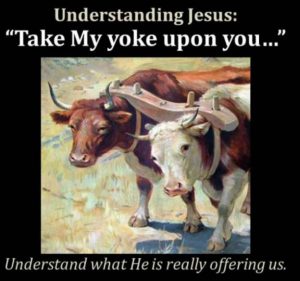 give us rest for our souls. In Jesus’ call to us who are overburdened, He speaks of taking His yoke upon us. Now we all know that a yoke in that agricultural society was a wooden press that bound two animals together who would then contribute equally to the pulling of the plow by putting their strength together. Some yokes were extremely heavy according to some commentators and some were lighter but all involved some kind of a burden. But the yoke that Jesus was referring to was the heavy burden that the religious leaders had placed around the necks of the people binding them to a law that was unbearable. That yoke, the Yoke of the Law, only drove us to the recognition of our true sinfulness. Jeremiah made this clear when he used the idea of a yoke in his lament. In Lamentations 1:14 we read “…My transgressions were bound into a yoke…they were set upon my neck.”