service genset jogja
Titus 1:1-2

Committed to God’s Mission

Paul begins his letter to Titus by modeling what it takes to become a good disciple maker. In verses 1 through 4 of chapter 1, Paul illustrates for Titus and us that it all begins with commitment. The first commitment is to the mastery of Christ in our lives. We must place ourselves fully under Christ’s authority. Then we must commit ourselves fully to God’s Mission.  Jesus calls us to “Make Disciples.” That’s every believer’s true commission. It’s recorded in every one of the four Gospels as well as in the book of Acts. Committing ourselves together to this purpose gives life true meaning and eternal significance.

The first two verses give us the three focuses our mission must take. Paul calls himself a “servant” of God “for the sake of the faith of the elect.” This is “Evangelism.” Paul’s primary role as God’s servant is to bring those chosen to their full stature as believers in Jesus Christ. The mission always begins with evangelism. There are those who must hear God’s Good News about Jesus. Paul is God’s servant in this respect. We should be also. The second aspect is “Edification.” Paul is God’s servant, not only for the sake of the faith but also for the “knowledge of the truth which is according to godliness.” This speaks to me of building up the faith we profess through learning God’s word and growing in our understanding and then putting it in practice in our lives. Paul wants to lead others to faith in Jesus and then help them grow in that faith. Thirdly, it’s “Encouragement.” Paul is God’s servant for evangelism, edification “in the hope of eternal life.” Paul charges those with growing faith to live their lives with an eternal perspective.

Committing ourselves to a life of making disciples, evangelism, edification and encouragement is the path to living a meaningful life. Paul told another young disciple, Timothy, that he should “Command” his followers to live like this. He writes, “Command them to do good, to be rich in good deeds, and to be generous and willing to share. In this way they will lay up treasure for themselves as a firm foundation for the coming age, so that they may take hold of the life that is truly life” (1 Timothy 6:18-19).

Chuck
“Go… and make disciples.” Matthew 28:19

Titus 1:1

The Lord’s Servant

The Great Commission calls all true believers to be committed to the mission of making disciples. Paul left Titus on the Island of Crete to do just that in a troubled, difficult environment, but he did not desert him to the task. We know of at least one letter Paul wrote to Titus instructing him and encouraging him in his mission. This letter is one of the letters in the Bible. Paul begins his letter to Titus by modeling what it takes to become a good disciple maker. In verses 1 through 4 of chapter 1, Paul illustrates for Titus and us that it all begins with commitment. The first commitment is to the mastery of Christ in our lives. In verse 1, Paul calls himself “a servant (slave) of God and an apostle of Jesus Christ.”

Placing oneself under the umbrella of rightful authority is the safest place anyone could ever be. It’s the most secure place. It’s the most rewarding place. It’s the most productive place. To Paul God was his master, and Christ was his authority. The word “apostle” means “sent one.” Paul saw himself as one sent out by Christ. Jesus told His disciples that just as the father had sent Him, so too was He sending them. You might also notice that the Great commission in Matthew 28:19 begins with the phrase “all authority has been given to me (Jesus) in heaven and on earth, therefore go, make disciples…” Israel’s leaders, judges, kings and prophets were all called God’s servants because they were speaking for God. Of course many of them fell short of the ideal. It’s when that happened that the Prophets began to speak of the one future, perfect servant of God; the Messiah. Jesus was that perfect figure. He said, “I have come to do my father’s will.” Just as God had sent Jesus, Jesus has sent us.

Obedience is the key to success. If we study the genealogies in the bible we soon learn this lesson. Constable puts it this way, “Throughout history people and nations have succeeded or failed as they recognized God.” Recognizing God as the ultimate authority in life and committing ourselves to be His servants is the first step of obedience. It’s also a prerequisite for making disciples.

Chuck
“Submit yourselves therefore to God.” James 4:7

Acts 4:12

Seeking a second opinion?

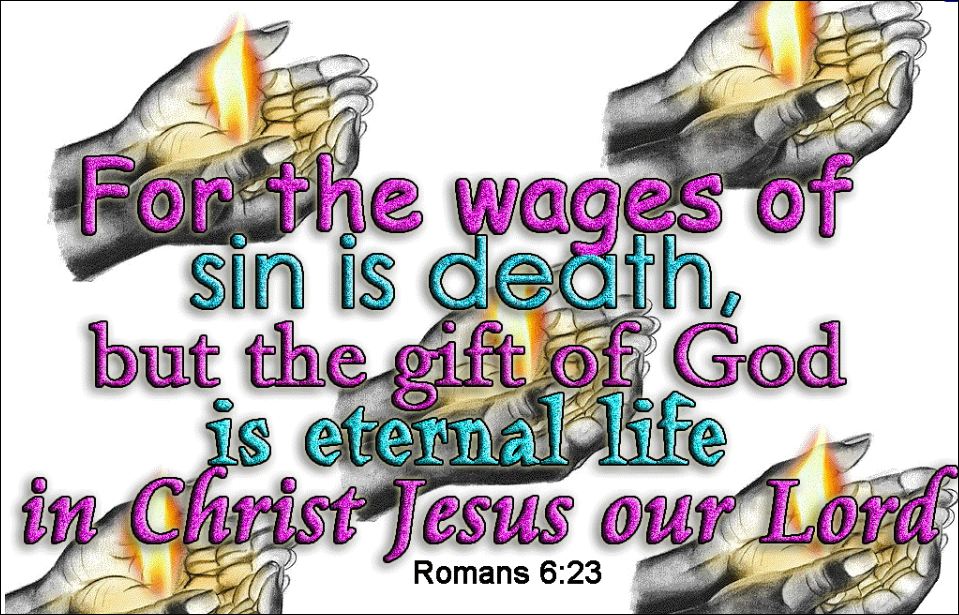
If my doctor gives me a diagnosis of “bad news” and recommends a particular difficult treatment or even radical surgery, I’m free to seek out a second opinion. Some doctors will often recommend that you get a second opinion because they realize their own fallibility and want to be certain they haven’t missed something. The greatest physician has given each of us a diagnosis. He says the “wages of sin is death.” He says that you and I have sinned. It is “appointed to man once to die…” There is a time for everything; “a time to be born and a time to die.” Our diagnosis is fairly settled.

Well, I don’t know about you, but I’d like a second opinion! I’ve read many testimonies of men and women who have spent their lives seeking for a second opinion. They travel the many roads offered by many religions all promising some kind of “salvation” from life’s situation, but have all come away empty. While many religions profess their own kinds of salvation and prescribe a particular treatment, there is none that offer what Jesus offered.

R. A. Torrey wrote, “What men need is not morality, but life; not to make death respectable, but to receive the gift of eternal life; not decent interment, but a pathway out of the realm of death. Many men have brought forward their schemes for the “up-lift of humanity” (though the results thereof are not yet discernible); but there is only One Man who makes, or ever made, the offer of eternal life. None other has ever said, “I am the resurrection and the life; he that believeth on Me though he were dead yet shall he live. And whosoever liveth and believeth on Me shall never die” (John 11:25, 26). He only claims to be the “Fountain of Living Waters” (Jer. 2:13; John 4:14; 7:37), and says to all who are suffering the thirst of death, “Come unto Me and drink” (John 7:37). When Jesus asked His disciples if they’d like to go find a second opinion, Peter answered for them all. He said, “Lord, to whom shall we go. You alone have the words of eternal life (John 6:68)

Chuck
“There is no other name under heaven given among men by which we must be saved.” Acts 4:12

2 Timothy 1:10

That’s what I call GOOD NEWS!

The surest cure for the fear of death is the certainty of eternal life. That’s the essential ingredient of the Gospel. The word “Gospel” sounds very religious to us in the 21st century and conjures thoughts of Matthew, Mark, Luke and John. We think of the “Gospels” as books of the Bible. They are of course, but the word “Gospel” communicates so much more. It’s the wonderful old Greek word “euangelion.” The prefix “eu” means good. The stem word “angel” means message. The Greek word for the beings we know as angels literally means messengers. Literal the Gospel is a “Good Message.” You and I have often heard it called “Good News.”

If you were trapped in a collapsed cave, running out of air, shut in claustrophobic darkness, and were becoming overcome by fear, how would you feel if you heard workmen breaking through the rubble to rescue you. One of them shouted, “Hold on we’re almost through to you.” Would you call that “good news?” I sure would. If you knew you would be rescued you’d have the hope you need to wait it out and quell the rising tide of panic knowing that any minute you’d be rescued. Well, here we are, separated from God by sin, trapped on a doomed planet, facing death and hell. And God Himself became a man, dying in our place, rising from the dead to give us life. Is that good news? Yes, but it’s more than good news. We don’t have a word to describe it. The angels put it: “Behold, I bring you good tidings of great joy which shall be to all people. For unto you is born this day in the city of David a Savior.”

The salvation of the rescue workers would only be to resume the mortal life again. The salvation that Jesus brings is one that transcends every other imaginable salvation. Thus for thousands of years the Gospels have brought to the world the ultimate good news to all mankind. The assurance of eternal salvation is based only on the promise God makes in His Word that everyone who trusts in Jesus Christ alone possesses eternal life. Jesus himself says, “Truly, truly, I say to you, whoever hears my word and believes him who sent me has eternal life.” That’s what I call GOOD NEWS!

Chuck
“…Christ Jesus…abolished death and brought life and immortality to light through the Gospel…” 2 Timothy 1:10

Psalm 119:103

Sweeter than Honey!

One of the most important ways that I deal with the inevitability of my own death is to focus my attention on the promises of God contained in the Bible. Nowhere in the world will you find more comfort, more assurance, and more compassion than you will find in God’s Word. The Psalms, though not the only book, offer a treasury of comfort regarding our mortality. One Psalm especially is key to this treasury. It is Psalm 119. The Psalmist, presumably David, writes the longest of all the Psalms with176 verses. The subject is God’s communication to man. There are nearly two dozen different titles for this revelation in the Psalm; precepts, laws, rules, commandments, directions, guides, instructions, and so on. The entire Psalm is an acrostic. The first 8 verses begin with the first letter of the Hebrew Alphabet, the Aleph. The second 8 verses begin with the second letter, the bet, and so on through all 22 letters of the Hebrew Alphabet. Of course the letters of the Alphabet are the instruments through which God’s Word has been revealed to man, thus even the poetic acrostic serves to reinforce the focus on God’s written revelation to man.

In verse 103 David writes, “How sweet are your words to my taste, sweeter than honey to my mouth!” Chocolate is sweet. Candy is sweet. Sugar is sweet. Honey, of course is sweet. But how can the Bible be sweet? It can only be explained by giving you an example. The following are some of the sweetest words I know: The LORD is my shepherd; I shall not want. He makes me lie down in green pastures. He leads me beside still waters. He restores my soul. He leads me in paths of righteousness for his name’s sake. Even though I walk through the valley of the shadow of death, I will fear no evil, for you are with me; your rod and your staff, they comfort me.”

I listened to the podcast of Dallas Theological Seminary’s chapel service. Donald Campbell spoke on the sweetness of God’s word. He (in effect) said that these sweet words should excite the taste buds of every person. If they don’t, your taste buds have been dulled by the saccharin of this world’s culture. He went on to quote James Montgomery Boice, who said, “to soothe bitter experiences of life, fill your heart with sweet verses like this.”

Chuck
“The Lord, all powerful, will destroy the power of death and wipe away all tears.” Isaiah 25:8

Psalm 54:5

It’s OK to be afraid to die!

David is often referred to as a “man after God’s own heart.” His name is actually a title that means “warrior or champion.” There are immense articles in theological journals expounding on this reality and explaining its origin. That fits with his life as well. He stood up to Goliath in the Valley of Elah when all Israel’s Army was crippled by fear. He led the Israeli forces to victory after victory against the perennial enemy of Israel the Philistines. He recruited men of great courage and skill in warfare that they were called “David’s mighty men.” David’s courage and valor and faith led him to become the man “after God’s own heart.”

Yet in Psalm 54, he writes, “my heart is troubled within me; and the fear of death has fallen upon me.” I’m so encouraged that “fear” is something that even the bravest warriors experience. Courage and valor are not expressed because of the absence of fear, rather, they are expressed in the presence of fear. In fact, there is no courage or valor without the presence of the fear of death. Have you noticed that Psalm 23 says, “Though I walk through the valley of the shadow of death, I will fear no evil…” Please notice that David, the author, is acknowledging his walk through the “valley of the shadow of death.” It’s not death he will not fear, it’s evil of any kind.

David, the great warrior, does not repress the fear of death; he acknowledges it in his poetry. We don’t live our lives with the daily consciousness of the fear of death. How morbid would that be! But it’s absolutely essential that we come to terms with our mortality. Hebrews tells us that Christ came to die for those who “through fear of death were subject to slavery all their lives.” The slavery comes not from the fear of death, but from the denial of the fear of death. Even 1 Corinthians 15:32, “let us eat and drink for tomorrow we die” is not a declaration of freedom to live life any way we want, but is simply another form of, as Piper says, “benumbing denial.” He continues, “Death looms as the great enemy. And we become its slaves in the illusory flight of denial…” Once we acknowledge, like the warrior hero David did, that the fear of death is real, we are then truly free to come to terms with it.

Chuck
May …peace be yours …Jesus was the first to conquer death…Christ loves us, and by his blood he set us free…” Revelation 1:5

Ecclesiastes 3:1-2

A Time To die!

Everyone must die! This is a given, isn’t it? It’s a cliché almost. It doesn’t even bear repeating because it’s so obvious. The Bible clearly states, “There is a time for every event under heaven; a time to be born and a time to die” (Ecclesiastes 3:1-2). Everyone knows it. Everyone is introduced to it from childhood at the death of a pet, a loved one, or something they see on TV. It’s just part of life. I attended several funerals and memorial services for family and friends in 2011 and was surprised at how many people seemed shock when death becomes part of their experience. They know death as a reality but they are totally unprepared for it.

As a preacher of the Good News of Jesus Christ, I feel it’s one of my most solemn responsibilities to give attention to preparing people for the inevitability of death. But it’s such a delicate subject, especially in the wake of a loss. I think I’ve had more zeal than knowledge in some attempts to share this truth with others. You may have heard of the barber who was newly saved and was eager to witness to his experience with Jesus Christ. As he met his first customer the next day, he was sharpening his straight razor on the leather strap. His initial approach to his customer was, “Are you ready to die?” Just imagine what went through the customer’s mind as he viewed the finely honed razor.

I really want to be careful how I talk about this subject because only a truly morbid person obsesses over the inevitability of his own death. . On the other hand, only a foolish person refuses to ponder his own mortality. One of the most profound truths come from the mouth of William Wallace of Brave heart fame. He said, “no man can really live until he is ready to die.” So what about you? Do you ever consider that God has granted you a fixed amount of time in this world and that every tick of the clock brings you that much closer to your date with eternity? Imagine you were to discover that you have one week to live. What regrets would you have? What unfinished business would fill you with sadness? Would you feel you have lived wisely, in a way that honors God? Why or why not?

Chuck
“…it is appointed for man to die once, and after that comes judgment.” Hebrews 9:27

2 Sermons

Get Connected

This is a two part series on the subject of getting connected.


Sermon Videos
Click a link below to watch the video. Click the same link again to close.

1) Get Connected: Part 1

2) Get Connected: Part 2

sewa motor jogja
© Chuck Larsen 2019. Powered by WordPress.