service genset jogja
Philippians 2:19

Expecting the Best

Paul really wanted the Philippians to feel the joy he himself had through all his trials and sufferings. He even used the imperative mood (mood of command) when he said they should be glad and rejoice with him. Christ was 06 the bestGod’s whole burnt offering for the sins of the world. Christ had to suffer! He had to die in order for our salvation to be secured. Like the drink offerings of the Old Testament, Paul saw his life as a mere libation added to the great sacrifice of Christ. He offered himself with great joy and encouraged us also to consider all our pains and sorrows as fellowship with the sufferings of Christ. In that way no pain is ever wasted and we too can find meaning and purpose in the miseries of life. Paul wants them to find joy through all their sufferings just like he did.

Then in Philippians 2:19, Paul goes back to the things that bring him real joy in life. He and Timothy were on the team that planted the Church in Philippi years before. They knew Timothy well and Paul intended to send him to them knowing how they will be glad to see him again. But he adds a thought when he writes, “I hope in the Lord Jesus to send Timothy to you soon, so that I too may be cheered by news of you.” They will be cheered upon seeing Timothy again, and Paul himself will be cheered when Timothy returns to Rome with news about how things are going in Philippi.

Paul is expecting the Best! I love this man! He knows of the struggles and divisions in the church and he addresses the need for each and every one, along with the elders and deacons, to cultivate the mind of Christ in all their dealings with each other. He expects them to receive his instructions with open and willing hearts. He expects the two women who had brought division and animosity to respond well. He expects the best from them! We don’t give our best to those who expect us to fail! We don’t get the best from those we expect to fail. It’s nearly a self-fulfilling prophecy. Christ teaches us to expect the best, but always be ready to forgive and restore when someone fails. We all do, and we all will again. So will others around us. I love what Max Lucado said in “No Wonder They Call Him The Savior.” He writes, “Expectations alone are the bullets that can kill; but buffered by acceptance and forgiveness, they can bring out the best.”


Philippians 2:20, Proverbs 27:6

The Wounds of a Friend

Paul is sending Timothy to the Philippian Church expecting that he’ll bring back good news to him regarding the condition of the church and this will cheer his heart, or bring him great joy. On the other hand he is sending 09 slappedTimothy to them in order that they too may rejoice and be cheered up as well. Timothy was part of Paul’s team that planted the church in Philippi and he is loved and respected there. Paul broached some pretty serious subjects in his letter to the believers. He did so out of a heart filled with concern and compassion for them. It is only those who truly care who dare to take risks to confront us. Paul wasn’t the only one who would do this. He knew Timothy had the same depth of love and concern. In Philippians 2:20, Paul writes, “For I have no one like him, who will be genuinely concerned for your welfare.”

Proverbs 27:6 carries a profound truth that Paul and Timothy illustrate for us. It says, “Faithful are the wounds of a friend; profuse are the kisses of an enemy.” In the United Bible Societies Handbook for Bible Translators there is an interesting comment on this verse: “Faithful are the wounds of a friend means that a true friend’s criticism or frank speaking (wounds of a friend) is based on the sincerity of the friendship.  The Contemporary English Version  says ‘You can trust a friend who corrects you.’ Profuse renders a word meaning ‘plenty’ or ‘abundant.’” The suggestion is that the kisses of those who don’t really care about you may be excessive, meaning there are too many, yet those who will step out of the comfort zone and tell you how it really is are few. Isn’t this what Paul is saying about Timothy. He had no one like Timothy who cared enough about the Philippians to confront them about their divisive spirit.

We all need some close friends who are willing to wound us in order to help us. A person who does nothing but compliment you may not be a true friend. Some people have hidden agendas and want something from you that they expect to get out of flattery or unwarranted praise. Good friends know how and when to compliment us and they also know how and when to correct us. Good friends don’t always say what we may want to hear, but that’s exactly why we need them. We need friends like that who will ask us the hard questions in life. Good friends will push us and challenge us onward toward Christ likeness even when we don’t want to go. Paul knew the Philippian believers needed Timothy. We need a Timothy also in our lives. Do you have one?

Philippians 2:15

Twinkle, Twinkle!

After Paul exhorts us to do things in community without grumbling, arguing and complaining he explains the result of having that humble obedient attitude of Christ. Philippians 2:15 explains, “that you may be blameless 01 twinkleand innocent, children of God without blemish in the midst of a crooked and twisted generation, among whom you shine as lights in the world.” Earlier I had compared Paul’s exhortation to us to do everything without “grumbling and complaining” to the episodes recorded in Exodus where all the Israelites grumbled, argued, and complained against the leadership throughout their journey to the Promised Land. None of the adults in that party were allowed to enter, but they all died in the wilderness. The phrase in this passage “crooked and twisted” is the same phrase used in Deuteronomy 32:5 to describe the generation that failed to inherit the land. Could Paul be contrasting a blameless church with a blameworthy Israel? One commentator took it further and observed, “Further, the church now constituted the children of God, and was the true Israel.” Paul wants us to be the “children of God” who are “without blemish” in such an environment.

Israel was called to be a light to the gentile nations. It failed! The world was to be illuminated by the presence of God’s people in such a way as to stand out against the darkness all around it. Christians are exhorted to let our lights shine also. Jesus’ attitude and demeanor of humble obedience and submission should be the guiding example for us. When that’s the case the whole world can be enlightened by the church. But unfortunately, from the very beginning as seen in this letter, the church has failed in many ways to do that, just as Israel did, because it has been riddled with dissension.

It’s easy to miss the point in this passage by focusing solely on the exhortation not to complain or argue with each other. But there’s a purpose behind it. We are to shine like stars in a black world where there are few examples of Christ. We are to have Christ’s attitude to stand out from the rest! This calling is a tall order! One commentator said it will require an “extreme makeover.” He writes, “How can we possibly do that? This gift of salvation also brings with it the gift of power. The power to change. We can no longer justify our behavior with ‘That’s just the way I am,’ because God empowers us to be new. Paul writes about this to the Corinthian church: ‘Therefore, whoever is in Christ is a new creation; the old has gone, the new has come!’ (2 Cor 5:17.) We don’t have to let our faults rule and ruin us. When we give our lives to Jesus and accept His powerful grace, He literally walks with us and makes us who we are intended to be.”

Philippians 2:14

Grumble, Grumble, Grumble!

30 the grumblerIn previous devotions I’ve focused on Paul’s exhortations for believers in community to adopt the attitude of Jesus in humility and obedience. He then asserts that God is anxious to help produce in us the desire and ability to live out these traits in community. Paul’s purpose was to sustain a healthy, loving, and effective ministry in the church at Philippi. His words are inspired by God and addressed to us as well. Continuing in this line of thought Paul then instructs the Philippians and us in Philippians 2:14. He says, “Do all things without grumbling or disputing.”

For the biblically literate this phrase conjures up the sad story of the Israelites in the wilderness. All they did was grumble, complain and argue with Moses. It’s not a pretty picture and leads to nothing good for anyone. The grumblings in the wilderness were against the leadership. It’s the same thing at Philippi. This is probably why the “elders and deacons” where singled out by Paul in his introduction. We will also see specific people named as the source of conflict in the church in chapter 4.

Critical, grumbling, complaining and arguing spirits have been the bane of every church from Philippi to Philadelphia, from Boston to Blair and everywhere else. If I read Paul correctly, this issue is not a minor issue. It’s a central theme found in many of his epistles. He wants the church families everywhere to live healthy, wholesome, humble and obedient lives, filled with joy. Kent Hughes observes that this problem of grumbling, questioning and complaining is “a watershed state of the soul. Those who persist in such murmuring are not obedient to Christ and his gospel and are rejecting the divine call to work out your own salvation.’ They impede their own souls and the souls of their brothers and sisters in this matter. They are undertows to the body of Christ. So if you are one of these people, understand that when you finally stand before your Savior, you will answer with shame.”

Philippians 2:13, Psalms 37:4

To Will and to Work

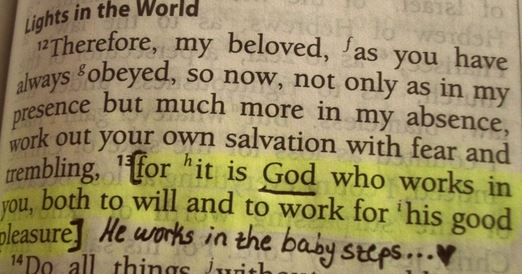
Paul gives his readers many exhortations in his epistles to live lives worthy of their calling. He exhorts us to be like Christ in the early verses of Philippians Chapter 2. He says we should have 27 godworksthe same attitude of Christ in humility and obedience. But anyone who has attempted to live the “perfect” Christian life soon learns how impossible it is. We often say things we shouldn’t. We assert ourselves in un-godly ways, and we have thoughts that Jesus would often disapprove of! What then are all these exhortations to be like Jesus all about? Well, in Philippians 2:13, Paul lets us know that we are not alone in this process of becoming more and more like Jesus. He says, “…it is God who works in you, both to will and to work for his good pleasure.”

God is in us creating the will in us to be like Jesus. We don’t really want to be like Jesus in and of ourselves. We want pleasure, personal peace, possessions, and even power and privilege. The scriptures make it clear that none of us are righteous, none of us seek after God, and all of us have gone astray. We don’t want to be like Jesus. But it’s God who brings about a change in what we really want in life. God has to do a work in our wills before we can achieve any kind of spiritual growth. I have good days and bad days with regard to what I really want. The Psalmist did too. In Psalm 119:36 he prayed for God to change what he wanted. He prays, “Turn my heart toward your statutes and not toward selfish gain.” Psalm 37:4 teaches us to, “Delight yourself in the LORD, and he will give you the desires of your heart.” Some suggest this means God will give you the things that you desire in life, wealth, popularity, pleasure, etc… But when God gives you something it is something you don’t have. If He gives us desires, He gives us the desire itself to do what He wants us to do.

The will to be like Jesus in His humility and obedience has to come from God. And so does the power to do it. The word in our verse for “work” is the word for energy. Sometimes I find myself wanting to do the right things, wanting to be humble and gentle and obedient like Jesus, but find I don’t have the ability in certain situations. But God promises not only to work in the right kind of desires but to also work them out. Augustine wrote, “God makes us do what he pleases by making us desire what we might not desire.” Specifically with the church at Philippi, Paul argues that God wants them to put an end to the dissensions among them through living out the humble and obedient example that Jesus set for them. He wants the same thing for us today!

Jeremiah 6:4-5

Pray for Peace!

The new release of the video game “Fallout4” presents us with a scenario in which mankind destroyed itself with nuclear war and few are 15 war never changesleft alive. The landscape is one of devastation and decay. Its introduction consists of various views of the rubble with a somber voice saying, “War never changes, War never changes.” Its repetition is ominous and most sobering for a video “game.” However, how true! In Jeremiah’s day it was his repeated chant. The devastation to mankind as a result of war “never changes.” He reminds his own people, who in their arrogance refuse to repent and turn to God for salvation and guidance, look to Egypt and other earthly sources to protect them from the coming invasion from Babylon. But Jeremiah tells them it’s too late. In Jeremiah 6:4-5 he says, “Prepare war against her; arise, and let us attack at noon! Woe to us, for the day declines, for the shadows of evening lengthen! Arise, and let us attack by night and destroy her palaces!”

War never changes! It’s always devastating. The World War I patriot, Wilfred Owens, who died on the battlefield in France, recognized the necessity of war but denounced the glamorization of it. The great poet Horace was famous for the line “Dulce et decorum est pro patria mori.” It means how beautiful and becoming it is to give one’s life in war. Owens named one of his last poems after this Latin phrase. Here’s the concluding stanza: If in some smothering dreams you too could pace behind the wagon that we flung him in, and watch the white eyes writhing in his face, his hanging face, like a devil’s sick of sin; If you could hear, at every jolt, the blood come gargling from the froth-corrupted lungs, obscene as cancer, bitter as the cud of vile, incurable sores on innocent tongues,– My friend, you would not tell with such high zest To children ardent for some desperate glory, the old Lie: Dulce et decorum est Pro patria mori.”

I was watching the PBS special “Christmas through the Decades.” In the episode of the 60’s the life and works of John F. Kennedy were reviewed. As important as the moonshot was, it was acknowledged by most that his greatest contribution was the aversion of war in 1962 during the Cuban Missile Crisis. The western hemisphere faced an imminent danger of nuclear war as Cuba stockpiled nuclear weapons 90 miles off the coast of Florida. Kennedy averted that potential disaster by a show of force on the seas turned back the weapons. Noël Regney wrote a song in 1962 in response to the Cuban Missile crisis that Bing Crosby made famous. “Do you see what I see, do you hear what I hear…” You know it. But the haunting verse concludes, “pray for peace people everywhere….” Good exhortation for us all because war never changes. Let’s celebrate the coming of the Prince of Peace together!

Jeremiah 6:2-3

Linebacker or Cheerleader

One summer night during a severe thunderstorm a mother was tucking her small son into bed. She was about to turn the light off when he asked in a trembling voice, “Mommy, will you stay with me all night?” Smiling, the mother 18 bothgave him a warm, reassuring hug and said tenderly, “I can’t dear. I have to sleep in Daddy’s room.” A long silence followed. At last it was broken by a shaky voice saying, “The big sissy!” Our culture has adopted the practice of applying feminine slurs on males who don’t live up to the masculine image of the day. Some slurs are more graphic than “sissy” but they refer to the same idea. I once had a discussion with a strong feminist who blamed that practice on the Bible. I couldn’t deny the fact that the scriptures do use the feminine gender to point to weakness. In Jeremiah 6:2, the prophet says, “The lovely and delicately bred I will destroy, the daughter of Zion.” As Ryken observes, “Jeremiah uses feminine vocabulary to show how vulnerable his people are. Previously he suggested that Jerusalem was preparing for battle by putting on makeup (4:30). Now he says Jerusalem is more like a maiden than a warrior.” One translation puts that verse like this: “I will destroy the Daughter of Zion, so beautiful and delicate” (6:2).”[1] This is not a slur, it’s a contrast between beauty and brawn.

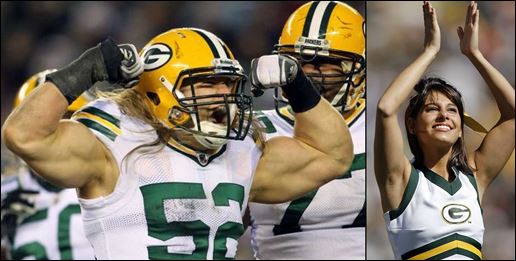
In Jeremiah’s day, a shepherd was used to picture a leader who had many followers. It became the metaphor for strong kings who ruled nations and who were to be feared by their enemies. In Jeremiah 6:3 we read “Shepherds with their flocks shall come against her; they shall pitch their tents around her; they shall pasture each in his place.” To think of a shepherd as the image created in the Psalms and in the New Testament is to misunderstand Jeremiah. He’s comparing a young girl with a Mike Tyson male figure. Maybe a better image would be a Green Bay Packer linebacker with one of the Green Bay Packer cheer leaders. Who would win in a physical battle of might between these two? It seems obvious. But it’s not a slur. The word sissy is used specifically to refer to the linebacker acting like the cheer leader when he’s in combat. You don’t bring beauty into a contest of brawn! The end is obvious! That’s exactly what Israel did in the face of their enemy.

Jeremiah, or any of the human authors of the bible, did not demean women. The scriptures are full of women who surpass their male counterparts, Deborah being just one example. Anyone who watched the Republican Presidential debates this week should have been impressed with the courage, wisdom, and strength of the only female candidate on the block. Carly Fiorina showed herself stronger, smarter, and more courageous than many of the male candidates.

[1] Philip Graham Ryken, Jeremiah and Lamentations: From Sorrow to Hope, Preaching the Word (Wheaton, IL: Crossway Books, 2001), 96.

Jeremiah 6:1

The Warning

Fourteen years ago today thousands of people in New York died in the tragic attack on America by religious fanatics. Many lives were ended without warning, reminding us all that our lives are fragile and could end at any 11 warningmoment. But the truth is whether we die instantly of a heart attack like my grandmother in her 40’s, or of an unexpected brain aneurism like my sister in her 40’s or of an enemy attack in an instant, the truth remains that we all really do have a warning. God loves us! In the Garden of Eden God warned Adam and Eve of the consequence of eating from a particular tree. He didn’t forbid it! He informed them of the danger and then gave them everything they needed to live healthy and happy lives. He did that because He loved them. In Noah’s day God warned them. At the first Passover in Egypt God warned of the death that would visit them. He warned them and gave them a way out. They needed only to put the blood of the lamb on their houses. My point this morning is that God loves everyone and no one ever really dies without warning.

Jeremiah 6:1 is another warning to the people of Israel. The nations of the north were coming to destroy them and their city and God tells them. He says, “Flee for safety, O people of Benjamin, from the midst of Jerusalem! Blow the trumpet in Tekoa, and raise a signal on Beth-haccherem, for disaster looms out of the north, and great destruction.” As Constance observes, “They were directed to leave the city, which God was about to destroy, and take refuge in the mountains. The destruction was so near that Jeremiah saw the invasion as if it were already in progress. The trumpet call and fire signal were the two means of warning the people.”[1]

God loves us. There is a destruction that will fall upon us all one day. God always judges sin. But in His great love for us He sent His Son to take that judgment for us. You all know the verse: “For God so loved the world that He sent His only Son so that whoever would believe in Him would not perish” under the hand of God’s judgment. That means without Christ every sinner will pay for their own sins. Christians today are the Jeremiah’s shouting run! Run to safety! The prophets in Jeremiah’s day were ignoring the message of God’s judgment. Jeremiah calls them “lying prophets.” We must not be like them. Ryken says, “And we will not be lying prophets. We will not hide the wrath of God from people. We will warn them that God judges sinners, and that the only protection from his curse is the righteousness of Jesus Christ, received by faith.”[2]


[1] Mrs. T. M. Constance, Jeremiah, vol. 1 (Dickson, TN: Explorer’s Bible Study, 1978), 33–34.

[2] Philip Graham Ryken, Jeremiah and Lamentations: From Sorrow to Hope, Preaching the Word (Wheaton, IL: Crossway Books, 2001), 105.

sewa motor jogja
© Chuck Larsen 2019. Powered by WordPress.